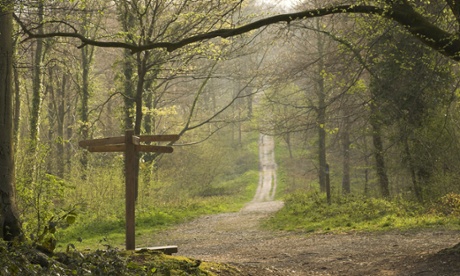
The rooks roar angrily over my head as I wander through the small, tangled wood. The narrow, muddy path winds between patches of unfurling bluebells. The whirling black shapes rise from their large untidy nests and out over the fields. I clamber over a rickety stile into the sunshine, and find myself standing on the long, broad, grassy embankment of the ancient Roman road.
Stretching from London in the northeast down to Chichester in the southwest, the road is thought to have been built not long after the Romans arrived in force in the first century AD.
It was given the Old English name Stane Street, or stone street – like similar metalled roads across England – and was used for many years afterwards as a way to cross the difficult, mud- and clay-ridden ground of West Sussex. Stretches of the ancient route are used to this day by traffic on the A29.
I walk along the bank, the loud calls of the rooks still ringing in my ears. Out across the fields on either side, sheep are bleating and munching the thin grass. The rooks wander among them, pecking for worms and insects brought to the surface by the heavy overnight rain. A brown hare, possibly even a descendant of one of the animals brought here for food by the Romans, bounds away.
The bank has subsided on one side, revealing a small curved cliff of chalk and stone. I clamber down to look at the exposed structure. Beneath the thin grass topsoil, it is possible to make out the layers from the bottom: heaped clay and chalk to form a mound, then large flints and rocks, and the top layer of smaller stones and gravel.
Two swallows chase low, weaving between the sheep and lambs. The sheep become agitated, and their cries louder, as a high-pitched engine approaches. A farmhand on a quad bike weaves from side to side in the field, gently pushing the animals towards the farm.
To the southwest, Stane Street stretches downhill towards the white stump of Halnaker Windmill, and the dark grey spire of Chichester cathedral beyond.