At the end of what was often a disturbingly jarring contest under the Millennium Stadium’s closed roof, a lid that offered no release of the day’s tension, Rob Howley, who knows a thing or two about playing and now coaching in stressful conditions, was lavish in his praise of the Wales half-backs, Rhys Webb and Dan Biggar.
In a style that the assistant to Warren Gatland considers “unique”, the scrum and outside-half had “navigated” the winning team around the park, allowing Wales to prevent their opponents from scoring in the last few minutes for the first time in the autumn series.
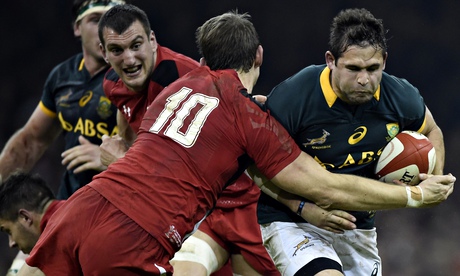
Well, perhaps they had. Biggar in particular was remarkably industrious, a 10 whose number was luminescent at just about every point of contact. He tackled and he kicked, he plucked the ball out of the air and picked it up off his toes – with one exception – and he ran and he passed, and then he tackled some more. It was a prodigious personal contribution. He has spent November making the most cherished jersey in Wales his own for years to come.
But what he and Webb did even more outstandingly was survive. This was a game of deliberately constricted channels of collision. Width was never mentioned; if wingers touched the ball it was only Lwazi Mvovo covering back to collect kicks threaded through a South African defence advancing at a pace beyond reckless. Or it was Alex Cuthbert crashing into midfield, a giant steed running into a line of defenders matching him stride for stride. The blitz defence needs taming by speed-guns.
There was no way through, at least not in what Wales probably view as “normal time” – that is, the first 70 minutes. Two sides spent an hour and a bit knocking lumps out of each other. The only quirk outside the routine reward of the penalties that accounted for all the points on the board was the attempt by the home side to drive a 13-man maul over from a five-metre lineout. Twice.
How interesting it would have been if the ball on the second attempt had not slipped out off the ageless Victor Matfield’s grasp as he jumped against the throw. To say his team had an overlap would be an understatement. In the event, Wales regathered possession, but their all-in drive led to nought. It was that sort of day, stripped of wit and invention, totally devoted to reduction by a hammer that produced nothing but pain.
South Africa came prepared to absorb torture with a full squad of 23. On came the replacements, even before the hour was up. Poor old Trevor Nyakane had not judged the ferocity of the engagement, or else he had not warmed up his pecs sufficiently. At the prop’s first scrum he was blasted backwards. And Wales’s lead grew to six points, a chasm on a try-less day.
There were two other elements before the turn of the game into the last period of “abnormal time”, the closing period that had tormented Wales all month. The first was the injury to Jean de Villiers. His knee – a source of trouble for the venerable centre over the years – buckled in contact as he pursued a restart. It looked a career-threatening dislocation of the joint; De Villiers had the courage to offer Damian de Allende a word of encouragement as they crossed, the replacement heading for the fray, the captain on his cart leaving for a large dose of pain relief.
The second was the sending to the sin-bin of Cornal Hendricks for making contact with Leigh Halfpenny in the air. It looked as if they were both challenging only for the ball. The Irish referee, John Lacey, who as a former wing/full-back could be said to have a more specialist knowledge of this area, thought otherwise, judging the wing to have made illegal contact with the full-back.
The absence of De Villiers and Hendricks meant that Wales were better prepared for the end-game. Or that South Africa were not as primed as Australia and New Zealand to expose Wales at this juncture. Perhaps it was that. Instead of raising their game and seizing control, South Africa collapsed. The quite wonderful Willie le Roux knocked on twice. South Africa lost a scrum against the head five metres out and seconds from the end.
Wales were no better. They did not win this by reversing the trend of earlier games. They simply survived here. Scott Williams, one of only two replacements used by the home side tried to keep the ball in play (and failed) when every cell of his brain on a sane day would have told him to leave it. Biggar tried a drop goal but the ball barely moved off his boot. He then dropped a pass – a tricky one aimed at his feet by Webb – and the chance of the try that would have given a real gloss to the victory went begging.
That makes it sound as if Howley was a little generous in his praise of his young half-backs. He was not. It was just that when he said “navigate” he probably meant keep the battered ship afloat in a vicious storm. If survival can be brilliant, this was it.
Wales Halfpenny (S Williams, 67); Cuthbert, Davies, Roberts, L Williams; Biggar, Webb; Jenkins (Jarvis, 74), Baldwin, Lee, Ball, AW Jones, Lydiate, Warburton (capt), Faletau.
Pens Halfpenny 4.
South Africa Le Roux; Hendricks, Serfontein, De Villiers (capt; De Allende, 57), Mvovo; Lambie (Pollard, 53), Reinach (Hougaard, 61), Mtawarira (Nyakane, 53), Du Plessis (Strauss, 56), Oosthuizen (Redelinghuys 70), Etzebeth (De Jager, 68), Matfield, Coetzee, Mohoje (Carr 53).
Pens Lambie 2.
Referee J Lacey (Ire). Att 58,235.