England, Wales and Australia will next month wade into what has been described as the Rugby World Cup’s pool of depth. Given the involvement also of the Pacific Nations champions Fiji, it would be more appropriate to call it a lake. Someone will get out of their depth.
England started their match preparation with victory over France at Twickenham last Saturday night, a game that revealed that many of their third choices, to be euphemistic, were not ready. As only 31 players are allowed in a World Cup squad, third picks comes down to hooker, prop and scrum-half. With the exception of hooker, England have at least two proven players in each position.
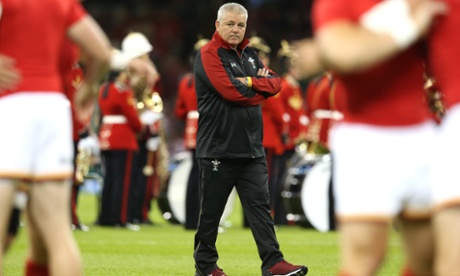
Wales are not so blessed. Their defeat at home to Ireland earlier this month may have come too early in their training schedule to be definitive but it was still used by the management as a means of sifting players out of the squad – and not only those whose initial inclusion had been with the future in mind.
James Hook, a peripheral member of the squad since the last World Cup, Mike Phillips and Richard Hibbard were all released last week, three Lions with 210 Wales caps between them. If it were typical of the refusal of the Wales head coach, Warren Gatland, to mire himself in romance – Phillips’s five Lions Test caps put him on 99 overall – trusting in statistics rather than history, he has sacrificed experience in a group that may oblige him to field some players in all four matches.
Hook, despite his ability to thrive in broken play, always looked an outside choice but Wales’s resources at scrum-half and hooker are not deep enough to condemn Phillips and Hibbard to fourth choice. In the case of the latter, he has been overtaken by Scott Baldwin and Ken Owens, while Lloyd Williams or Gareth Davies will be trusted to shadow Rhys Webb against England and Australia.
Once Gatland had decided that Phillips and Hibbard were not the second pick in their positions, there was no place for them: while Kristian Dacey, the hooker who won his first cap against Ireland, will regard it as the height of his career to be in the World Cup squad, never mind as third choice, Hibbard’s reaction would not have been as gleeful; the same with Phillips, another player used to playing a central role.
Gatland is like Sir Alex Ferguson when it comes to moving on trusted players; anyone who drops Brian O’Driscoll from a decisive Test knows his own mind but Hook, Phillips and Hibbard were due a public explanation beyond a few paragraphs of quotations in a statement. Wales have gone into media quarantine since last week’s trip to Colwyn Bay and nothing is scheduled until next Thursday, when the team to face Ireland in Dublin will be announced.
Does it mean the decommissioning of Warrenball? Phillips and Hibbard at their pomp were key components of the approach: it was Hibbard who made George Smith’s comeback for Australia in the third Lions Test two years ago a short one, with a typically forthright challenge. Baldwin and Owens, like Davies and Williams, are not players whose default is set on confrontation, and while that has not worked for Hook, it is an indication that Gatland’s gameplan will now have more to do with the busting of lungs rather than opponents’ bodies.
Hibbard was told that his fitness did not match up to that of his rivals: some of his figures were less impressive than the props in the squad but at another time he may have been given some latitude as his season did not end until 31 May because of Gloucester’s presence in the play-offs for the final sport in the European Champions Cup.
Hibbard played 30 matches last season for Gloucester and Wales, five from the bench, and had little meaningful time off before the World Cup training squad met to prepare for camps in Switzerland and Qatar. It may have been different for him had he still been central to Wales’s approach but the train moves on.
Gatland, like his England counterpart Stuart Lancaster, is contracted until the end of the 2019 World Cup at least but failure to reach the quarter-finals this year would leave both men under pressure. The early demise of the hosts would leave the Rugby Football Union, which was criticised for extending the contracts of the management team last year, facing a barrage of questions and there are sure to be escape clauses.
Gatland would remain in charge of his own destiny if Wales made an early exit, not least because in his eight years in charge the national side has risen above the state of the professional game in the country and operated at a consistently high level for the first time since the 1970s. Now that attention is at last being paid by the Welsh Rugby Union to the levels that lie below, sustainability should, in time, not only depend on the head coach and his management team but Gatland, at a juncture when the policy of keeping players in the regions is being continually taxed by the offer of success in France and England, may feel it is time to go, having come in after Wales failed to make the last eight in 2007.
Australia, like England, have never failed to qualify for the quarter-finals but their head coach, Michael Cheika, will not be under the same pressure as Lancaster, having taken over last year, the third appointment in 16 months, at a time when the Wallabies were on their knees. He has helped to give them the Rugby Championship, albeit in truncated form, and while the 41-13 defeat by New Zealand last weekend injected a dose of reality, his side will be far more of a force than looked likely last November.
The lake that is the hosts’ pool has led to criticism of making the draw for the groups so early – three years before the event. A strong team will be heading home early, while weaker ones remain but that is that nature of cups and at least a tournament that used to be loaded in favour of the eight foundation unions is now more democratic. Wales play Fiji next month, five days after meeting England – four years ago that demand was placed on nations such as Namibia, who were far less equipped to deal with it.
• This is an extract taken from The Breakdown, the Guardian’s weekly rugby union email. To subscribe, just visit this page, find ‘The Breakdown’ and follow the instructions.