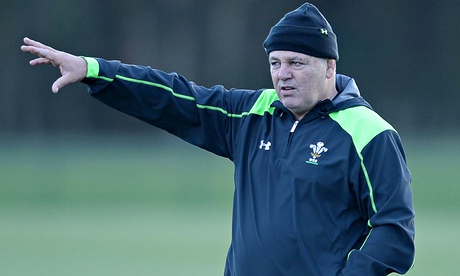
If Warren Gatland is chosen as the castaway on Desert Island Discs, John Lennon’s Mind Games would be an appropriate choice for one of his pieces of music. The Wales head coach is never one to spurn an opportunity to get inside the head of opponents and cause discombobulation.
Gatland is a believer in little things making a difference at a period in the sport – the 20th anniversary of the game going open will fall in August – when the use of science has minimised the element of surprise. Armies of analysts pore over footage of opponents, teams and individuals so assiduously that they are able to provide their coaches with detailed dossiers on the habits and tendencies of rival players, not that laptops are yet able to stop Jamie Roberts in full flow.
The players of today have to absorb considerably more information than their predecessors of a generation ago: being told what to expect is one thing, dealing with it is another. Four years ago, when England won in Cardiff on a Friday night, Gatland stressed the importance to his players of guarding rucks because of Toby Flood’s ability to spot a gap.
Messages become scrambled in the heat of the battle: when Flood spotted the Wales props Craig Mitchell and Paul James standing too far apart, he ran in between them and beyond to set up the opening try of the game for Chris Ashton, hushing the crowd and establishing the platform for victory. Gatland, who had before the match questioned whether Dylan Hartley’s skills, rather than his temperament, had too low a melting point, despaired at a mistake he had prepared his players to avoid.
It is the human, rather than the robotic, side that gives sport its appeal. It is a test not just of ability and skill but character and attitude. During the Clive Woodward era, England looked to turn hostile environments like at Cardiff to their advantage by silencing the home support and unnerving their opponents, not that Wales were then anything like the force they have become under Gatland.
England have tried to replicate in training some of the hazards they will face at the Millennium Stadium on Friday night, such as noise. They were pushed hard in training to test their decision-making after the ball had been in play for more than four minutes. Little things can make the difference, which is why Gatland likes to indulge in mind games when he judges the time is right.
That is usually when Wales are, if not up against it, looking up a hill. Gatland has been accused in the buildup to the Six Nations opener of playing games, not least when he said he was unsure how England would play and the backline they would select. It was interpreted in some quarters as an attack on his opposite number Stuart Lancaster and his squad whereas it was nothing more than a question properly answered.
At that stage, Lancaster had the contrasting choice of George Ford or Owen Farrell, at outside-half, Brad Barritt or Kyle Eastmond at 12 and Luther Burrell or Jonathan Joseph at 13. Wales’s analysts would have been working through the night assessing all the potential combinations while also paying attention to the combination the management thought most likely to be picked. Gatland was not playing mind games, just stating a fact.
Gatland has no reason to indulge in head tricks for this match because Wales have more to lose than England: they are at home, they won the fixture two years ago by a record margin, they have all their first-choice players available, they have settled combinations and 11 of their players have started a Lions Test.
England, on the other hand, are on the road in a year when they will be playing all their World Cup matches, including Wales, at home; they are some way below full strength with their leading three second-rows among those injured; they have an element of the unknown and there is more pressure on Wales who are expected to win.
A pity for Lancaster is that he is not able to maximise the element of surprise he has in selection. The England side was announced on Wednesday but known the previous evening because of the agreement between the Rugby Football Union and Premiership Rugby that requires all the players not chosen in a matchday 23 to return to their clubs on a Tuesday evening.
It is one of the quirks of rugby that teams are always announced well in advance of matches. Premiership clubs have to do so within 24 hours of a fixture, or face a fine, and it is 48 in tournament Test rugby. A football manager would scoff at the suggestion he should name his team on the morning of a match, never mind days before.
Wale’s preparations would have been more hectic had they not known until shortly before the kick-off whether it would be Burrell or Joseph at 13, Burrell or Billy Twelvetrees at 12. Lancaster could have had fun at hooker, tempting Wales to think one way while tilting to another. Why is it that lineups have to be named so far in advance?
For the (expensive) match programme? For the broadcast rights’ holders? For the sake of it? It benefits a side in one sense because they have ample time to get analysis on their opponents, but it takes away an element of surprise at a time when predictable holds sway.
Allowing sides to delay naming their teams until just before the kick-off would not benefit England or France because of the deals they have with their leading clubs over the release of players, but they could be renegotiated. England have little in their favour this week, so the longer Lancaster could have kept Gatland and the other Wales coaches guessing, the better for the visitors.
Lancaster was bound by red tape at a time when he would have been confident of guessing Wales’s lineup. He has been bold in his midfield selection, but is he using the choice of Joseph as a bluff? All is not always what you see.
• This is an extract taken from the Breakdown, the Guardian’s weekly rugby union email. Sign up here.