This Rugby World Cup has been billing itself as “44 days of crazy”. Japan’s supreme madness in defeating South Africa last Saturday set the tone. And for sheer frenzy it is hard to imagine that anything of the next five weeks will match the emotion of Twickenham on Saturday night. In a match in which the teams were hardly separated by more than one score, and were tied at 25 points each with six minutes to go, Dan Biggar, the Welsh fly-half, slotted a penalty from the halfway line to win the match for Wales.
In doing they so went a long way to sealing their advance out of the “group of death” and into the tournament’s knockout rounds. For England to have any chance, Australia must be overcome in a week’s time.
This fixture has been synonymous with do-or-die drama since it was first played in 1881, and there have can have been no more extreme encounters than this one. From the first whistle players flew into challenges, literally so in the case of the twitchy Biggar who went after high balls on the run like a berserker, a compulsion mirrored in the evil genius sideways stare of England’s Owen Farrell as he lined up his kicks. Inevitably, the England wing, Johnny May, who always runs as if his house is on fire and his children all gone, scored the only try of the first half in the corner.
The players’ nerve-shredded mood was infectious. Within the stadium there were 83,000 souls on the verge of a nervous breakdown, a tension that you could feel spreading out beyond into the fanzones and the big screens and the pubs and bars all points west.
In this sense, by 9.50pm when the match ended, it had been a long day. Sometimes a Twickenham trip might be seen as a jolly, but this was not one of those occasions. To the Welsh in particular it had all the pilgrimage, another opportunity to prove the efficacy of that famous prayer of Merv the Swerve Davies: “Lord, if we’ve got to get beat, let it not ever be by England.” On this occasion, those prayers were answered.
I’d risen early, looking for portents. At Paddington I’d gone armed with tell-tale signs of the three crucial elements in any true pilgrimage, first identified, I’d discovered, by the pre-eminent authority on the subject, the anthropologist Victor Turner.
The first stage was separation from the mundane habits of life, usually achieved by an arduous quest. Then there was the so-called “liminal” phase in which the individual (or fan) became part of a new fluid society, an ambiguous period typically characterised by great psychological tests, sexual ambiguity, and “communitas” (an unstructured society in which all members become united and equal).
Finally there was a third stage by which the pilgrim returns to his former life, after the climactic conversion experience (think Biggar unerring from 50 metres), fundamentally changed in mindset and beliefs.
Watching the earliest trains come into Paddington station from Swansea and Cardiff on Saturday morning, I had figured that the particular Welsh pilgrims stepping out on to platforms six and eight were by then somewhere between stage one and stage two. They had blearily separated themselves from normal life – the first trains from Cardiff had set off at 5.50am. They had become somewhat more united in belief and spirit: one trio from Merthyr were already working slightly coyly on their Bread of Heaven harmonies aware, it seemed, of all those red-shirted pilgrims who had travelled this way before.
Other elements of the pilgrims’ liminal phase were harder to spot. I looked among that crowd for any clear sense of sexual ambiguity – and, unless you counted arms around shoulders of tight shirts and hair still worn in shaggy homage to the former prop forward Adam Jones – found few. You could certainly, however, even then feel a palpable sense of severe psychological tests to come. Some clutched tightly to plastic bags full of tins of ale, one or two had already succumbed to the temptation to crack one open: and still 12 hours to go till kick-off.
That other great social anthropologist, Max Boyce, has long given the mythical shape to this particular day out.
The pilgrims’ progress to Twickenham tends to re-enact the verse by verse progress of his Hymns and Arias, so that by the time the crowds who have come up by train and by car met those who were stepping off coaches near the traditional Twickenham pubs, the Cabbage Patch and the William Webb Ellis, the sense of observed ritual was everywhere apparent.
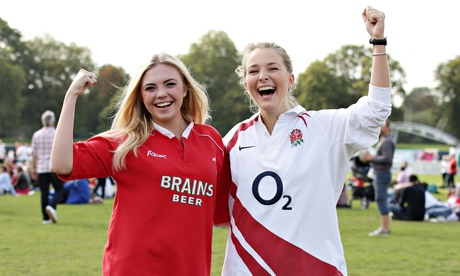
The price of tickets – averaging at £100, though many had paid a great deal more – serves to separate this rugby era from those amateur days when “we paid our weekly shilling for the January trip”. Players no longer double as schoolmasters; the mythical outside-half factories have given way to drills and stats; 11 of the current squad were born outside Wales, four of the starting XV were born in England. But still the essential magic – that heady and sentimental mix of chapel and boozer – casts a spell.
All those memories were summoned by the 25,000 Welsh voices that sung the anthem Hen Wlad Fy Nhadau. They seemed to be brought to mind too in the desperate breaks the Welsh team made as they tried every which way to breach the England back line in the final 15 minutes, culminating in Gareth Davies scoring the winning try under the posts. In some ways it seemed a shame that such drama should occur so early in the tournament’s story. Still it wouldn’t be a pilgrimage if there were nothing at stake.
Victor Turner, the anthropologist, believed that only once such rites of passage had been overcome could the third and crucial transformational stage of pilgrimage be experienced. Which is to say, a long journey home is a whole lot easier to negotiate if you win by three points.