

The owners of Auckland’s derelict hot pools complex say resurrecting the family water park is off the table. It’s too expensive. Instead they want lower volumes of higher value punters.
Evan Vertue insists nothing has changed around plans for a phoenix-from-the-dead thermal water complex at Waiwera, north of Auckland. Vertue, Waiwera project director for site owners and development company Urban Partners, says wellbeing not warp speed has always been the focus as it prepares its plans for the future of the natural hot springs site.
LISTEN HERE: The extraordinary tale of rust, Russians and rent battles that led to the demise of the 50-year-old park
Still, when Newsroom talked to Vertue a year ago for a Detail podcast, pools and slides were still under consideration.
No longer.

“There was not a strong enough business case for a water park,” Virtue says. “There was never a proposition to replicate what was there before.”
Instead, Urban Partners looked for a theme, and hit upon “wellness”, which Vertue says is a $US4.5 trillion industry worldwide.
The design of a possible new complex involves hot pools, a day spa, a hotel spa, apartments with hot tubs, food and drink options, maybe even a microbrewery.
The $250 million price tag still stands, Vertue says. But the Black Hole and the Twister don't feature. “Rather than a complex based on high-volume water slide activities, we are looking at potentially lower volume and higher value visitors,” Vertue says.
Parking was always a nightmare at the height of the water park's popularity, when around 300,000-350,000 people visited a year. “Waiwera needed 250 car parks, but didn’t have them.”

He says rather than having 300,000 people spending on average $30-$40 a head, the Waiwera community would be better served with a smaller number of people spending more.
“We are exploring a number of options, using top advice, but no decisions have yet been made by the board.”
That’s not a message Waiwera residents want to hear. They want action soon, particularly around cleaning up the site.
The once iconic, but by then run-down Waiwera hot pool complex closed its doors for a $3 million renovation in February 2018. When the then-owners looked closely at what needed to be done, they realised they had a far bigger problem on their hands.
Waiwera never reopened, and since then, the site has gone downhill.

A meeting last month of the Waiwera Property Owners & Residents Association opened with a clear message to Urban Partners: “The community has reached a stage of being tired of looking at the mess and are asking if we can get something done.”
“Lively discussion” ensued between locals and Urban Partners’ Ross Porter, minutes of the meeting show.
Residents asked, for example, why the derelict buildings couldn’t be got rid of and the site levelled? Porter countered that some of the buildings might be useful in the future, but it wasn’t clear which.
“Ross said it’s a matter of how to spend the money available and demolition is a major expense,” the minutes say. “Can’t promise any timeframe on this.”
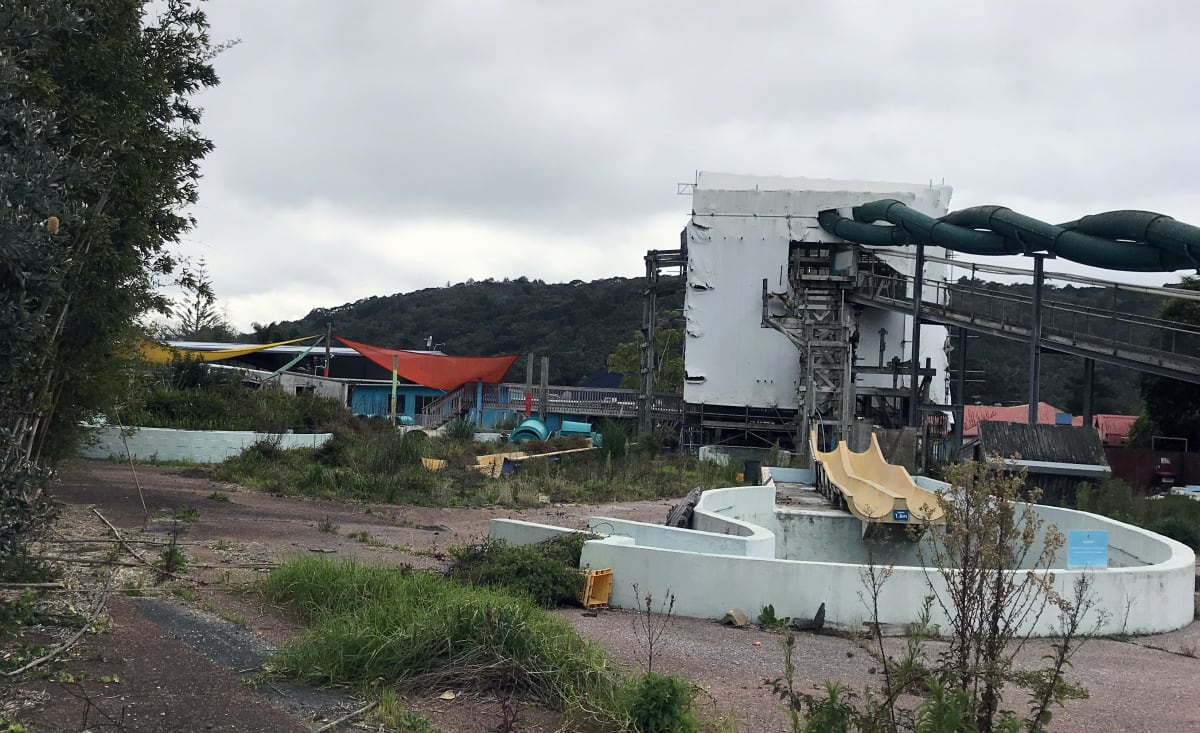
What about the central tower, which once supported the waterslides, which is an eyesore and possibly a safety hazard, and surely won’t be needed? Could that be taken down? Porter said Urban Partners hasn’t wrapped up dealing with the liquidators, though they might be able to remove the scaffolding.
Residents were also worried about graffiti, about police choppers using the site potentially stirring up dangerous asbestos dust from the buildings, and about overgrown bamboo, rampant pampas grass and phoenix palms harbouring pigeons and attracting rats.
They said the flats on the site were a mess “and possibly not legal” under new healthy homes requirements, although Porter said Urban Partners had no obligation to upgrade them while existing tenants were in situ.
And they worried about the old bore in the carpark, spewing out water and encouraging ducks and mosquitoes.

It’s a conundrum, says Evan Vertue. He accepts that the residents are concerned, but says the Urban Partners directors want to agree to a development plan before they commit to razing the old site.
“The buildings on the pool site will cost close to $1 million to demolish. The organisation is saying they need to know there is a credible plan for development of the site before they commit to that expense.
“Still, I believe the time is right for these buildings to come down, if only to improve relations with our neighbours.”
And the future? Vertue is optimistic.
“Waiwera will at some stage be magnificent. I just can't give you a time.”




.png?w=600)








