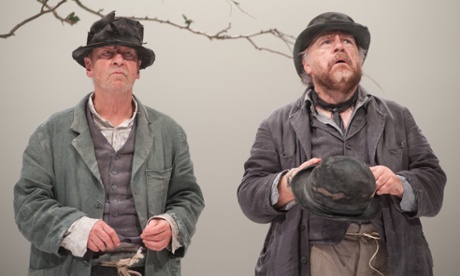
Something fascinating happens when John Bett comes on as Pozzo in Samuel Beckett’s existentialist tragicomedy. Until this moment, it’s been Brian Cox and Bill Paterson standing alone in the brilliant-white tundra of Michael Taylor’s curving set. As Vladimir and Estragon, it’s their faces on the posters, them doing the interviews, and they have duly occupied the stage with a larger-than-life presence.
In their battered bowlers and dust-flecked suits, they have the weatherbeaten air of Charlie Chaplin, two whiskery tramps who’ve seen better days. They could be Laurel and Hardy, if only their routines would click and their dialogue seemed less like a way of filling in the void and staving off despair.
Cox is the more buoyant of the two. He has the enthusiasm of a puppy and the stature of a great teddy bear, forever trying to trigger something – anything – into action in this theatrical wilderness. When Paterson admits to spending the night in a ditch, Cox treats it like a revelation: “A ditch! Where?” He’s willing to see the potential even in a hole in the ground.
Paterson’s Estragon is a more lugubrious fellow, tetchy where the other is bouncy, morose where the other is game. He’d rather turn his back on the circling Vladimir and look life’s futility in the face, but begrudgingly succumbs to his charms.
Loose-limbed and sprightly, they slip into high-velocity conversational exchanges as if helpless to resist – only to feel the emptiness more keenly when the banter comes to an end.
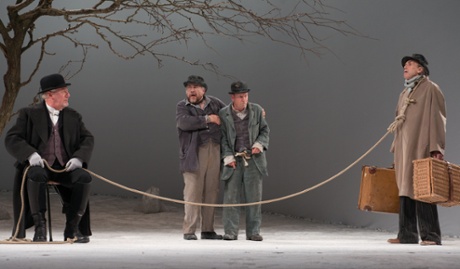
But when Bett enters, heralded by Benny Young’s Lucky as his luckless packhorse, the dynamic changes. Standing tall in his cavalry boots and jet-black riding suit, he dominates the scene. The edges of his bowler hat are more sharply drawn, his face more ruddy, his voice more strident. Pozzo is a man born with a sense of entitlement.
Instantly, Vladimir and Estragon are diminished. Their linen suits lose their colour. They stand smaller. We see them as children when a grown-up has arrived.
To see these charismatic leading men, so capable of holding the stage, switching so deftly to low status, is to see the arbitrariness of class privilege. Pozzo has nothing to commend him but his own arrogance, yet the deference of the others makes his position secure.
It ensures Mark Thomson’s lucid, precisely choreographed production is not just a star vehicle but a full-blooded ensemble performance – and an electrifying start to the Lyceum’s 50th-anniversary season.
-
At the Royal Lyceum, Edinburgh, until 10 October. Box office: 0131-248 4848