On this note, we’re closing up for the day. Thanks for all your comments, and we’ll be back next week.
Opel rejects dieselgate allegations
My colleague Julia Löhr reports that the German carmaker Opel, owned by US giant General Motor, has been caught up in the emissions-rigging scandal that has engulfed Volkswagen. Tests have shown that the Opel Zafira 1.6 CDTi model emitted up to 17 times the permitted level of nitrogen oxides, the German Environmental Aid Association said today.
The car repeatedly failed emissions standards in a series of tests conducted at the University of Applied Sciences in Bern on behalf of the association. However, the carmaker firmly rejected the claims. A spokesperson insisted that Opel cars have not been fitted with a software device that recognises test situations.
Updated
Responses To China Rate Cut Trickle In: "China Is Getting More And More Desperate" https://t.co/ZxZWvoTGON
— zerohedge (@zerohedge) October 23, 2015
CNY Depreciation vs. EUR, BRL, ZAR, MYR, IDR & RUB pic.twitter.com/tMn8B9qK3K
— Michael McDonough (@M_McDonough) October 23, 2015
Chinese president Xi Jinping, meanwhile, has arrived at Manchester town hall.
President Xi arrives at Manchester Town Hall to a huge roar from supporters gathered here pic.twitter.com/wkZZKXsChM
— Richard Edgar (@ITVRichard) October 23, 2015
Back to Athens, where the French president has addressed the Greek parliament.
"#Grexit's behind us": French President Hollande addressing #Greece's Parliament. Not the guy with the best track record for predictions...
— Maxime Sbaihi (@MxSba) October 23, 2015
Wall Street looks set to open higher. US stock futures have also been boosted by strong quarterly results from Google parent Alphabet, Microsoft and Amazon, which suggests tech stocks will rally when markets open in 40 minutes.
S&P futures after China rate cut https://t.co/pcjP8e3PDb pic.twitter.com/nuXzjrh3Zf
— zerohedge (@zerohedge) October 23, 2015
Updated
Global interest rates are going in opposite directions....
ECB, PBOC both just confirmed December Fed rate hike in play
— zerohedge (@zerohedge) October 23, 2015
European equities love what China just did https://t.co/5UpewDzxOJ pic.twitter.com/fehmd9Ytvf
— Joel Lewin (@JoelLewin) October 23, 2015
China’s rate cut is the sixth since last November as the authorities try to kickstart the slowing economy. The People’s Bank of China has lowered its one-year benchmark bank lending rate by a quarter point to 4.35%, effective from 24 October. The one-year benchmark deposit rate was also cut by 25 basis points, to 1.5%.
This is China’s most aggressive policy easing cycle since the global financial crisis in 2008/09, Reuters said.
European stock markets, already buoyant after the ECB’s stimulus talk, are extending their rally after China’s surprise rate cut. The FTSE 100 index in London is now up more than 100 points at 6481.26, a 1.6% gain. Germany’s Dax is 2.1% ahead while France’s CAC has added nearly 2%.
ECB and the PBOC helping the Fed hit its "high stocks" mandate.
— Joseph Weisenthal (@TheStalwart) October 23, 2015
Updated
Here comes the Chinese cavalry! https://t.co/EQn0m672kK
— Shaun Richards (@notayesmansecon) October 23, 2015
When's Xi's away the PBOC will play...https://t.co/QT5GhdxnBm
— Mehreen (@MehreenKhn) October 23, 2015
China cuts interest rates
The People’s Bank of China has cut its benchmark interest rate by a quarter point. It has also reduced its reserve requirements.
CHINA CUTS 1 YEAR LENDING RATE BY 25 BPS, CUTS RRR REQUIREMENT
— zerohedge (@zerohedge) October 23, 2015
Updated
Spanish and Italian bond yields fall below zero after ECB stimulus talk
The euro is still shaky but flat since the ECB’s hints of more stimulus in December. Mario Draghi’s comments yesterday have pushed yields on Italian and Spanish two-year government bonds below zero – which means some investors are now paying to hold them.
Draghi surprised markets when he told a press conference that the central bank had discussed lowering the deposit rate further at its meeting in Malta, and some members on the governing council hinted they wanted to cut rates this week.
The ECB’s latest quarterly Survey of Professional Forecasters sees inflation across the eurozone hovering just above zero this year, and still missing the ECB’s 2% target over the next two years.
Here in the UK, Monsoon, the fashion chain, has been named and shamed by the government for failing to pay more than 1,400 workers the national minimum wage. The privately owned firm is one of 115 companies caught in the latest swoop by HM Revenue and Customs, which oversees implementation of the pay regulations.
The government list is only the tip of the iceberg, says the TUC. The union estimates that at least 250,000 workers are being denied their legal pay, and that only a quarter of offenders are being caught.
TUC general secretary Frances O’Grady said:
It’s good to see that the government is naming and shaming more companies who pay their employees less than the minimum wage. However, today’s list of offenders is only the tip of the iceberg. Many more employers are getting away with illegal underpayment.
I am particularly saddened to see Monsoon Accessorize acting in breach of the law. A large firm with thousands of employees has no excuse for not having proper systems in place to ensure staff get their legal wages.
The government must continue to increase enforcement of the minimum wage, and ensure that all workers get what they are owed. Bosses who try to duck the minimum wage should have nowhere to hide.
For employees the message is clear: strong unions in every workplace are necessary to stop these abuses.”

Hollande is addressing the Greek parliament.
#Hollande monte a la tribune du parlement grec.message de soutien du pres du parlement pr le drame en Gironde pic.twitter.com/Ea5ssA6k73
— adea guillot (@Adea_Guillot) October 23, 2015
More news out of Greece, where prime minister Alexis Tsipras has welcomed the French president François Hollande.
#Greece Tsipras attacks creditors' demands for conclusion of 1st review. "We can't accept neoliberal demands that will tear social cohesion"
— Yannis Koutsomitis (@YanniKouts) October 23, 2015
Welcoming French President @fhollande to Maximos Mansion #Greece pic.twitter.com/RUDoxs3jUH
— Alexis Tsipras (@tsipras_eu) October 23, 2015
Greek two-year bond yields fall below 10-year yields for first time this year
Meanwhile, Greek two-year bond yields have fallen below 10-year yields for the first time since last December, in a sign that fears among investors that the heavily-indebted country is heading towards a debt default are easing. This summer, Greece came close to being forced out of the eurozone.
The rally on European stock markets continues, following suggestions from European Central Bank president Mario Draghi yesterday that more monetary stimulus – which could take the form of more rate cuts or a boost to QE – may be on its way.
Danish shipping giant A.P. Møller–Maersk has downgraded its annual profit forecast as global trade weakens. The Copenhagen-based company is seen as a bellwether for the world economy. It said global market conditions had been weaker than expected.
You can read the full story here.

UK government and Tata Steel announce £9m support package for Scunthorpe
Here in the UK, the government and Tata Steel have announced a support package of up to £9m to support the local economy and employees affected by the job losses at the Scunthorpe steelworks.
Tata Steel’s regeneration arm UK Steel Enterprise has pledged £3m to support job creation in Scunthorpe. This is being matched by the government, to fund more start-ups and businesses that are looking to expand and create jobs. In addition, the government is providing up to £3m for training of steel workers who are losing their jobs, through local further education colleges.
Tata Steel is cutting 900 jobs at Scunthorpe and 270 at two sites in Scotland, blaming cheap Chinese imports, the strong pound and high electricity costs.
The company is also providing £1.5m to support job creation in steel communities around its Dalzell and Clydebridge sites in Scotland, while the UK government is in talks with the Scottish government about further support.
Business secretary Sajid Javid said:
This is a very difficult time for the workforce, so it is important that the Government and the company have come together to support people and the local economy.
The Government has no intention of simply standing aside whilst the steel industry faces global challenges on a scale unprecedented in recent years. We will do everything we can to help workers and to ensure a level playing field for the industry.”
The government has come under fire this week for wining and dining the Chinese president, Xi Jinping, while more than a thousand steel workers are losing their jobs – with China’s “steel dumping” seen as the main culprit.

German transport minister to head to US next week
German transport minister Alexander Dobrindt is heading to Washington next week for talks with US officials over the deepening scandal. He will meet his counterpart Anthony Foxx as well as officials at the Environmental Protection Agency. The EPA discovered that some of VW’s diesel vehicles emitted up to 40 times the permitted level of nitrogen oxides.
The scandal broke in the US, but most of the 11m affected diesel vehicles are in Europe. VW faces tens of billions of dollars in fines and compensation for drivers around the world.
My colleague Julia Löhr reports that during his five-day trip, which starts next Monday, Dobrindt will also visit a test centre for driverless vehicles at the University of Michigan. He will also discuss the effects of digitalisation on the transport industry, with visits planned to BMW and Google.

Updated
There is no mention in the PMI surveys of the Volkswagen emissions-rigging scandal, which has rocked the German carmaker, the world’s biggest. Some economists were expecting confidence to take a hit within Germany industry. Some companies seemed more worried about Russian sanctions, as reported earlier.

Updated
Looking at the detail of the eurozone recovery, survey compiler Markit explained:
Output rose across both services and manufacturing, pointing to a broad-based upturn. The former sector once again recorded the stronger gain, with the divergence widening as services growth accelerated slightly but factory production showed the smallest rise for five months.
Eurozone economy gains momentum
Chris Williamson, chief economist at survey compiler Markit, said:
The PMI brings welcome news that the eurozone economy picked up some momentum in October. With new business growing at the fastest rate for six months, firms were encouraged to boost staffing levels again.
However, the PMI remains at a level signalling a modest 0.4% quarterly rise in GDP, suggesting the region will struggle to attain more than 1.5% overall growth in 2015. The rate of job creation, although on the rise, remains insufficient to make serious headway into reducing unemployment.
The renewed fall in output prices meanwhile suggests that inflation will remain in negative territory as we head towards the end of the year.
Unless the PMI business activity and price indices pick up significantly in coming months, the combination of relatively weak growth and deflation signalled by the survey will fuel expectations that the ECB will step up its quantitative easing programme at the December meeting.”
Updated
Back to the PMI surveys, which suggest that the eurozone recovery regained some momentum at the start of the fourth quarter.
Key points from the eurozone composite PMI:
- Flash Eurozone PMI Composite Output Index at 54.0 (53.6 in September). 2-month high.
- Flash Eurozone Services PMI Activity Index(2) at 54.2 (53.7 in September). 2-month high.
- Flash Eurozone Manufacturing PMI at 52.0 (52.0 in September). Unchanged.
- Flash Eurozone Manufacturing PMI Output Index at 53.3 (53.4 in September). 5-month low.
Updated
In London, shares in Talk Talk have crashed nearly 11% to 239.6p, wiping some £280m off the company’s market value. The telecoms provider suffered a cyber attack on its website, which could affect 4 million customers in the UK.
Chief executive Dido Harding has apologised to customers, but the company is unsure at the moment how many people are affected. Find out what to do if you’re a customer.
Updated
The eurozone composite PMI is out
Faster service sector growth lifts pace of #eurozone expansion in Oct. Comp Output at 54.0 https://t.co/pJr3wot3zn https://t.co/de7K1dI6sP
— Markit Economics (@MarkitEconomics) October 23, 2015
German manufacturing PMI hit a five-month low of 51.6, still above the 50 mark that separates expansion from contraction. Markit said the numbers “signal a note of caution for German manufacturers”.
Oliver Kolodseike, economist at Markit, said:
October’s PMI results paint a fairly passive picture of the health of the German private sector economy at the start of the final quarter of 2015. Companies signalled a slight acceleration of output growth and were able to secure new contracts despite raising their charges to the greatest extent in 21 months.
However, much of the strength was attributed to the service sector, where companies enjoyed the strongest rise in business activity for seven months.
Meanwhile, today’s numbers signal a note of caution for German manufacturers. Output and new orders increased at weaker rates, with some companies explicitly mentioning ongoing uncertainties stemming from the Russian sanctions. Moreover, the combination of rising stocks of finished goods levels and slower new order growth suggests that companies may scale down their production in coming months.”
Solid services growth offsets manufacturing weakness in Germany
Private sector firms in Germany started the fourth quarter on a solid footing, with output increasing at an accelerated pace, according to survey compiler Markit.
Key points:
- Flash Germany Composite Output Index(1) at 54.5 (54.1 in September), 2-month high.
- Flash Germany Services Activity Index(2) at 55.2 (54.1 in September), 7-month high.
- Flash Germany Manufacturing PMI(3) at 51.6 (52.3 in September), 5-month low.
- Flash Germany Manufacturing Output Index(4) at 53.2 (54.0 in September), 5-month low.
#Germany Mfg #PMI at 5-month low of 51.6: "Today’s numbers signal a note of caution for German manufacturers." https://t.co/p8Gy3cx0m6
— Markit Economics (@MarkitEconomics) October 23, 2015
That said, German/French PMI details generally weaker than headline indices.
— Frederik Ducrozet (@fwred) October 23, 2015
Markit Purchasing Managers surveys show German joint services & manufacturing output picking up in October; follows improved French acvitiy
— Howard Archer (@HowardArcherUK) October 23, 2015
The German flash PMIs are out, compiled by Markit.
Flash #Germany Composite Output Index at 54.5 in Oct (54.1 in Sep), Services at 55.2, Manufacturing #PMI at 51.6 https://t.co/pl2VKKW7LH
— Markit Economics (@MarkitEconomics) October 23, 2015
The euro has turned lower again, slipping below $1.11.
The broader trade-weighted EUR is down 3.7% from its summer high, aka the key driver of the ECB's next move. pic.twitter.com/BdxOrbAUc0
— Frederik Ducrozet (@fwred) October 23, 2015
Updated
In London, bookie William Hill has warned on profits after too many favourites came home, pushing its shares down 6% to 324.7p. You can read the full story here.
Updated
Economists at Daiwa have sent us their thoughts on the ECB and the French PMI data:
Clearly, we had a highly significant Governing Council meeting yesterday with Draghi going almost as far as he could without actually precommitting to altering policy. While ostensibly the ECB’s forthcoming forecast update will determine whether we actually see new policy action in December, Draghi sent an unambiguous signal that additional easing is highly likely. Indeed, he stated that some Governing Council members had ‘hinted’ that they wanted further stimulus already. And options on the table now not only include amendments to the ECB’s asset purchase programme in terms of size, composition and duration but – in a significant U-turn – a further cut in the deposit rate.
Since the ECB expects the consumer-led economic recovery to be maintained and has been encouraged by the ongoing improvement in bank lending conditions, in the absence of a new adverse shock we had expected it to agree in December simply to extend the current asset purchase programme beyond September 2016, perhaps by one further year. But doing only that would now significantly disappoint the market. e.g. 2Y Bunds have plummeted to a new low of -35bps and the euro is down more than 2 cents to $1.11, the lowest since August, starting to reverse the 7% appreciation in the trade-weighted exchange rate seen since April.
Certainly, any adverse news between now and December – in terms of either economic or financial conditions – would bring the other policy options, such as an increased rate of asset purchase or a cut in the deposit rate, into play. And by maintaining the rate cut as a feasible option in December and (if it is not implemented then) beyond, short-dated yields should remain super-low and downward pressure should be maintained on the exchange rate. Indeed, in that respect, yesterday’s announcement might partly be interpreted as an effective means of verbal FX intervention.”
Despite Draghi’s dovishness, today’s economic data should maintain cause for cautious optimism about the near-term economic growth outlook.
The French flash PMIs for October just released surprised on the upside: contrary to expectations of declines this month, the manufacturing, services and composite indices improved.
So, while the equivalent euro area PMIs were also expected to have eased somewhat from September’s levels (with the euro area composite index forecast to fall 0.2pt to below 53.5 for first time since February), the risks appear now to be to the upside. And overall, they should be consistent with ongoing moderate expansion of euro area GDP circa 0.3-0.4%Q/Q in the present quarter.”
European stock markets have opened higher after yesterday’s stimulus talk from the ECB.
- FTSE 100 index in London up 0.67% at 6419.25 in early trading
- Germany’s Dax up 1.1%
- France’s CAC up 0.8%
- Spain’s Ibex up 0.7%
- Italy’s FTSE MIB up 0.4%
- Portugal’s PSi-20 up 0.6%
French economy sees promising start to Q4: PMI bouyed by stronger services growth & signs of life in manufacturing https://t.co/Umms2u8o7r
— Chris Williamson (@WilliamsonChris) October 23, 2015
Updated
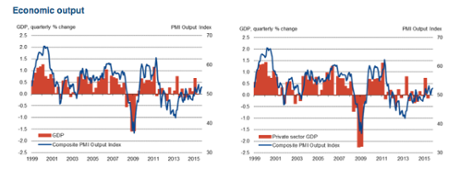
French private sector growth hits 4-month high
So the French economy has clearly strengthened, with output growth across the private sector hitting a four-month high in October, which came as a surprise to economists.
Jack Kennedy, senior economist at Markit, which compiles the surveys, said:
French private sector output growth firmed slightly in October, underpinned by rising activity across both services and manufacturing. The data point to modest growth momentum at the start of the final quarter, following a likely small rise in GDP during Q3. However, companies continued to trim staffing levels in the latest month, pointing towards ongoing softness in the labour market.”

Updated
And we’re off. The French PMI data are out: they are better than expected. The manufacturing PMI has edged up to 50.7 in October from 50.6 in September, while the services PMI climbed to 52.3 from 51.9.
The composite PMI, which comprises both sectors, also improved, to 52.3 from 51.9.
Updated
The research team at Danske Bank have looked at the manufacturing surveys:
So far, the manufacturing PMI seems broadly unaffected by the weakness in emerging markets, even though we have had a couple of months with falling financial sentiment indicators (Sentix and ZEW).
In line with the financial sentiment we expect a decline in the manufacturing PMI, which would also be consistent with the lower order-inventory balance and the recent weak German data.
The German PMIs should decrease the most as the Volkswagen exhaust scandal is likely to add to the negative sentiment, whereas the French PMIs are set to be less affected as suggested by the recent improvement in French business surveys.”
Eurozone PMIs in focus
Good morning and welcome to our rolling coverage of the world economy, the financial markets, the eurozone and the business world.
European Central Bank president Mario Draghi’s hints of more stimulus in December lifted European stock indices yesterday and pushed the euro lower. Major markets (Germany’s Dax, France’s CAC, Italy’s FTSE MIB and Spain’s Ibex) all ended the day more than 2% higher, while the FTSE finished 0.4% higher.
On Wall Street, the Dow Jones closed up 1.9% while in Asia, shares were also higher, with Japan’s Nikkei rising 2.1%.
As Jasper, Lawler, market analyst at CMC Markets UK, writes:
There were two defining moments in Mr Draghi’s press conference. The most important was when he said that “the degree of monetary policy accommodation will need to be re-examined at our December monetary policy meeting.”
The next one was during the Q&A session when he said that, unlike on previous occasions, the ECB did discuss cutting the deposit rate at the October meeting. An explicit reference to both a date and an easing measure was enough to send the euro plummeting and stocks off to the races.”
Today, the main focus are manufacturing surveys for October. The French and German flash services and manufacturing PMIs for October are expected to contract on Friday, Lawlers says, while the eurozone composite PMI (which includes manufacturing and services) is projected to drop from 53.6 to 53.4.
Investec economist Ryan Djajasaputra has done a preview:
September’s composite PMI fell back to 53.6 from 54.3 in August, with falls seen across both manufacturing (52.0) and services (53.7). Despite September’s edging back, activity remains comfortably in positive territory.
A steady level in the PMIs over the third quarter (Q3 averaged 53.9, the same as Q2) suggests that the euro area maintained a steady pace of growth around 0.4%. Looking forward momentum looks to be maintained with the PMIs signalling further expansion in output, employment and new orders.
We suspect that the composite PMI will remain relatively stable (53.4) in October, continuing the trend of a gradual euro area recovery.”
We will also get the Markit flash manufacturing PMI for the US.
Updated