The 2026 Vuelta a España will feature seven summit finishes, two individual time trials, and many climbing days, starting on 22 August.
The Spanish Grand Tour begins in Monaco, with a start against the clock in the city state, before heading into France, then Andorra, before entering Spain on stage five.
The 81st edition ends on 13 September in Granada, after a tough race with very few flat days. Yet again, it appears tailor made for climbers, like 2025, when Jonas Vingegaard won. There will be a maximum of five bunch finishes.
Notably, it spends most of the race in southern Spain, with no visit to traditional Vuelta hotspots like the Basque Country, Galicia and Asturias.
The key climbs in the 2026 race are likely to be Font Romeu in the Pyrenees on stage three, Alto de Aitana in Valencia on stage nine, and then Calar Alto, Sierra de la Pandera, and the Collado del Alguacil in Andalusia in the final two weeks. The Algaucil comes on the penultimate day.
Vuelta a España 2026 stage table
Stage |
Day |
Start |
FInish |
Distance |
Type |
|---|---|---|---|---|---|
1 |
24 August |
Monaco |
Monaco |
9km |
ITT |
2 |
25 August |
Monaco |
Manosque (France) |
215km |
Hilly |
3 |
26 August |
Gruissan |
Font Romeu |
166km |
Medium mountains |
4 |
27 August |
Andorra La Vella (Andorra) |
Andorra La Vella |
104km |
Mountains |
5 |
28 August |
Falset (Spain) |
Roquetes |
171km |
Hilly |
6 |
29 August |
Alcossebre |
Castelló |
176km |
Medium mountains |
7 |
30 August |
Vall d'Alba |
Aramón Valdenlinares |
149km |
Mountains |
8 |
31 August |
Puçol |
Xeraco |
168km |
Flat |
9 |
1 September |
La Vila Joiosa |
Alto de Aitana |
187km |
Mountains |
10 |
3 September |
Alcaraz |
Elche de la Sierra |
184km |
Hilly |
11 |
4 September |
Cartagena |
Lorca |
156km |
Flat |
12 |
5 September |
Vera |
Calar Alto |
166km |
Mountains |
13 |
6 September |
Almuñécar |
Loja |
193km |
Medium mountains |
14 |
7 September |
Jaén |
Sierra de la Pandera |
152km |
Mountains |
15 |
8 September |
Palma del Río |
Córdoba |
181km |
Medium mountains |
16 |
10 September |
Cortegana |
La Rabída |
186km |
Hilly |
17 |
11 September |
Dos Hermanas |
Sevilla |
189km |
Flat |
18 |
12 September |
El Puerto de Santa María |
Jerez de la Frontera |
32km |
ITT |
19 |
13 September |
Vélez-Málaga |
Peñas Blancas |
205km |
Medium mountains |
20 |
14 September |
La Calahorra |
Collado del Alguacil |
187km |
Mountains |
21 |
15 September |
Carrefour Granada |
Granada |
99.4km |
Hilly |
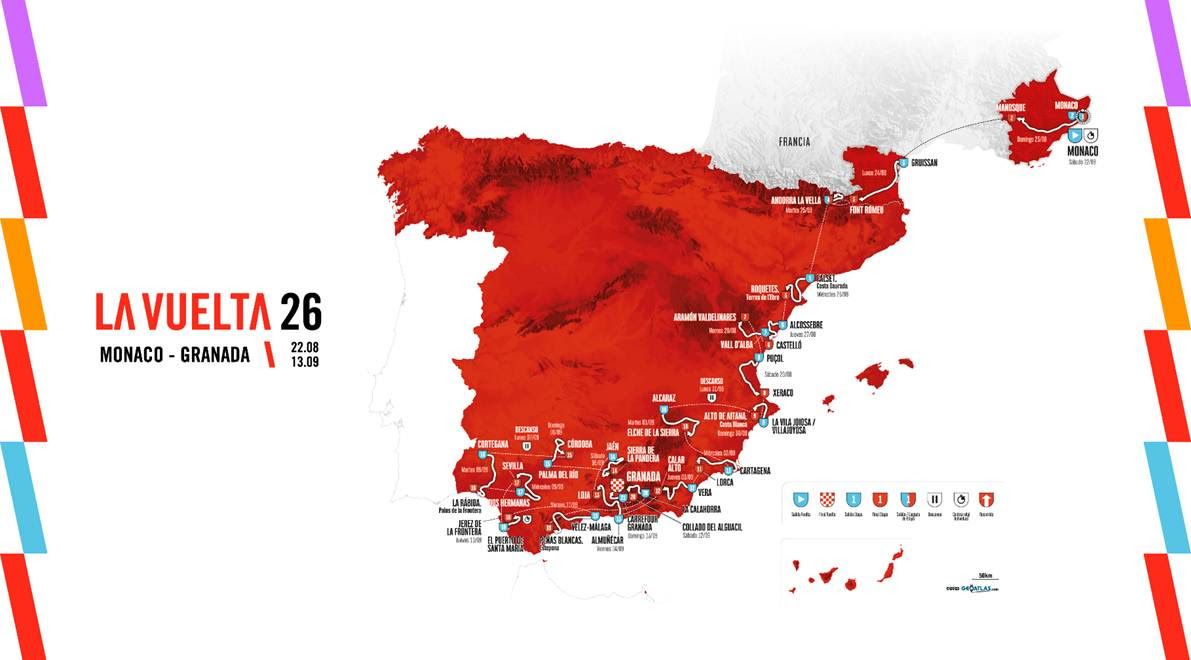
Vuelta a España 2026 full route map
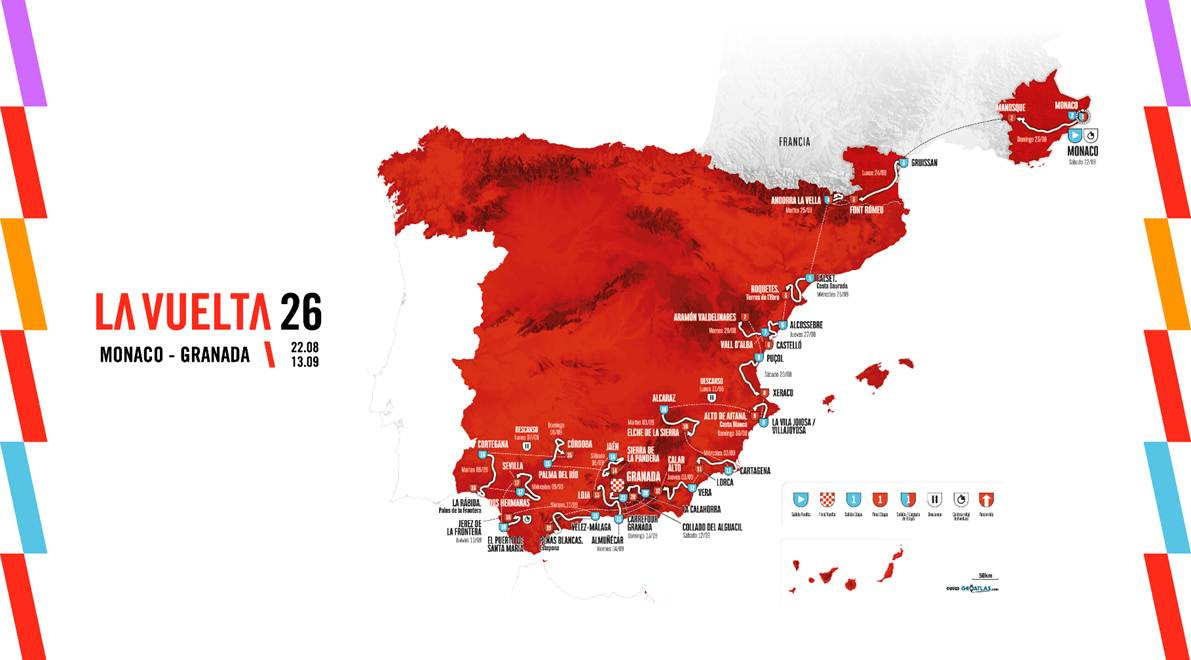
Vuelta a España 2026 race guide
The race begins with a 9km individual time trial in Monaco, followed by a hilly day to Manosque in France on stage two, before the first summit finish, at Font Romeu on the third day. The final climb is only a category-two climb, but it follows the Col de Mont-Louis, a first category peak.
There then follows a day in Andorra, complete with three first category climbs: the Port d’Envalira, the Collada de Beixalís and the Coll de Ordino, before the third cat La Comella. Stage four should sort out the general classification.
Stage five should provide the first bunch sprint, but nothing is definite, before the following day sees a return to the mountains. The category-one climb of Bartolo has 3km of dirt roads to add to the excitement.
However, that is nothing compared to stage seven, with the second-highest altitude finish of the 2026 race after the climb up to Aramón Valdelinare. Stage eight should be the second bunch sprint of the race.
It's another summit finish on stage nine, to bring the first week to a close, after over 5,000 metres of altitude. There are six categorised climbs, including the toughest of Alto de Aitana.
The second week begins with a hilly day that finishes in Castile-La Mancha, but it is nothing compared to the tougher tests to come. Mark this down as one for the breakaway. Stage 11 could be the third bunch sprint of the day, but the organisers have again not made it easy for the fast men, with a climb 30km out.
A return to the mountains comes on stage 12, as the race enters Andalusia. Calar Alto will be the next summit finish, after the Velefique is also tackled. The next day, stage 13, is one for punchy riders, before another summit finish on stage 14. This time, Sierra de la Pandera is summited. This race does not let up. The second week ends with a breakaway day on stage 15 to Córdoba.
The final six days begins with the a sprint opportunity, on stage 16, before the last flat road race on stage 17. That is a maximum of five bunch sprints across the three weeks. Simple.
There is the return of the time trial on stage 18, a fairly flat 32km effort, but one where the wind could play an important role. The mountains come into view again the next day, with three categorised climbs before the final ascent to Peñas Blancas.
It is the penultimate day, however, that should be kept in mind throughout, with over 5,000m of climbing again. The Alto de Hazallanas is summited twice, with the Puerto de El Purche in between, before Collado del Aguacil (8.3km at 9.8%). It won't be the final test, though.
Rather than Madrid, the 2026 Vuelta will end in Granada, with a punchy stage around the Andalusian gem. Five ascents of the Alhambra does not necessarily mean a GC shootout, but it is unlikely to be a bunch sprint.