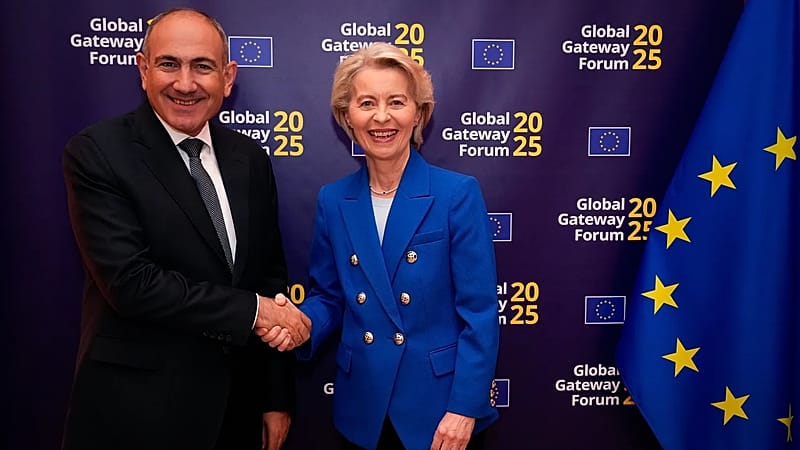
European Commission President Ursula von der Leyen will travel to Armenia next week for talks with Armenian Prime Minister Nikol Pashinyan to further develop strategic EU-Armenia relations following Pashinyan’s recent re-election, sources in Yerevan with knowledge of the matter confirmed to Euronews on Tuesday.
The European Commission endorsed Pashinyan just days before the crucial elections on 7 June and announced a support package to counter the Russian onslaught of sanctions following Yerevan’s cautious pro-Western, pro-EU turn.
Pashinyan carefully balanced Armenia’s approach to Russia in the last days of the election campaign, stating that Armenia’s EU membership bid at the moment is “theoretical.”
In a statement at the time, following the high-level EU-Armenia summit in Yerevan in May, von der Leyen said the European Commission was “standing firmly” in its backing of Pashinyan and that “by extending export restrictions on Armenian products, Moscow is weaponising economic relations for political pressure.”
The EC announced at the time a support package of financial assistance and practical measures to support Armenian agri-food trade after Moscow unleashed an economic onslaught, restricting imports of various Armenian fruits, vegetables, flowers, and fish products, as well as wine, brandy and mineral water, while also threatening to cut critical Russian oil and gas supplies to Armenia.
Von der Leyen’s visit will take place following a new announcement by the European Commission last Friday that it “disbursed €34 million to Armenia to help mitigate the impact of Russia's trade restrictions on the country's private sector,” as “the EU is delivering swiftly on its commitments to support Armenia and its people.”
“Additional support will be provided to sectors affected by the trade restrictions, including agri-food products, flower production and other export-oriented industries, through trade initiatives, business matchmaking events and targeted market access initiatives,” the European Commission said in a statement.
The EU-Armenia Task Force on Economic Resilience continues to meet regularly to steer and monitor the implementation of these measures, the Commission added.
Armenian apricots arrive
In last Friday’s package announcement, European Commissioner for Enlargement Marta Kos said she would travel to Armenia soon “to strengthen EU-Armenia cooperation,” as “the EU stands firmly with Armenia, a sovereign, democratic and independent country.”
Kos said the EU support package “will help address immediate economic challenges while opening new opportunities for Armenian businesses to trade with regional and European markets."
"This is European solidarity in action," she emphasised.
On Monday, Commissioner Kos announced that Armenia’s Territorial Administration and Infrastructures Minister Davit Khudatyan brought her “the first symbolic batch of Armenian apricots” ahead of the launch of a so-called Connectivity Agenda Platform, “where we will take forward our work to better connect Armenia with its neighbours and Europe”.
“This will help Armenian producers diversify their exports and bring more of their high-quality products to new markets,” Kos said in a statement on X.
Days before the elections, Pashinyan attempted to defuse tensions with Russia and said he agreed with Russian President Vladimir Putin to travel to Moscow to “have a meeting and resolve all current issues,” after the elections.
"We will not engage in a war of words with Russia, we will calmly defend Armenia’s positions," Pashinyan said in the run-up to the elections, adding that Yerevan "will not act against Russia’s interests, but neither will we act against our own interests.”
The Armenian premier also made it clear at the time that his country's EU membership bid is at the moment “theoretical” and that “we will continue to work calmly and steadily, without disputes, within the Eurasian Economic Union, and I am convinced that we still have potential in this direction, which we will use in the near future."