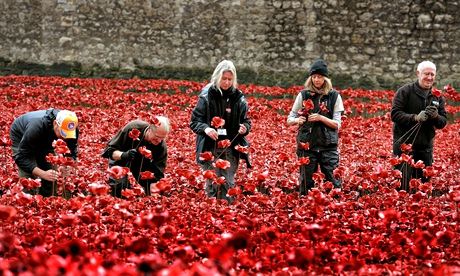
Dozens of volunteers began the long and painstaking task of removing and packing the 888,246 ceramic poppies which have so gripped the public’s imagination at the Tower of London.
Even the rain stopped as the first poppies were individually taken off their sticks at around 9am on Wednesday, the day after Armistice Day. Each will be carefully put in to white cardboard boxes in preparation for their delivery to the hundreds and thousands of people who paid £25 for one. Six charities are expected to benefit to the tune of £1.2m each.
Around 1,000 people a day, many of whom were among the 19,000 who put the flowers in the Tower moat between July and Armistice Day, will spend two weeks pulling and packing the flowers, with some 8,000 expected to take part overall.
More than 5 million people are estimated to have visited the art installation, Blood Swept Lands And Seas Of Red, since the first ceramic flower was placed in the moat in July.
The crowds on some days have been overwhelming. On Wednesday morning there were fewer people but it still felt like a moment.
Irma Ansell, a garden designer, had travelled down from Buckinghamshire to see them before it was too late. “I had no idea how enormous this was,” she said. “It’s breathtaking. I haven’t got any family who were killed in the first or second world wars but I do have family who were in the war and it had a great effect on them and their friends. Their whole lives were changed. So I’m here really to respect what they gave up.”
Ansell said it was sad to see them going and would have liked to see them remain for four years, to be in place until the centenary of the end of the first world war. “This was just the beginning.”
Raven Tuson, a 22-year-old jewellery designer from London, had mixed feelings about them going and thought the points made by the artists – ceramicist Paul Cummins and set designer Tom Piper - were good ones. They have said that the installation’s transience was always meant to be part of its power.
“I thought I’d kick myself if I never saw it,” said Tuson. “It would be one of those things I’d be gutted about because everyone I’ve spoken to has seen it. It’s about coming to pay your respects as well and there is the shock factor of seeing how many there are. I never imagined this many.
“It’s moving. My generation don’t really know how many people it was but when you see it … the reality.”
Sonja Underwood, a South African who has lived in London for nine years and works in marketing, dropped by the Tower with her husband. “We read about it in the Metro and we just wanted to come and see what it looked like and in real life it is much much more impressive. It’s stunning. It’s amazing. It’s horrible to think that so many people died. Each one was a person … it’s crazy.”
She said she was glad it is going because it would lose its impact if it stayed.
Christine Prudhoe, an education consultant who lives in Stratford, east London, was with her parents-in-law, Maureen and Harry Prudhoe, from Jarrow.
“It’s the third time I’ve been. I’ve been with my husband and father and now my parents-in-law because we just wanted to see them before they got taken away.”
She pointed to the messages to people killed in action that have been tied to the railings. “The whole thing is very impressive and I think it has more impact because of the individual messages. It makes it more personalised … it is very moving.”
Her mother-in-law Maureen said: “It is absolutely beautiful. My uncle was killed in the first world war so it is touching.”
Two parts of the installation - the Weeping Willow, a cascade of poppies which spills from a window of the castle, and the Wave, which swirls out of the moat to form an arch over the entrance to the Tower - will remain in place until the end of the month. They will then go on tour around the country until 2018, when they will be gifted to the Imperial War Museums in London and Manchester.