Volunteer cleanup activities resumed Saturday after a long hiatus in the cities of Nagano and Sano, Tochigi Prefecture, which were severely damaged by the last autumn's Typhoon No. 19. In delaying the cleanup, the new coronavirus outbreak has already drastically changed how support for disaster-hit areas will be carried out going forward.
In order to prevent infections, volunteers are being solicited only from among residents in the affected neighborhoods, and the activities are being done with fewer people.
In Nagano, about 3,800 structures were flooded due to the collapse of the banks of the Chikuma River. The Nagano Council of Social Welfare has restarted accepting volunteers for the first time in about three months, and 24 people signed up.
Before the suspension of the activities, the council had accepted volunteers from all over the country, but this time they were limited to residents of the city. The council also made it a condition that would-be volunteers have no fever or cough and have not traveled outside the prefecture over the previous two weeks.
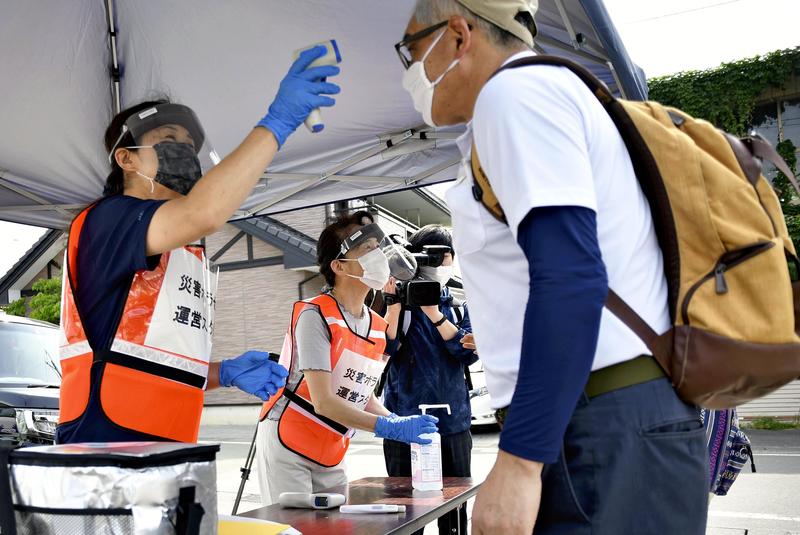
Nurses wearing face shields were stationed at the registration desk. After having their temperatures checked, the participants cleaned and removed mud from nine houses. A 62-year-old office worker who has participated in the activities several times before, said: "It has been frustrating not being able to work. I work while keeping distance from my colleagues."
A 78-year-old apple farmer in Nagano whose house was flooded 2.5 meters above floor level, said, "I really appreciate that they came to clean up, while taking steps to prevent infections."
In Sano, where about 2,300 structures were flooded, volunteers were solicited also only from among the city's residents. Volunteers were asked to wear protective masks and have their temperatures checked before receiving an antiseptic solution and mouthwash. In addition, the number of volunteers per working site was reduced from about 10 to about four in a step to avoid crowded settings. On Saturday, 16 people were divided into five groups to remove mud or engage in other activities.
A 52-year-old city worker was working in sweltering conditions when the day's high temperature reached almost 30 C. "We are taking turns to have a break and apply disinfectant even to the soles of our feet when entering someone's house," he said. "We take meticulous care, and we know that's what we need to do."
Changes in the ways volunteers work are also being seen in the areas affected by the Great East Japan Earthquake in March 2011. In Otsuchi, Iwate Prefecture, life-support counselors have visited 969 households affected by the disaster and spoken to them about their troubles. In order to reduce exposure to close contact, they do not enter the homes, but only talk for a short time at the entrance.
If virus infections flare up again, the counselors plan to limit the scope of their support to those living alone and switch to phone conversations to confirm their wards' safety.
The Japan Voluntary Organizations Active in Disaster (JVOAD) and the Japan National Council of Social Welfare provide guidelines for volunteer activities in situations where coronavirus infections are a concern.
They say it is appropriate to limit the participants to those living in disaster-hit municipalities. Solicitors are urged to seek opinions from residents, experts and municipalities when expanding the scope of volunteers if they encounter difficulty in coping with the activities using only local residents.
JVOAD Secretary General Tetsuya Myojo said: "Conventional practices of 'support from all over the country' and 'short-term, concentrated support' need to be reviewed. It is necessary to prevent [the spread of] infections and listen to the needs of the communities concerned."
Read more from The Japan News at https://japannews.yomiuri.co.jp/