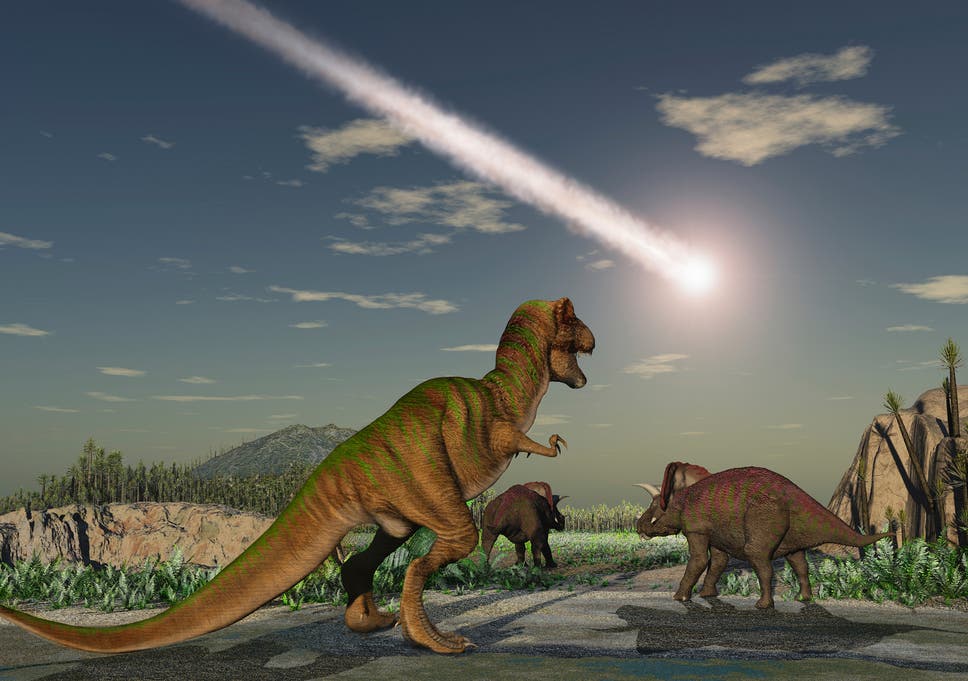
Volcanic eruptions belching out climate-altering gases into the atmosphere may have wiped out the dinosaurs long before an asteroid arrived to finish the job.
That is according to new research, which is the latest to unravel the mystery of how these prehistoric reptiles were wiped off the face off the planet after walking the Earth for millions of years.
The event, which occured 66 million years ago, is perhaps the most famous of the five mass extinctions that have struck the planet, but the circumstances surrounding it remain mysterious.
While the discovery of the Chicxulub crater in the Caribbean appeared to confirm an impact by an enormous asteroid sealed the dinosaurs’ fate, the solidified lava field of the Deccan Flats confuses the story.
Measuring more than 2 kilometres thick in some places, these rocky stretches in India are evidence of massive volcanic activity that took place around the same time.
Key to understanding whether volcanoes or space rocks were primarily responsible for the mass extinction is determining a precise time for the eruptions in relation to the impact.
By using uranium and lead within minerals from the solidified magma, scientists identified four enormous volcanic events that began tens of thousands of years before the asteroid struck.
Each lasting around 100,000 years, these explosions would have vented enormous quantities of climate-altering greenhouse gases, potentially triggering the first wave of mass extinctions.
During this period, temperatures increased by around 8C as these gases were pumped into the atmosphere.
These new results were released alongside another study published in the same issue of the journal Science, which arrived at a slightly different conclusion.
Their dating of basalt rocks of the Deccan Flats appeared to show most of the eruptions took place after the asteroid’s arrival – perhaps triggered by super-earthquakes following the impact.
However, Dr Courtney Sprain, a geoscientist at the University of Liverpool who led the second study, said this did not mean the volcanoes played no role in the extinctions.
“Either the Deccan eruptions did not play a role – which we think unlikely – or a lot of climate-modifying gases were erupted during the lowest volume pulse of the eruptions,” she explained.
The team suggested that instead of the gases blasting out as the volcanoes exploded, they leaked out gradually in the years building up to the eruptions.
While a definitive answer to the question of what killed the dinosaurs remains elusive, Dr Sprain and her colleagues argue it was likely the result of a “one-two punch” from both volcanoes and asteroid.
Rapid warming of the Earth’s climate may have left remaining creatures adapting to life in hot conditions, only to be faced with rapid cooling after dust from the asteroid impact blotted out the sun.