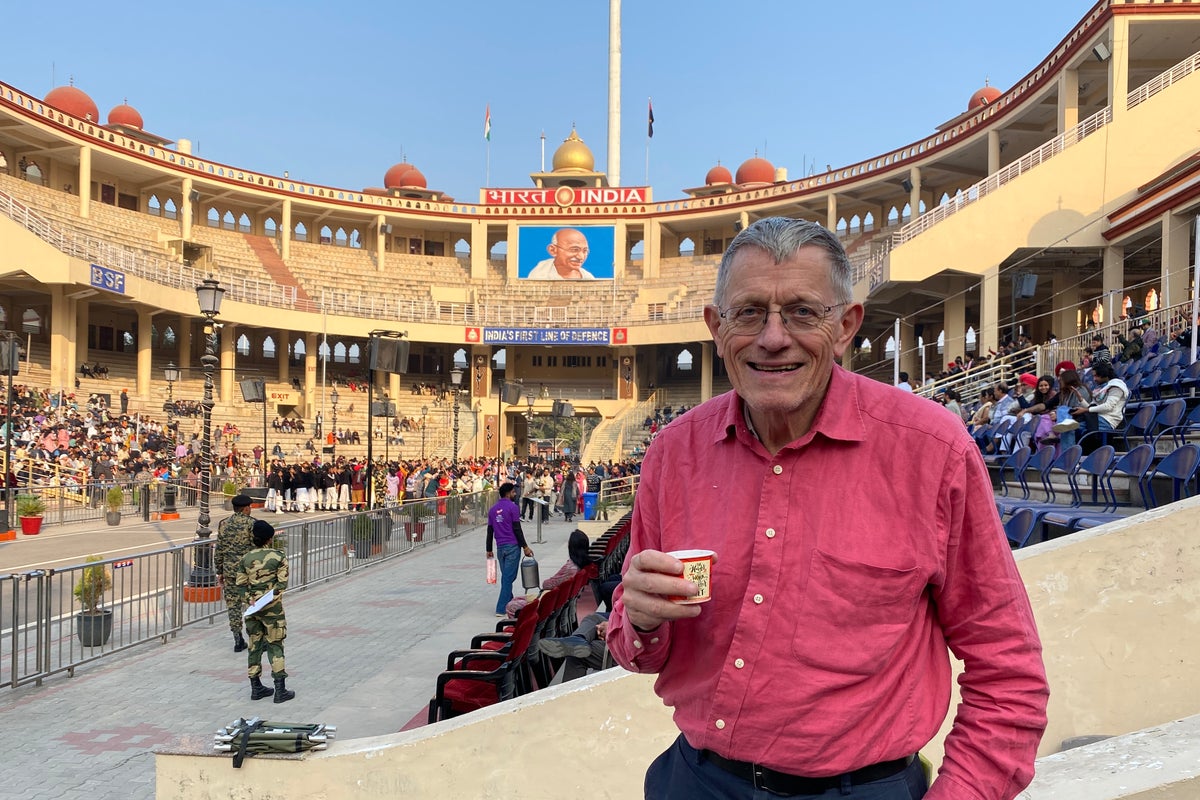
Mahatma Gandhi is smiling. The bespectacled father of Indian independence beams across a multi-tiered arena. The December sun, low in a clear blue sky, heightens the power of the image. The banner beneath reads: “India’s first line of defence.”
The great cities of Amritsar in India and Lahore in Pakistan are just 30 miles apart. They are connected by the Grand Trunk Road, Asia’s “main street” – but agonisingly divided by geopolitics.
With a combined population approaching 15 million, the border crossing here at Wagah, roughly halfway between the two, should be the busiest in the world. Instead, one of the world’s great frontiers has been demoted to pure theatre.
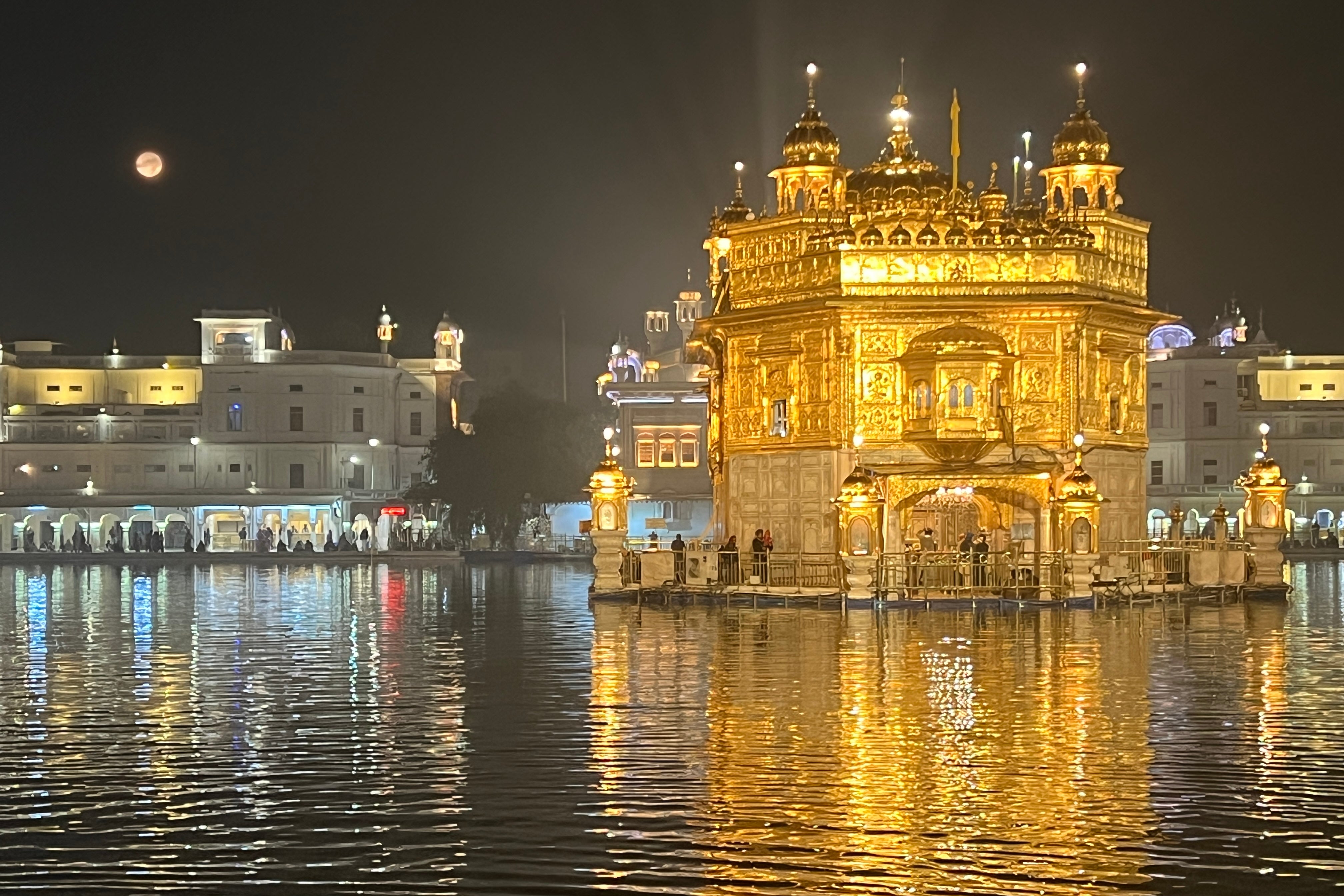
At the heart of Amritsar is one of the planet’s glories: the Golden Temple, shimmering in the Pool of the Nectar of Immortality. The holiest site for the Sikh religion is a rival for the Taj Mahal as India’s finest building. Once the visitor has been dazzled by ornate architecture, soothed by the constant sacred music and fed by the charity of the Sikh community, the next attraction is waiting: a sightseeing excursion to the border ceremony.
It’s 3pm, and the government of Punjab’s open-top bus (a snip at £3) has just delivered me and a couple of dozen Indian tourists to the border. We are offloaded in a car park the size of an airfield, and amble past “the first and last restaurant in India”, the Shahi Qila.
As with any border, side industries have sprung up. Hand or face painting in the Indian colours of green, white and saffron is available for 40 rupees (35p) as you step from the bus; souvenir vendors sell patriotic baseball caps and flags. Your neck cranes up to take in the giant flagpoles, one on either side.
Many more people arrive by cars and minibuses, and surge towards the frontier as though they were cricket or football fans. Security is tight: everyone needs their passport, and goes through an airport-style security check. A suicide bombing on the Pakistani side in 2014 claimed dozens of lives. Anyone carrying a power bank is sent away to lodge it with left luggage.
Where once travellers followed Border Security Force (BSF) signs across the frontier, now they direct visitors to the Selfie Point.
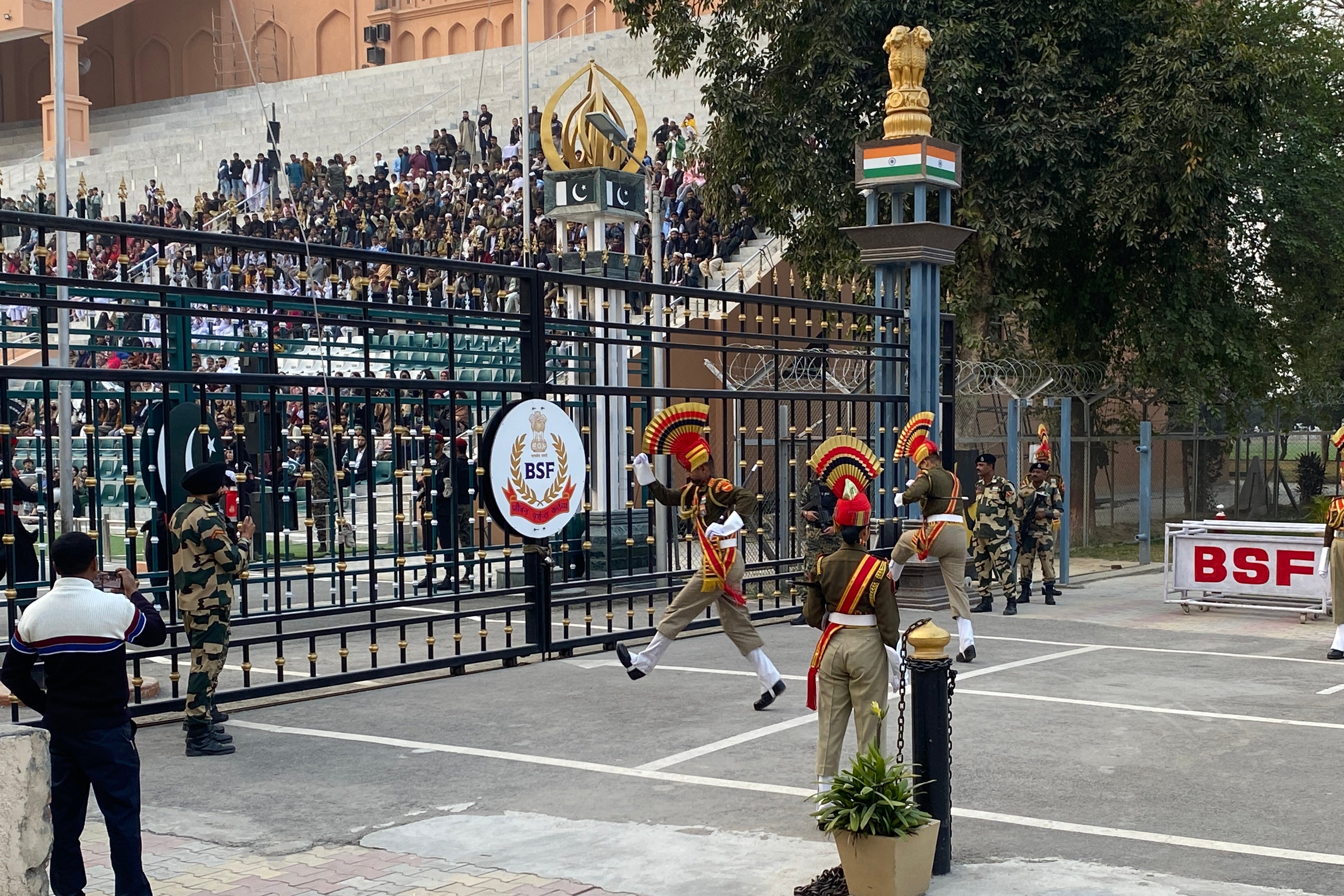
Beyond it, the arena where the geopolitical dance recurs daily. Imagine a big sports stadium where, in place of the running track or football pitch, there is simply a road. The halfway line is marked by tall metal gates that share DNA with the Berlin Wall. On the other side, rather fewer tourists are filing up to the stands where they will watch the same lowering of the flags ceremony that has been going on for decades.
Over the years, it has become a bi-national drama – where the main players are extravagantly uniformed officers, and everyone else is an extra.
During the warm-up, a line of women queues to take turns running with the Indian flag towards the gates, then running back. Others filter from the stands to the road for family pictures – with the officers happy to snap them.
As the ceremony approaches, the patriotic music becomes so deafening that it almost drowns out the “Chai! Coffee!” chants from the vendors with vats of hot drinks on their backs.
I have managed to grab a seat close to the gates so I can view the ceremony on both sides of the border. Rather like some sporting events I have attended, the actual performance is puzzling (my team is Crawley Town FC). It has been described as the ceremony of silly walks, and the cross-cultural reference to Monty Python is appropriate. This is a military parade choreographed for the entertainment of the audience: Strictly Come Prancing.
An elaborate ritual with extravagant gestures is played out by moustachioed officers, with women soldiers relegated to a warm-up role. Everyone looks rather too well-dressed to be going to war any time soon.
They step through a series of belligerent balletic manoeuvres – as do their opposite numbers across on Pakistani territory, although their performance is somewhat more subdued.

The lowering of the flag itself is also muted. These are not the giant national symbols hoisted on the skyscraping flagpoles, but much smaller flags above the gates. By this stage, I am feeling sad: I want the gates to open, the officers to shake hands, and the travelling public to be allowed to flow across the frontier and along one of the world’s great arteries. When relations between the two great powers are warm enough, all of that happens. Currently, we get mutual loathing in fancy dress.
Every evening at sunset, this Bollywood tribute to the Berlin Wall ends in a perpetual no-score draw. Everyone goes away happy, their sense of national supremacy confirmed. But at the end of a lively bus ride back to Amritsar, it is good to return to the real world of Asia: noisy and chaotic but gentle and kind – as, no doubt, is Lahore. But it will take another long journey, approaching the frontier from the other side, to get there.
Simon Calder paid a total of £766 to fly from London Gatwick to Delhi on a combination of Wizz Air and Air India, and from Amritsar to Gatwick, Air India also flies from Birmingham. The government of Punjab border bus departs daily at 3pm, price 375 rupees (£3).
The Foreign Office “advises against all travel within 10km of the India-Pakistan border”.
Read more: Should overseas visitors pay more for our museums?
Why travellers are now opting for lesser-travelled US destinations
World’s longest plane journey, lasting 29 hours, takes flight
New fee introduced charging tourists more than £10 to visit the famous Juliet balcony
New €10 train tickets launched from Amsterdam to Berlin
Panic as traveler ‘tries to open plane door mid-air’ on 15-hour flight from US
Budget Christmas escapes still available as some airfares soar