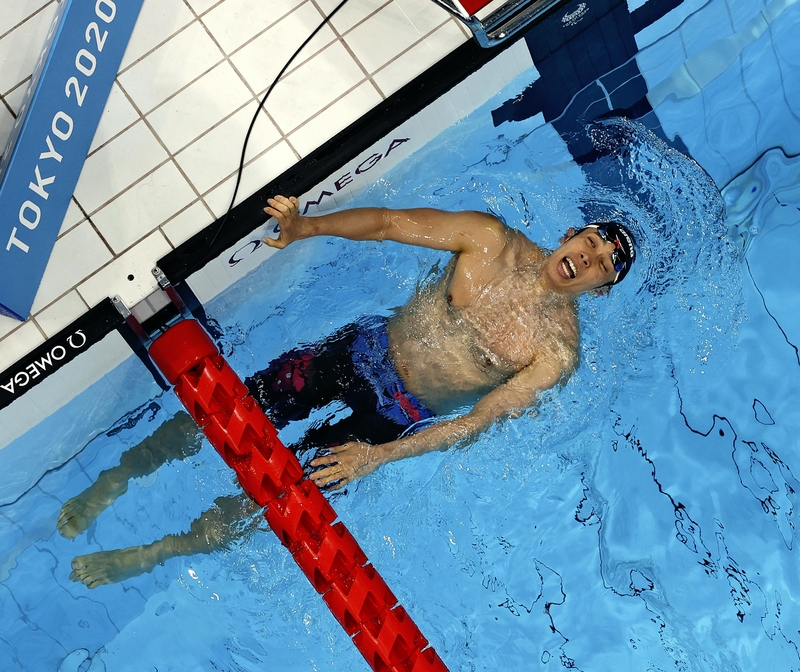
Swimming in complete darkness, Uchu Tomita discovered a shinny silver medal.
Tomita, 32, stood on the podium after the men's 400-meter freestyle S11, a category for those with visual impairments, having just set the Asian record.
He sported opaque black goggles as he entered the final in that classification. There was a time when he could see, meaning it's difficult now for Tomita to swim straight in the darkness.
Swimming through the water in the dark makes him feel like he's moving in the weightlessness of space, and therefore he calls himself a "space swimmer."
His parents named him Uchu, meaning "space" in kanji characters, hoping their son would grow up with a broad perspective.
The boy who loved looking at the stars through a telescope dreamed of someday venturing into space. He studied hard and enrolled at Seiseiko High School, a top-ranked school in his native Kumamoto Prefecture, where he joined the swimming club with the goal of trying to excel in both academics and sports.
When he was in his second year of high school, he was diagnosed with an intractable disease that gradually diminished his eyesight. He started having difficulty reading and his grades started to suffer. He abandoned his dream of becoming an astronaut and looks back on the moment, saying he was hit with the feeling that his "life was over."
"I wanted to get away from people who knew me," he said and chose to attend a university in Tokyo.
Tomita then dedicated himself to dancesport, trying to quell the suicidal feelings he was experiencing. He tried to reach the pinnacle of the sport, but his illness progressed, causing him to make mistake after mistake.
He ended up giving up dancesport when he was in his mid-20s. "I didn't want to drag my partner down," he said.
Tomita said he grew tired of trying to compete against able-bodied people. Para swimming became his new world, and being around fellow disabled people allowed him to just be himself, he said.
"My disability won't disappear. So, I have no choice but making use of it," Tomita said.
In 2017, he entered Nippon Sport Science University's graduate school, where he refocused on swimming. That same year, his classification dropped from "weak eyesight" to total blindness.
When he was sighted, he was "rather reclusive, trying not to interact with people," he said. Since his disease is progressive, the support of those around him has become imperative in both daily life and competition. Tomita's voice cracked during an interview after his silver-medal finish.
"I am overwhelmed with the feeling that I received this medal from the people who have supported me, rather than the notion that I won it on my own. I think the reason I was burdened with this disability might've been to have this moment," he said.
Tomita has set his next goal; the space journey that he once gave up on.
"I spent a lot of time worrying about my disability, but now I've come to realize that I, even without eyesight, have potential."
These days, private citizens have been able to travel into space, and Tomita said, "I want to swim in space someday."
Read more from The Japan News at https://japannews.yomiuri.co.jp/