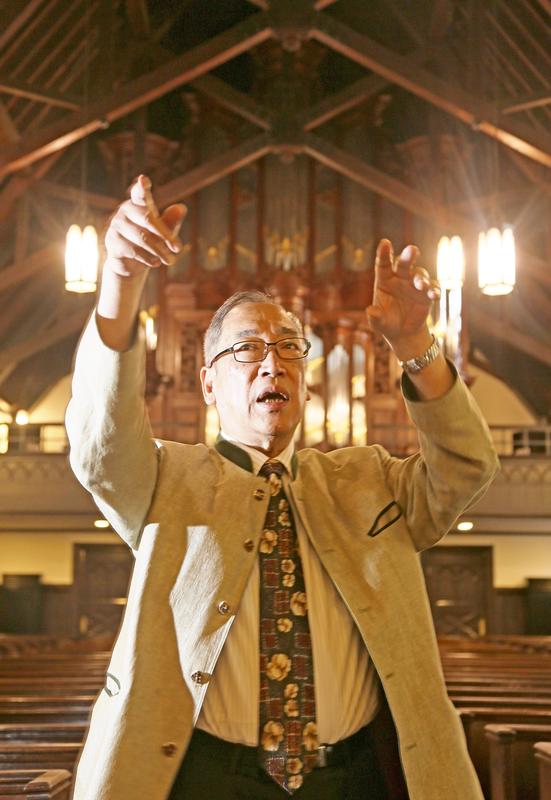
Well-known as a scholar on Western classical music history, Ryuichi Higuchi has taken on the task of researching the life of his grandfather, Kiichiro Higuchi, an army lieutenant-general during World War II who helped save Jewish refugees and led the defense of Shumushu Island to stave off a Soviet invasion.
Such accomplishments hold even greater significance today, says Higuchi, currently a professor emeritus of Meiji Gakuin University, said as he talked about his grandfather at length in a recent interview with Yomiuri Shimbun. Here are excerpts of his account of his grandfather's life.
My grandfather, who went all over the world while in the military and never served in public office after the war, died in 1970. The general perception of the postwar years was that soldiers and humanitarian principles were incompatible. But the facts are gradually coming to light that during his days as head of the Harbin secret military service of wartime Manchuria, my grandfather helped save the lives of many fleeing Jewish refugees.
In March 1938, Jewish refugees fleeing prosecution from Nazi Germany and other European countries flooded into Otpor station in northwest Manchuria (currently northeast China) near the Soviet border, mainly via the trans-Siberian railway. They were desperately seeking entry into Manchuria. Forced to wait in an extremely cold area, the Jews were left in dire straits.
Solicited for help by prominent Jews living in Harbin, my grandfather requested that the Manchurian Foreign Office grant the visas. Within the army, the secret military service was tasked with gathering intelligence and forming strategy, and the Harbin secret military service wielded enormous power in Manchuria. As a result of my grandfather's approach, as many as 20,000 Jewish refugees, according to a report, were able to escape, mainly from Manchuria to Dalian or Shanghai, then on to the United States and elsewhere.
My grandfather had been sent to Vladivostok and Khabarovsk as a member of the secret military service during the Siberia Intervention (1918-1922), and was engaged in intelligence gathering on the Soviet Union. Later he also served as military attache to Poland. Back then, he knew very well the fate that awaited the Jews of Europe.
"Discrimination was present in Europe before the war, and it was the Jews who rented out houses to Asians," my grandfather said. "It was only natural for us to help them in their time of need."
Prior to the Otpor incident, my grandfather showed his understanding of the Jewish people in a speech at the "1st Far Eastern Jewish Council" held in Harbin, in which he expressed his support for the establishment of a Jewish state. Germany, which had already concluded the Anticomintern Pact with Japan (in 1936), lodged a protest. But the Japanese army never pursued the matter.
Within the army, some thought that Japan should maintain friendly relations with the Jews, so as to make use of their economic might and prevent relations with the United States from worsening. While there were movements to spread anti-Semitism in Japan, the government never had discriminatory policies such as those of Germany, all the way through to the end of the war.
As a sign of appreciation, my grandfather's name was inscribed in the "Golden Book" of the Israeli non-profit organization "Jewish National Fund." I went to Jerusalem the year before last -- the 70th anniversary of the establishment of the State of Israel -- where I met the descendant of a person who survived because of the visa which my grandfather helped them get. The descendant expressed gratitude, saying, "Had it not been for your grandfather, I would not be here."
Among efforts to help Jewish refugees during the war, diplomat Chiune Sugihara (1900-1986) is well-known. As the vice-consul for Japan in Kaunas, Lithuania, Sugihara saved many Jewish lives by issuing more than 2,000 transit visas allowing for travel through Japanese territory. I believe that one reason my grandfather is less known than Sugihara stems from the postwar trend of negatively regarding those in the military.
Presently, there are still countries that assert that wartime Japan and Nazi Germany are to be regarded in the same light. I think it is meaningful to convey that there were members of the military who acted based of humanitarian principles, as my grandfather did, and that the Japanese government did not go along with the racist ideas of Nazi Germany.
Another part of my grandfather's story as a military officer that cannot be overlooked is that he was commander in the battle to defend Shumushu Island, on the northeastern tip of the Kuril Islands chain.
Even after Japan's acceptance of the Potsdam Declaration of Aug. 14, 1945, the Soviet Union continued its invasion of Sakhalin Island and the Kuril Islands. Before dawn on Aug. 18, Soviet forces started landing on Shumushu Island. Kiichiro, who had assumed command of the Sapporo-based 5th Area Army, ordered a counterattack as a "self-defense war," inflicting more damage on the Soviet forces than his suffered.
As my grandfather had long dealt with the Soviet Union, he well understood the Soviet character, which he described as "ungentlemanly and unreasonably obstinate." In fact, Soviet dictator Joseph Stalin had intended to establish a stronghold in South Sakhalin and then move to occupy half of Hokkaido. U.S. President Harry Truman informed Stalin that occupying Hokkaido was impermissible, but it is fully conceivable that Stalin planned to create new facts on the ground had he met no resistance from the Japanese army.
It was in 1961 that the Berlin Wall went up. I was in my third year of junior high school, and on a visit to my grandfather's house in Kanagawa Prefecture, he asked me if I could write down where Berlin is. He then explained that Berlin was like an isolated islet within the borders of East Germany, and had become a divided city. I think he wanted his grandson to know that Tokyo, like Berlin, could also be half-occupied by the Soviet Union had there been no resistance on Shumushu Island.
My mother, who was 19 when the war ended, was living in Sapporo with my grandparents. She said she was given potassium cyanide to commit suicide in the event of a Soviet invasion. I think many Hokkaido residents remember having heard rumors of such an invasion at war's end. Back then, there were 400,000 Japanese living on South Sakhalin and the Kuril Islands, and 3.5 million in Hokkaido. We must never forget the officers and soldiers who died on Shumushu Island and on South Sakhalin, nor the civilian victims of the battles.
My grandfather talked little about the war. He probably had an ingrained habit as a former intelligence officer of maintaining secrecy, even with his family. Humans do not speak about their tragic experiences.
He passed away when I was a senior at university, and until his dying day, he harbored regrets over one battle in particular. On Attu Island in the Aleutian Islands (in 1943), he commanded his troops to fight to the last man. Death before the dishonor of surrendering was the rallying cry. About 2,600 soldiers perished in the fighting. Each morning after waking up, he would say a prayer in front of a drawing of Attu Island for the repose of the souls of his subordinates killed in action. From the visits starting back in my childhood, I would feel a deep pity every time I witnessed that scene.
The year before last, I had an occasion in Sapporo of giving a talk on my grandfather. Following the lecture, a man over 80 came up to me with tears in his eyes and said, "It has been said that my father, who was killed in a battle fought after the war ended, died a useless death. But that's not so, is it?" He said his father was killed in action in Sakhalin.
As I looked at the old man's tears, I was gripped by a strong calling to hand down the story of my grandfather to future generations.
Profile
Kiichiro Higuchi
Born in 1888 in what is now the city of Minami Awaji, Hyogo Prefecture. He graduated from an army preparatory school, the Imperial Japanese Army Academy, and the Japanese Army Staff College. He was posted to Vladivostok and other places during the Siberia Intervention. Was military attache to Poland before becaming the head of the secret military service in Harbin in 1937. He became commanding officer of the Northern District Army in 1942 and the Sapporo-based 5th Area Army in 1944. He died in 1970.
Ryuichi Higuchi
Born in Tokyo. He completed the master's course in the Graduate School of Letters at Keio University. He earned a doctorate at the University of Tubingen in West Germany. He has been active as a music scholar and conductor. He authored many books, including "Bach Tankyu (Study on Bach)," and released many CDs, including "Matthaus-Passion."
Read more from The Japan News at https://japannews.yomiuri.co.jp/