A political firestorm is unfolding in Virginia after a Republican-appointed judge struck down a Democratic-backed redistricting amendment, invalidating the results of a closely watched special election and setting up a high-stakes legal battle that could ripple far beyond the state.
The ruling declared the amendment unconstitutional and "void from the start," effectively erasing all votes cast in the April 21 special election and permanently blocking the implementation of the proposed new congressional maps. The decision immediately halted what Democrats had framed as a long-awaited effort to reshape Virginia's electoral boundaries.
Virginia Attorney General Jay Jones, a Democrat, said the state would move swiftly to challenge the ruling.
"We will immediately file an appeal," Jones said, signaling what is likely to be a protracted legal fight over who controls the map-drawing process in one of the country's most politically competitive states.
Attorney General Jay Jones Shares Statement on Republican National Committee v. Koski Tazewell County Circuit Court Injunction pic.twitter.com/jKpyZJ1ACr
— Attorney General Jay Jones (@AGJayJones) April 22, 2026
The decision has also ignited a broader national debate over partisan gerrymandering, with lawmakers on both sides pointing to Virginia as the latest battleground in a yearslong struggle over electoral fairness.
-
Scammer Says 'Super Dumb People' Drove AI-Generated MAGA Influencer to 1 Million Followers, Thousands in Profit

-
Hakeem Jeffries Warns Florida GOP on Redistricting, Targets Eight House Republicans by Name and Promises: "Maximum warfare, everywhere, all the time"

-
DeSantis Looks to Join Trump Administration as AG, Supreme Court Justice or Secretary of Defense - REPORT


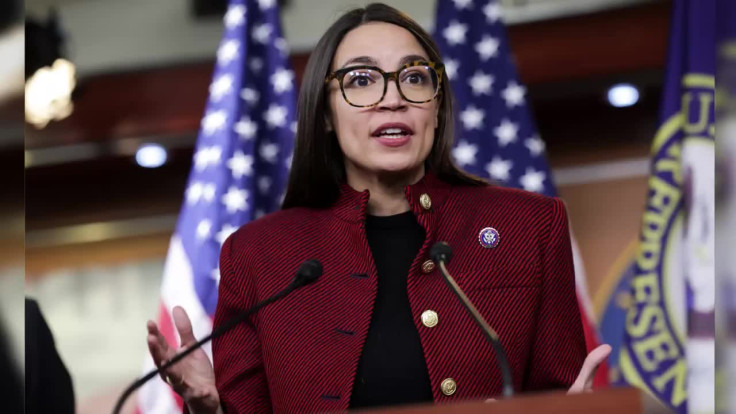
Asked about Republican criticism that the referendum itself lacked legitimacy, Representative Alexandria Ocasio-Cortez dismissed the argument bluntly.
"Wah wah wah," she said, before launching into a broader critique of GOP redistricting strategies across the country.
"We have asked Republicans for 10 years to ban partisan gerrymandering. And for 10 years, Republicans have said no," Ocasio-Cortez said. "Republicans have fought for partisan gerrymanders across the United States of America. And these are the rules that they have set."
She pointed specifically to recent redistricting fights in states like North Carolina and Texas, where court battles and legislative maneuvers have reshaped congressional maps, often with significant partisan consequences.
"They did this in North Carolina. They drew out three Democratic members of Congress in North Carolina. They did it in Texas," she said.
Ocasio-Cortez argued that the current backlash reflects a shift in Democratic strategy rather than a change in principle.
"What they're just mad at is that they have been accustomed to a Democratic Party that rolls over, doesn't fight, and takes everything sitting down," she said. "And what they're mad at right now is that we are here in a new day."
The congresswoman framed the Virginia fight as part of a larger national reckoning over how electoral maps are drawn, emphasizing that Democrats are increasingly willing to challenge Republican-drawn districts in court and through legislation.
"We have been asking the Democratic Party to stand up and fight, and now they did, and now the Republican Party doesn't like the fact that they are fighting against someone who actually will stand up for the American people," she added.
Reporter: What do you make of Republicans saying that Virginia—
— Acyn (@Acyn) April 22, 2026
AOC: Wah wah wah.
We have asked Republicans for 10 years to ban partisan gerrymandering. And for 10 years, Republicans have said no. Republicans have fought for partisan gerrymanders across the United States of… pic.twitter.com/BVa9uOH0zq
At the center of the dispute is the long-standing controversy over partisan gerrymandering, the practice of drawing electoral districts to favor one political party. While both parties have been accused of using the tactic, recent cycles have seen intensified legal scrutiny and competing efforts to reform the process through independent commissions or constitutional amendments.
Ocasio-Cortez said she would support a bipartisan solution, but questioned whether Republicans would agree.
"So if Republicans decide that they would like to revisit a ban on partisan gerrymandering, I welcome them," she said. "We have the bill right here to end this all today. But they don't want to, because they like pursuing and continuing to enact an unfair electoral landscape."
Earlier, House Democratic Leader Hakeem Jeffries issued a blunt warning after a major Democratic redistricting victory in Virginia, signaling that Florida could be next in a growing, coast-to-coast war over congressional maps.
"If Florida Republicans proceed with this illegal scheme, they will only create more prime pick-up opportunities for Democrats," Jeffries said in a statement, before naming eight Republican lawmakers he plans to target. He closed with a striking line that captured the tone of the moment: "Maximum warfare, everywhere, all the time."
© 2025 Latin Times. All rights reserved. Do not reproduce without permission.