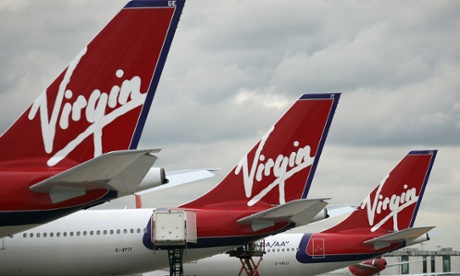
Virgin Atlantic has flown back into the black after three years of heavy losses, as its joint venture with the US carrier Delta helped Richard Branson’s airline post a £14.4m pre-tax profit for 2014.
Chief executive Craig Kreeger said that the airline was on course to consistently record £100m-plus annual profits by 2018, with more fuel-efficient planes and extended benefits from its transatlantic partnership.
While the profit margin remains slim at 0.5%, Kreeger said the airline was celebrating meeting the three targets in its recovery plan.
“We embarked with three specific goals – to get back in profit, preserve the magic for our people, and improve customer experience, and it’s great to report that we achieved all of those,” he said, citing internal polling of employee engagement and of customers who would recommend Virgin.
He added: “It’s a step on a journey not an end point. We’ve got every expectation that the future will be much better. In 2015 alone we will take delivery of eight Boeing 787s: they give a customer service benefit but also generate financial savings in decreased fuel consumption, and we’re replacing 50% of our fleet by 2018.”
The results come after three years where cumulative losses reached £230m, prompting the airline to draw back from its more exotic destinations and focus on lucrative US routes, underpinned by the sale of a 49% stake to Delta and the creation of a partnership to rival British Airways and American Airlines in the transatlantic market.
More than 4.5 million passengers flew on the joint venture’s services in its first year since launch in January 2014, and Kreeger said the second year’s performance would be better, including the start of new routes to Detroit.
Kreeger also promised a £300m investment to install Wi-Fi on every plane and better food in the economy cabin. He said they had also “spent an awful lot of energy trying to reinforce customer service” over the last two years.
The lossmaking domestic airline Little Red will close later this year, after disappointing passenger numbers on its Scotland-Heathrow service. Kreeger said that closure would also benefit the airline’s finances. However, he added: “It’s not a tonne, its results have improved over time. We’ve been pleased with how Little Red has helped serve Virgin customers and augment the brand, but unfortunately not financially.”
Virgin has long backed Heathrow expansion but Kreeger said that as a possible decision to grant a third runway neared, the airline was becoming concerned about the financial cost of expanding the airport. “We feel very strongly that current passengers should not be paying for capacity that will benefit future customers, and we want to be sure that it’s allocated with an eye to what provides the biggest customer benefits – not to become increasingly concentrated in one airline or alliance,” he said. Rival British Airways already owns a majority of slots at Heathrow, and is part of the oneworld alliance.
Richard Branson, Virgin’s co-owner, said: “I can’t think of a better way to complete our 30th birthday year than with a return to profit. The team at Virgin Atlantic has done a great job in turning around the airline and has the right strategy to take the business from strength to strength. I look forward to the next 30 years.”