LOS ANGELES _ The first to die was her friend "Ken Dog."
Five months later, her fiance was gunned down, then another friend, "Bug" _ all on the same South Los Angeles street corner.
Semaj Smith lives in Harvard Park, one of the deadliest neighborhoods in Los Angeles. Her yellow house is riddled with bullet holes. A dark stain from memorial candles marks the spot on the sidewalk where her fiance died.
Across the street, in the park that bears the neighborhood name, children play baseball and climb on jungle gyms. A Bloods gang known as the Six Deuce Brims claims the park and nearby blocks, while the surrounding territory is controlled by Crips. A Crip looking for a Blood knows where to go. Sometimes, the victim turns out not to be a gang member.
Lately, the violence has escalated. Homicides in the half-mile or so around the park nearly tripled in 2016, to eight from three the year before.
So far this year, six people have been killed. Most of the victims were black men, though the neighborhood's population of about 12,000 is roughly one-third black and two-thirds Latino. The area around Harvard Park was the deadliest place for African-Americans in Los Angeles County last year, according to the Los Angeles Times' Homicide Report.
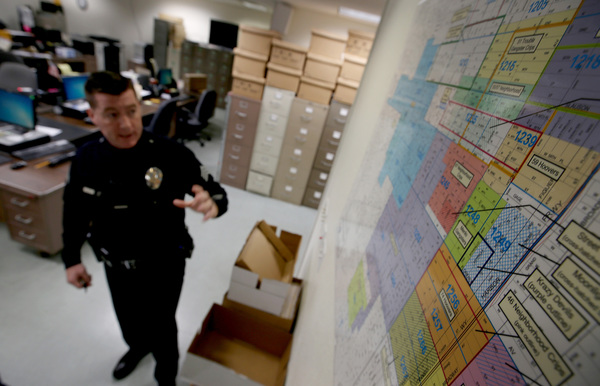
There is no clear pattern to the recent killings. Rather, police and other experts say, such increases are not unusual in an area where the baseline level of violence is high, fueled by gangs, poverty and a readiness to settle arguments with guns.
The Crips-Bloods rivalry, which long has made Harvard Park a dangerous place, has not intensified lately or sparked a tide of retaliatory shootings, according to police. Some killings, like the 90-year-old man who shot his wife on Valentine's Day, had nothing to do with gangs.
The southwest corner of the park, near Smith's house at West 62nd Street and Harvard Boulevard, has been especially deadly. In the last year and a half, four men have been killed there _ while sitting in a car, trying to defuse an argument or walking home from the barber shop or the corner store.
Smith, 40, knew them all. Harvard Park is close-knit. People gather for impromptu barbecues. Her fiance was not a gang member, nor were most of the other recent victims, police and relatives said.
Smith had planned to raise her children in the area, but she recently sent her 17-year-old son to live with his grandmother in Bellflower.
"You can't say that you can get used to it or get over it," she said. "You're still surrounded by all the memories and all the years that you spend with the people."