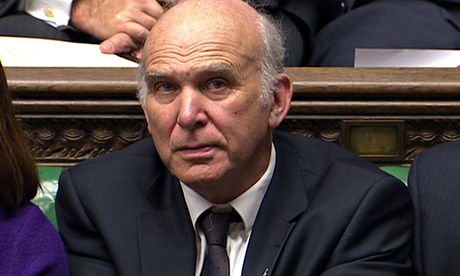
Vince Cable, the business secretary, has asked for a meeting with the Office for Budget Responsibility to discuss arrangements for officials to tell MPs about options for tax, spending and the deficit, before a Commons vote occurs on a new charter of budget responsibility.
George Osborne, the chancellor, has said he wants an updated charter – setting out how quickly the deficit would be erased – put before the Commons next week and voted upon in the new year.
Cable wrote to the OBR a fortnight ago asking it to do more to distinguish between the coalition plans covering 2015-16, and the following period, based on new spending assumptions.
He suggests that it would be possible for the OBR to lay out the different tax and spending plans, for post 2015-16, without getting drawn into party politics (the advisory body has independent status.)
Cable told LBC radio he was partly motivated by a desire to give MPs information in advance of the vote on the charter.
He said: “What I think we are going to have to do now, as we approach this issue about the vote in parliament in a few week’ time, is decide what the balance of tax, spend and welfare is, and to do that we need to have different scenarios.
“It would be very helpful if the OBR, a politically impartial body, were to say what the consequences were of different mixes, different options, and then we have got the evidence to have an informed debate and for the public to understand where the parties are coming from.
“I think the plans that Osborne set out are actually implausible. I don’t think they can be realised ... whatever government comes in, even a Conservative government is going to have to increase taxes, for example.”
David Cameron’s spokesman said the analysis the OBR produced for the autumn statement was based on a Treasury request to consider the impact of a real fall in total managed expenditure in 2016-17 and 2017-18, and then flat total managed expenditure for 2018-19 and 2019-20.
This assumption led to the OBR analysis that public spending as a proportion of GDP would fall to its lowest level for 80 years by 2019-20.
Cable challenged aspects of the figures at a cabinet meeting ahead of the autumn statement, but Nick Clegg said talk of a dispute between Cable and the Liberal Democrat Treasury chief secretary, Danny Alexander, was “nonsense tittle tattle”.
The dispute inside the party appears to be over whether the leadership is doing enough to distinguish itself from the Tories’ economic plans.
Clegg said the Lib Dems “would borrow less than Labour and cut less than the Tories”. But he was unapologetic about the coalition’s economic record and the plans set out in the autumn statement.
The Liberal Democrats’ leader told LBC he was not “sheepish or ashamed of what this government has done and what has happened to the state, far from it”. He added: “I am proud, I own it, we co-author it. It is a Liberal Democrat sort of statement just as much as anything else.”
Clegg said he did not attend the statement reading in the Commons on Wednesday as he had wanted to “get out of the Westminster bubble and meet normal people”.
Osborne showed his irritation saying that [Clegg’s absence from the autumn statement], “frankly, is his business”. He added: “He can choose to be anywhere he wants in the country. In private, they sign up to all these decisions and then in public they slag them off. But that’s for them to explain to you.”
Alexander slapped down Cable saying he was “entitled to write to whomsoever he wishes, but it’s not the job of the OBR to set out political differences between parties”.
The former Liberal Democrat minister Jeremy Browne said the biggest danger for the Lib Dems was “having one foot in government and one foot out”.
In his letter to the OBR Cable stressed that the coalition had firm spending plans for 2015-16, but that all spending thereafter was based on assumptions.
“I am concerned that the distinction between these two periods is insufficiently clear. The distinction is important because spending assumptions are very different to spending decisions: the former are indicative ‘placeholders’ and are contingent on future government decisions about public spending, while the latter are definitive and highly unlikely to change. My observation of the broader public commentary on fiscal policy suggests that this important distinction is not well understood.”