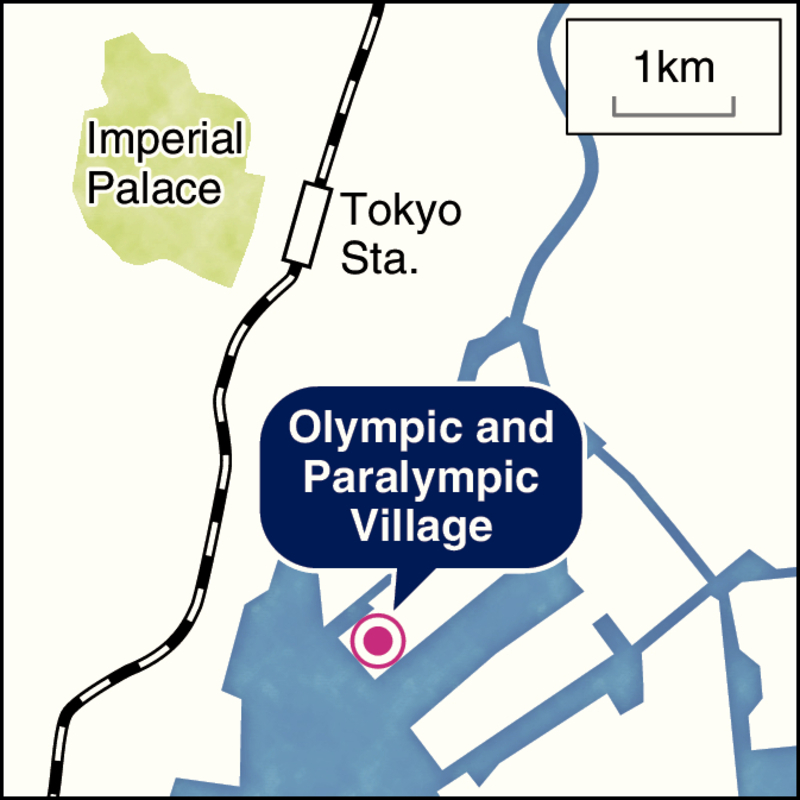
The Olympic Village in Chuo Ward, Tokyo, will accommodate more than 10,000 athletes and staff during the Games, which are scheduled to start on July 23.
Located about 2 kilometers from the busy Ginza shopping district, the village is comprehensively equipped with amenities to make athletes feel comfortable during their stay and to allow them to experience Japan from within the facility.
COVID-19 restrictions mean overseas athletes will not be allowed to go anywhere apart from competition venues, training areas and the village.
The residential blocks comprise 21 buildings that are from 14 to 18 stories tall. The athletes' rooms all contain beds made of recyclable cardboard and blackout drapes so that guests can sleep well even during the daytime, especially those who might be competing in evening events.
Based on a recommendation by the Tokyo Games organizing committee, the rooms will be ventilated every 30 minutes.
There are two cafeterias in the village. A screen at the entrance of the all-hours main dining hall will include information about how crowded the cafeteria is. Tables initially intended for six diners will now seat four. Also, acrylic panels have been installed on the tables and diners will be asked to eat quietly.
The village's other cafeteria offers onigiri rice balls, udon noodles and okonomiyaki pancakes, among other kinds of casual Japanese cuisine.
A bank and cafe are located in Village Plaza, whose buildings were made with 40,000 pieces of Japanese lumber, giving the area a calming aroma.
Athletes can work out at the village's fitness center, which, at 3,000 square meters, is larger than the 1,400 square-meter fitness facility at the London 2012 Games village and the 1,900 square-meter facility at the 2016 Rio Games village.
Also, a sauna is available for athletes who might need to reduce their weight before events, such as boxers and judoka.
Guests can relax on the western side of the village in the about 7,000 square-meter Harumi Port Park, which has a cooling mist area and massage chairs, or go for a jog along the Harumi Greenway, a 900-meter bayside path in the southern part of the Village.
Autonomous buses that can hold up to 20 passengers run every 5 to 20 minutes around the facility. The service, which operates 24 hours a day, has stops at nine locations in the 440,000 square-meter village.
"This is the best accommodation to date," said Tokyo Olympics and Paralympics organizing committee President Seiko Hashimoto, who has competed in seven winter and summer Olympics. "It'll be a relaxing space for athletes."
-- 100 medical staff
About 100 medical workers, including doctors, will be on hand to treat injuries or sickness. The general clinic has orthopedic, internal medicine, dentistry and psychiatry departments, as well as a section for female athletes, a first for an Olympic Village.
Mitigating the risk of novel coronavirus infections is one of the major concerns, as athletes who test positive in will not be able to compete in Games events.
Guests will be tested everyday using saliva sample collected by themselves in their rooms. Random checks will be done to make sure the tests have been taken properly.
PCR tests using swab samples will be conducted on athletes who develop coughs or fever, and those who test positive in the daily saliva tests. This will be conducted at fever clinic, where it will take about three hours to get results. Those who test positive will be moved to a hospital or a nearby recuperation facility.
-- Diverse menus
A variety of dishes will be served at the village to satisfy the appetites of athletes from about 200 countries and regions.
The main dining hall offers about 700 kinds of dishes, including halal, vegetarian and gluten-free meals, and has special booths for pasta and pizza. About 50 kinds of spices and condiments from all over the world are available so that athletes can season the food as they like.
"Meals are one of the ways athletes adjust their condition before games," an organizing committee official said. "One of our priorities was making sure that the dishes on offer were familiar to the athletes."
Read more from The Japan News at https://japannews.yomiuri.co.jp/