December is an important month for human rights and environmental protection movements.
Dec 4 is Thailand's National Environment Day while Dec 10 is Human Rights Day and today marks 75 years since Thailand joined the United Nations.
That makes Thailand a signatory of the 1992 Rio Declaration which enshrines the concept of environmental protection and environmental justice. Principle 10 states that: "Environmental issues are best handled with participation of all concerned citizens, at the relevant level. States shall facilitate and encourage public awareness and participation by making information widely available."
However, the situation on the ground is different from the spirit of Principle 10. Many communities have suffered from pollution due to farming, industrial activities or natural disasters.
At Ecological Alert and Recovery (Earth), a civic group monitoring industrial waste, we have been working with communities suffering from environmental pollution and trying to help them get justice and seek help from the government. Sadly, we have found the state agencies have not done enough to create environmental justice.
One case that lingers in our minds and serves as a case study is that of Phu Yai Sim, the former village headwoman in Moo 8 village of Nong Pla Lai subdistrict, Muang district, Saraburi province.
Her name is Srivarin Boonthap but her friends know her as "Sim" -- a term of endearment used by Thai-Chinese that is comparable to "auntie". The term phu yai refers to her former position as the village chief.
For over two decades, villagers of Nong Pla Lai, as well as the nearby Kud Nok Plao and Huay Haeng sub-districts, have been affected by pollution originating from landfills operated by a waste management company.
Having started operating in 1997, the company has been running large-scale sanitary landfills for industrial waste. Villagers in the three sub-districts have petitioned government agencies about the pollution of surface and groundwater there.
As early as 1998, locals noticed foul-smelling and polluted water in rice fields and local canals. They saw that the contamination was caused by waste brought in by the company.
By 1999, the problem had worsened. One area was so severely affected it was dubbed "Toxic Valley" in some news reports. At the same time, Phu Yai Sim spoke of the impact the pollution was having on local people, bringing the issue briefly into the limelight.
Sensing the pollution was worsening, seeing creeping signs of respiratory illnesses among her community, and realising that all this was spreading to two nearby subdistricts, she began writing petition letters.
Initially, letters of complaint mostly went to officials such as subdistrict chiefs and provincial governors. When they failed to solve the problem, more letters were sent to central authorities including the Pollution Control Department (PCD) and the Department of Industrial Works (DIW).
In this early round of letters, the PCD found that the company's landfills did not comply with the standards outlined by the Ministry of Industry. But the PCD had no authority to order the factory to improve its operations. It recommended the DIW -- the agency responsible for regulating factories -- take action. But the DIW failed to solve the problem.
Another regulatory agency, the Provincial Industry Office (PIO), used article 37 of the 1992 Factory Act to stop the waste-management operation. The factory followed the PIO's orders and then resumed operations. However, villagers still complained about the water pollution.
In 2003, the situation worsened. Heavy rain in September led to a particularly bad episode of foul smelling and polluted water.
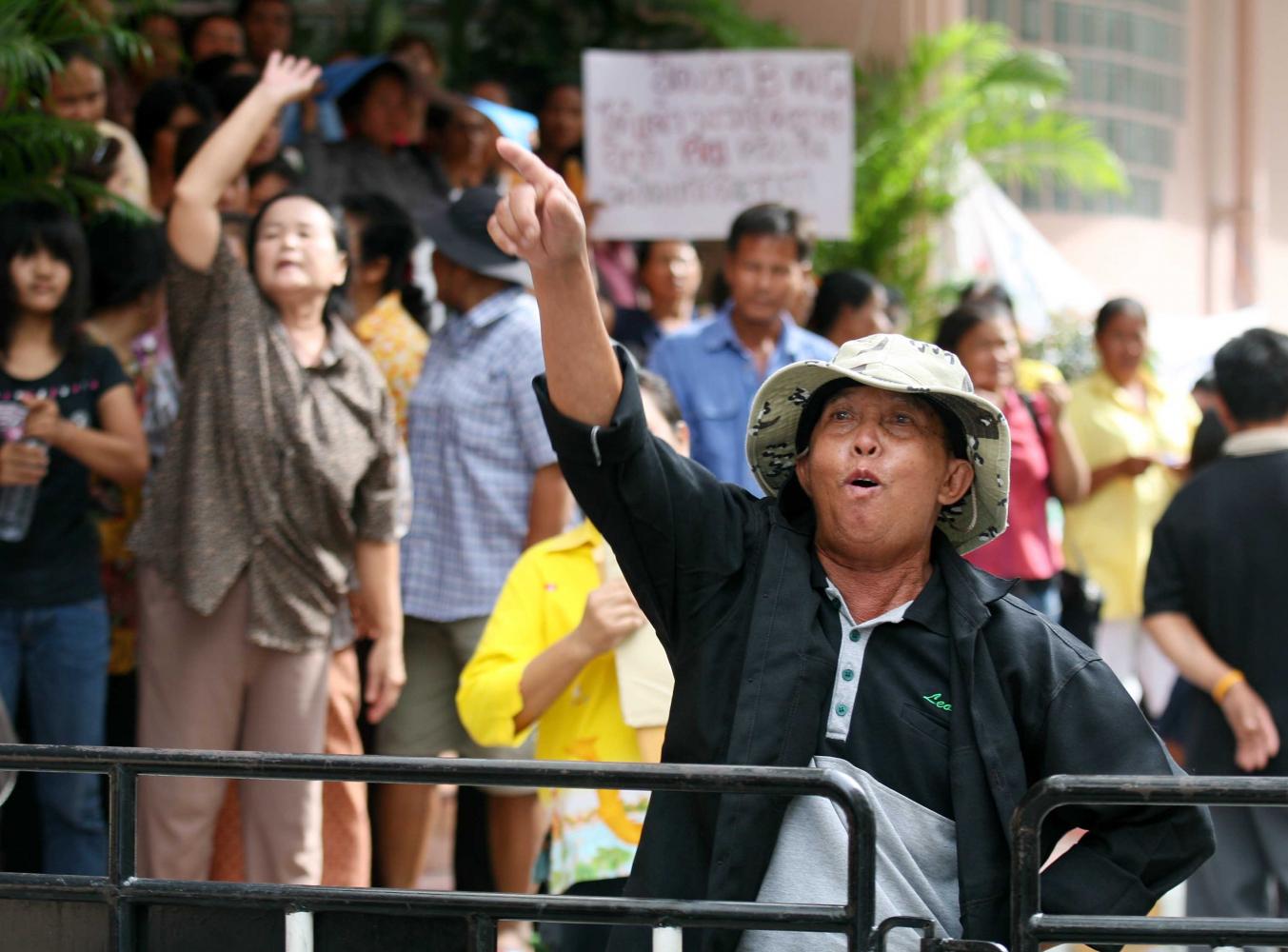
Fed up with the lack of action, citizens from the three subdistricts blocked a road in front of the factory, refusing to allow more waste to enter. Their protest lasted for five months and attracted much media attention.
Later, the waste management company reportedly sued Phu Yai Sim and two others for 395 million baht. The case was eventually dropped.
Then in the mid-2000s, students and teachers from local schools reportedly started developing health problems. Villagers claimed these stemmed from the pollution caused by the landfill.
In 2009, the affected citizens held a demonstration blocking Phaholyothin road, a major highway linking Bangkok to the northeastern region. This led to the temporary closure of the factory's operation. Counter-protests were then launched by employees of the factory whose jobs were deemed at risk.
As both sides refused to back down, more violence ensued. After a series of confrontations, state and government agencies did nothing to resolve the problem, leaving the villagers and factory in a stalemate.
For over a decade, Phu Yai Sim refused to back down. In 2011, she and 124 other citizens sued the company for 2 billion baht -- the first Environmental Civil Lawsuit in Thai history. It has yet to be concluded. Meanwhile, waste management factories and landfills proliferate in Thai society.
In Phetchabun, a community has been sickened by contaminated groundwater from a large landfill. In Rayong, citizens are suing a recycling company for damaging their land.
Penchom Saetang is director of Ecological Alert and Recovery (Earth), a civic group monitoring industrial waste in Thailand. Punyathorn Jeungsmarn is a researcher at Earth.