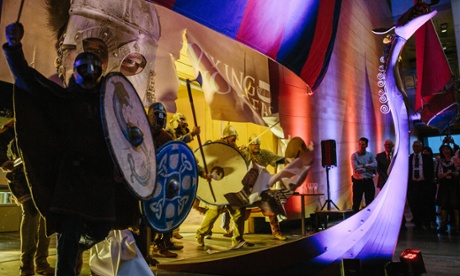
They are generally thought of as fearsome, unkempt, bloodthirsty raiders who caused mayhem wherever they went. But in fact, the Vikings were also skilled traders who loved jewellery, personal grooming – and even had a soft spot for cuddly bears, a major exhibition argues.
Opening at the National Maritime Museum Cornwall on Saturday, Viking Voyagers has brought together artefacts from Denmark, Ireland, the Isle of Man and the British Museum to humanise a people most often associated with death and destruction.
Gareth Williams, co-curator of the exhibition and a leading expert in Viking culture, conceded the warriors were guilty of some pretty reprehensible behaviour (after all, Vikingr is old Norse for pirate or raider).
“The criticism is justified, but their society was so much more than murder and violence. Those are just the headlines. It’s a bit like the English football hooligans in the 1980s. They attracted the headlines and some people began to think all English people were like that. Which obviously is untrue.”
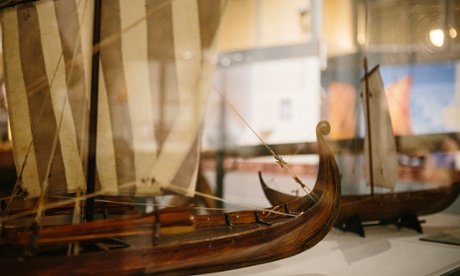
The centrepiece of the exhibition in Falmouth is not a dragon-headed Viking battleship but an altogether gentler looking replica of a trading ship – named Walrus – that would have plied coastal waters in the 11th century. It could carry up to five tons of cargo and sailed with a small crew of between five and eight men, sustained by buttery porridge bulked out with dried meat or fish. Broad and shallow, almost barge-like, it could easily be dragged up on to beaches.
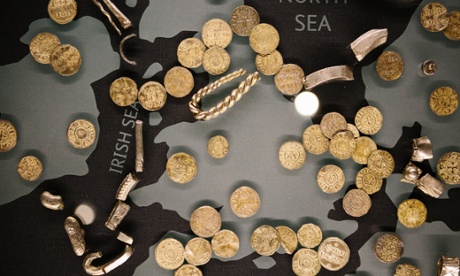
One of the display cases shows a collection of items found on the shoreline of the Isle of Man, indicating that a Viking beach market was held there. Travelling craftspeople would have traded in bronze objects such as cloak and scarf pins. Also found there were coins from the Islamic caliphate that ruled most of north Africa and the Middle East, a reminder of how widely the Vikings travelled.
The exhibition points out that Viking women would also have traded at a beach market like this – a reminder that their society was in many ways more equal than the Christian-dominated societies that followed.
Evidence of women’s presence was also found in a 76-acre Viking camp found in north Yorkshire dating back to the 9th century and represented in another display case. Williams is particularly excited about this exhibit as he believes it provides a missing link between temporary warrior war camps and the much larger, more permanent settlements that led to the creation of towns and cities, such as York.
This was a military camp – remains of weapons were found – but the discovery of weights and coins shows that trading was also taking place. “It suggests migration rather than simply an army resting here over winter,” he said.
And as for grooming? A rather large and severe looking bone comb with iron rivets found in York and dating to the 9th or 10th centuries shows that the Vikings did try to look after their hair.
“Despite the popular image of Vikings as wild and shaggy looking, bone and antler combs are very common finds,” said Williams. “We even know the name of one combmaker. A comb from Lincoln carries the inscription: ‘Thorfastr makes a good comb.” Toiletry sets for women and ear scoops to dig wax out have also been discovered.
But one of Williams’s favourite items on display (along with his own Viking toy from when he was three) is a bright brooch adorned, not with dragons or serpents, but bears’ heads. Cuddly teddy bears are generally thought of as a 20th-century invention. “But those look like teddy bears to me,” said Williams. “They are cute and cuddly.”
A final fascinating hypothesis suggested in the exhibition is that the Vikings might have settled in Cornwall. Viking camps and settlements have been found in Devon, Gloucestershire, Ireland and northern France.
It is also accepted that Viking raids and battles were fought in Cornwall and trading took place here. Viking coins have been found in Hayle on the north coast and a Norse buckle at Sennen, close to Land’s End.
Tehmina Goskar, the exhibitions registrar at the National Maritime Museum Cornwall, said the far west would have been an important point on a sailing route from Scandinavia to Brittany. “We haven’t proved yet that they settled here but they raided and traded here,” she said. “There are tantalising bits of evidence that begin to suggest they may have settled, too – why wouldn’t they? It’s a lovely place to be.”
• Viking Voyagers runs from 20 March 2015 to 22 February 2017.