
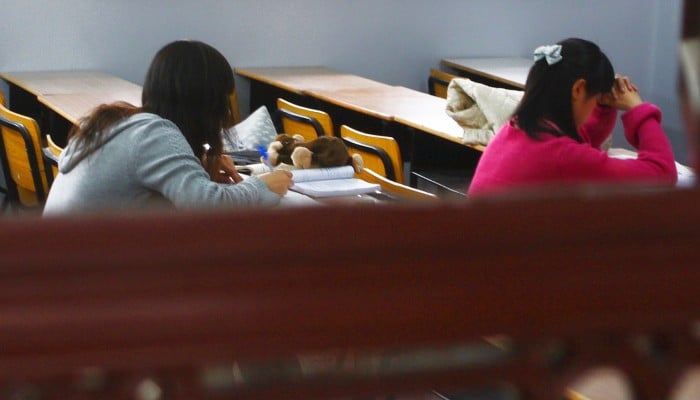
Nguyen Quy Duc, 17, speaks English with a near native accent. Like many Vietnamese teenagers, he wants to go abroad, hopefully to the United States, to study information technology. He takes A-level courses in English at his state high school in Hanoi, the first in Vietnam to offer British-designed advanced courses certified by Cambridge University.
“We get a chance to learn subjects in English which is very helpful for the future,” he said.
Vietnam is now in the final year of a 12-year, US$446 million initiative to ensure all students become proficient in a foreign language, namely English, to effectively integrate the nation into the global economy. While most indicators suggest the programme – known as Project 2020 – has fallen short, many Vietnamese students have nonetheless embraced the expanded opportunities to learn the language.
Vietnam is a young country – almost 40 per cent of its population of over 90 million is under the age of 40 – and around 23.5 million Vietnamese are enrolled in some sort of educational institute. These include the 1.5 million attending one of the country’s 235 tertiary education institutes, with 87 per cent attending public schools and the rest in private ones, according to government statistics.
Nguyen Phu Hoang Lan, a maths teacher at Chu Van An who teaches in English, said the language proficiency at his school was high.
“They have many chances to study English, from television, to music, from teachers, to the [A-level] programme … and most of them are really good,” he said.
But the situation at Chu Van An is not the norm. Project 2020 – originally launched in 2008 – has proven to be a “flop”, in the words of Communist Party-owned newspaper Tuoi Tre, with insufficient class time devoted to English and unqualified teachers in charge of classrooms. The state-run Vietnam News Agency also chimed in, admitting the project had “failed to fulfil targets”.
Retired parliamentarian Nguyen Minh Thuyet, former vice-chairman of the National Assembly’s culture and education committee, said the programme had asked for too much from too little.
“I know that this Project 2020 has been applied and has created some initial movements but its goals were too ambitious while our infrastructure and facilities were limited, not qualified for the demand,” he said, adding that the government had decided to go back to the drawing board.
More than 90 per cent of students studying foreign languages in Vietnam are learning English, said Thuyet, with Japanese and Korean popular in some circles. Students studying Mandarin, he said, were mostly limited to provinces near the Chinese border.
James Lumley, a veteran English teacher from the US who formerly taught in Hanoi and Shanghai, explained that most schools in the capital used English teachers from for-profit companies embedded in the schools. For a premium, usually a few hundred dollars a month, students can study English with a foreign teacher employed by a contracted firm.
“Those companies have exploded to the point now where I would say most schools in Hanoi employ outside teachers,” said Lumley, who used to teach at Chu Van An.
These teachers, mostly in their 20s and 30s, come from Western, anglophone countries. Pay ranges from US$15 to US$35 an hour, while the school can be billed up to US$100 by the company.
Nguyen Dieu Thuy, headmistress of Sai Dong junior school, said she saw a substantial improvement in her students after they began using foreign teachers for two hours of instruction per week, on top of the five they were already receiving from local teachers.
“I can see our students’ ability to speak English has been much better compared with three years ago,” she said, adding that the Ministry of Education vets the centres for quality issues.
Dinh Hoang Thang, director of the Centre for Information and International Cooperation at the Vietnam Institute for Development Studies, an NGO, said there was a problem finding qualified local teachers as Vietnamese people who excelled in English usually preferred more prestigious, higher-paying jobs.
“People who are good at English are busy in other fields of work, so they do not have time to teach English,” he said.
While Project 2020 has fallen short of its target of having all the country’s students speak a foreign language proficiently, Vietnam’s English-language proficiency is nonetheless relatively high. In 2018, the EF English Proficiency Index placed Vietnam at 41st place globally, ahead of Thailand and Indonesia.
Vietnam’s education system shines in other areas, too. Jayant Menon, a lead economist at the Asian Development Bank in Manila, said he was encouraged by Vietnam’s high PISA scores, an international study that measures comparative abilities in maths, science and reading. In 2015, Vietnam’s average score was tied with Australia and came in slightly better than Britain.
But with the advent of the digital revolution, Menon said the challenge for students in Vietnam was to adapt to yet-to-be invented technology, as well as the ideas of the future to drive economic growth.
“Students need to be able to learn how to learn,” he said.