Venezuelan opposition leader María Corina Machado arrived in Madrid looking for a political image that could travel far beyond Spain and sent a clear message to Washington: one of a movement still alive, a diaspora still mobilized, and a democratic project that could speak directly to the Trump administration as Venezuela remains stuck in a strange transition under interim Chavista president Delcy Rodríguez.
Instead, one ugly chant from the stage pushed the conversation from unity to racism, from momentum to fracture, and from Machado's future to the kind of country her critics fear she could one day govern.
A day later, Machado gave an interview to the Spanish news agency EFE. "I will never utter a word or expression that judges or disqualifies a person because of their religion, their gender, or their race," she said. "That is exactly what the regime in Venezuela has done, divide us along those lines."
-
María Corina Machado in Madrid: 'Malignant Forces' Want the World to Doubt Venezuela is Ready for Free Elections

-
Colombia's Petro Proposes a Temporary 'Co-Governance' Between Chavistas and Opposition Forces in Venezuela

-
Machado's Comeback to Venezuela 'Not Dependent on Washington,' Opposition Says Amid Transition Push


"We are proposing a process of healing and reconciliation that is based on respect for each person's dignity and their right to live freely according to their ideas," Machado added. "Of course, we reject any kind of disqualification of this nature."
ÚLTIMA HORA | María Corina Machado expresa su rechazo a los cánticos racistas coreados por sus seguidores en Madrid https://t.co/mneJI37sWZ pic.twitter.com/YrQqDlgw0D
— AlbertoRodNews (@AlbertoRodNews) April 19, 2026
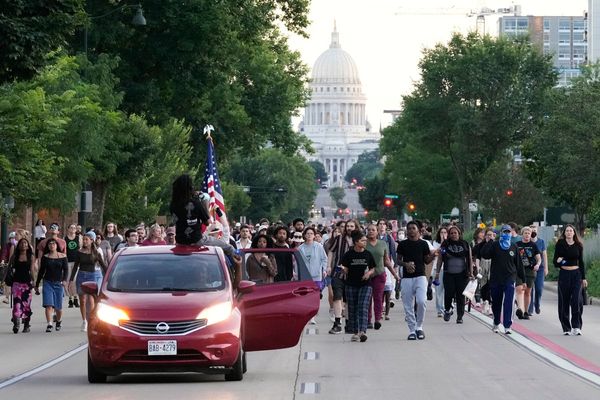
The episode happened during an event organized by Machado's team and the Madrid authorities. Before she appeared before the thousands of Venezuelans who had attended her call at Madrid's La Puerta del Sol, various people kept them entertained.
Among them was Venezuelan singer-songwriter Carlos Baute, who encouraged chants of "mona, mona" (monkey, monkey) and "fuera la mona" (out with the monkey) before Machado appeared. The target was broadly understood to be the interim president of Venezuela, Delcy Rodríguez, who has Trump's support.
🇪🇸 | Venezolanos concentrados en Madrid junto al cantante Carlos Baute gritaron «fuera la mona» durante el encuentro con María Corina Machado este sábado. El mensaje hacía referencia a Delcy Rodríguez, quien desde enero pasado asumió la presidencia encargada tras la detención de… pic.twitter.com/VRiuFj6mqo
— El Cooperante (@El_Cooperante) April 18, 2026
Machado's message in Madrid had been carefully aimed.
She cast the event as a turning point for exile politics and for the opposition's long wait to return home. "Hoy empieza nuestro retorno," or "Today our return begins," she told her compatriots exiled in Spain.
"It's everybody's job to make sure that we go forward without delay with free and clean elections." She also promised that the current phase of the struggle would end with a national reunion, saying millions of Venezuelans would return. "The return home starts today. Viva Venezuela libre."
Her most striking line was aimed at what she described as the interests feeding Venezuela's long crisis. "We have seen malignant forces from all over the world that took over our resources," Machado said, before accusing those forces of dismantling institutions and driving the country into misery. She told the crowd that a nation with the world's largest oil reserves now has 86% of its population in poverty, a figure she used to underscore the contrast between Venezuela's wealth and its collapse.
The rally was not just for exiles waving flags in Madrid. It was also a political signal to the White House. Since the U.S. captured Nicolás Maduro in January, Trump and his officials have made clear that their Venezuela policy is not centered on immediately handing power to Machado.
Manifestação para a líder da oposição na Venezuela, Maria Corina Machado AGORA, na Puerta del Sol, Madri, após receber a Medalha de Ouro de Madri na Real Casa de Correos: https://t.co/Ljm907crEa
— Vera Martins (@veramartins) April 18, 2026
Trump said in January, according to Reuters, "We're going to run the country until such time as we can do a safe, proper, and judicious transition," adding that Washington could not risk "that someone else takes over Venezuela." In practice, that has meant working with Delcy Rodríguez, lifting sanctions on her, reopening diplomatic channels, and engaging her government on oil, mining, and foreign assets.
That U.S. approach appears rooted in collapse management, as Washington formally recognized Rodríguez in March, opened the door for her government to regain control of overseas assets, and later removed sanctions against her while U.S. officials traveled to Caracas to negotiate energy and economic stabilization. U.S. intelligence has shown uncertainty about whether Rodríguez was fully aligned with Washington, which underlines the administration's real calculation: better a managed, transactional interim authority than a power vacuum in a country with oil wealth, mass migration pressure, and deep institutional decay.
That is why Machado needed Madrid to project discipline and national breadth.
Venezuela is not a small, racially homogeneous country, nor one easily reduced to elite exile aesthetics. The country's 2011 census found that 51.6% of Venezuelans identified as "moreno" and 43.6% as white, with smaller percentages identifying as Black, Afro-descendant, or Indigenous. The broad point is clear, even if the categories are imperfect: Venezuela is profoundly mixed, and political language that seems rooted in colorism lands hard.
That is why Baute's led chants ignited a fierce debate. Many people, including some anti-Chávez voices, heard the slogan as proof that a movement claiming to represent all Venezuelans can still slip into dehumanizing language when confronting an opponent.
Before Machado's comments to EFE, the Rodríguez-led government published a statement about the situation from its embassy in Spain.
The diplomatic mission has especially censured that these expressions were directed against a woman, understanding that they constitute "a form of political violence based on misogyny and racism." The diplomatic text adds that calling a woman "monkey" constitutes "an act of dehumanization incompatible with the principles of international human rights law."
According to the statement, Venezuela "categorically denounces these events" and emphasizes that its women, "as historical and political figures, cannot and will not be the object of hate speech, wherever it comes from."
Will the situation hurt Machado's efforts to convince the Trump administration that Venezuela is ready to organize a new democratic election? It may be too soon to tell, but independent analysts coincide that "a democratic leader trying to persuade Washington, Europe, and millions of skeptical Venezuelans that she represents national reconciliation cannot afford a public spectacle that reinforces the oldest critique of anti-Chavismo, that it speaks the language of liberty while too often sounding socially exclusive, racially coded, and contemptuous of the very country it says it wants to rebuild."
Her words condemning the racist chant were a good step towards it. In the end, Machado's Madrid rally still delivered one message to Washington: she retains a passionate base, particularly among exiles in Spain, where roughly 600,000 Venezuelans now live. But Baute's chant delivered a second message, one she probably did not want sent.
"If the opposition cannot keep a pro-democracy rally from curdling into a racialized insult, it risks confirming the suspicion that removing chavismo is not the same thing as building a broadly shared democratic future. For a leader trying to show she can unite Venezuela, that is much more than a minor distraction," the analysts added. It is actually the test she needs to ace for the nationals and the rest of the world.
© 2025 Latin Times. All rights reserved. Do not reproduce without permission.