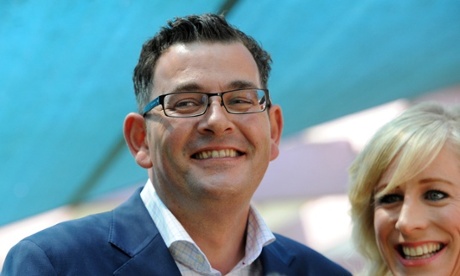
It may be a relief, but it is also a sign of how little real interest there is in state politics, that just a single opinion poll has been held into how Victorians are viewing their new state government, which showed they were viewing it rather well. A little more than 100 days into the Daniel Andrews administration, it’s best to look at its record and that’s no bad thing.
Labor’s win in November was remarkable, the first time in 60 years that a Victorian government had been defeated after a single term.
There were supposed lessons about the volatility of a mistrustful electorate, and assessments about whether Tony Abbott’s unpopularity was a factor, but the Victorian upheaval was soon overshadowed by Queensland’s revolt in January and the focus has shifted to New South Wales, where a serious swing is expected against Mike Baird’s government on 28 March.
As Abbott has learned, winning elections is one thing; governing is another. One hundred days is an artificial measure but it does mark a start. Nothing has gone horrendously badly for Andrews, there have been no ministerial embarrassments and no unforseen crises.
Late last month the government put out a PR brochure called Getting on With It, and it is blissfully too early for anyone to prove otherwise.
So far, this has been a cautious, progressive Labor government for a cautious, progressive state led by someone the Age’s political editor Josh Gordon called “serious, well-intentioned, intelligent and energetic.”
Andrews, who seemed so dorky for so long, seems to be growing into the job.
The government has a thoughtful progressive agenda, and is determined to be economically responsible at a time when unemployment at 6.6% is above the national average and the state’s manufacturing base is collapsing. The intriguing question will be how ambitious the government proves to be, and for that it is too early to say.
So far, its one display of national boldness was in establishing a royal commission into family violence, a key election promise. It is led by the impeccably credentialed Marcia Neave, a former supreme court judge and head of the state’s law reform commission. Although it was not obvious that a royal commission was necessary – the $40m earmarked could have been spent on front-line services and the previous Coalition government was hardly neglecting the area – but with this crisis now out of the shadows, it is likely to be eye-opening.
What is heartening is that is it policy-focused, charged with reporting on “practical recommendations to stop family violence”. It will look into early intervention, support for victims, perpetrator accountability and systemic responses in the legal, policy, child protection and support areas. This is not so much a cathartic royal commission, such as the national one into institutional responses to child sexual abuse, but a short sharp investigation designed to bring about change.
Last month, Andrews became the first premier to join the gay pride march in St Kilda and he has vowed to allow gay couples to adopt. He has a modest social policy reform agenda, and has scrapped the previous government’s “move-on” laws that had the potential to shut down legitimate protest. He has a touch of the populist about him, declaring two new public holidays, including Grand Final eve if you please, a decision business groups say is “absolutely insane”.
What will be worth watching is how Andrews handles the big issues that are the same ones that confronted the previous government – rampant population growth and the divisions it has created between facility-rich city dwellers and the neglected outer areas, with their long commutes and lack of services. Somehow, his government has to come up with practical steps to improve the economy and create jobs while not suggesting it is a problem state governments can solve.
Relevant to all that is the big headache: the continuing East West Link saga. The $6.8bn toll road was the most contentious issue of the election, with Andrews vowing to scrap the project, insisting that the contracts were “not worth the paper they’re written on”.
That is proving tough, and negotiations with the winning consortium are continuing to try to limit the damage to taxpayers – the latest suggestion is that it may cost around $700m to get out of the contracts. Local newspaper the Herald Sun continues to encourage Andrews to break his election promise and build the thing, but at this point that would be politically – and ethically – impossible.
The government says it is shifting the focus from giant road projects to public transport – a shift transport experts say is essential for a city expected to be home to close to eight million people by mid-century.
But the problem with its alternative Melbourne Metro rail project, a rail tunnel through the CBD with five new stations, is that the $9bn to $11bn needed isn’t there.
The Abbott government says it won’t offer the $3bn it pledged for the East West Link because it won’t fund rail projects. Andrews may boast that the Metro will give Melbourne a transport system “equal to those in cities such as New York, London, Paris and Hong Kong”, but just $300m has been earmarked for planning. It’s years away at a time when Melbourne needs an infrastructure boost now.
New planning minister Richard Wynne has been saying what many Melburnians grumble about – that the proliferation of skyscrapers is out of control and that the quality of high-rise apartments is often poor. Some parts of the city, he said, were becoming “hostile at street level”. But he will not scrap the previous government’s Plan Melbourne scheme to deal with rapid population growth, and he won’t yet say how he will handle the greater density that will be needed, however controversial it may be.
Plan Melbourne was criticised for barely mentioning the environment and climate change. The issue barely rated as an election issue, and the government has so far said little about whether it will be a leader on climate change while the national government stalls.
It is winding back the previous government’s restrictions on wind farms – considered the toughest in the country – and preparing a “renewable energy action plan” and a $20m scheme for “new energy jobs”. The Greens – newly confident with seven MPs – are pushing for the ageing Hazelwood, Australia’s dirtiest power station, to close. On that, the government is moot. It is continuing the moratorium on coal seam gas projects for 12 months while a parliamentary inquiry is held, no doubt watching the raging controversies in NSW.
So far, it’s been a smooth start. Renegade independent Geoff Shaw is thankfully gone, and stalwarts of Victorian politics, former premier Denis Napthine and deputy premier Peter Ryan, have disappeared too, although Napthine remains in parliament. It’s a new era.
The pity is that it will get so little scrutiny. The loss of the local 7.30 program on the ABC last year has left a hole that has not been filled. Despite promises that television current affairs would be somehow boosted with the changes, there have been no local segments that have analysed state politics in detail since the new government took office. No doubt that will be relief to the new government, but it’s another little blow for democracy, too.
- This article was amended on 11 March. The original said there had not been a single opinion poll into how Victorians were viewing their new state government. This has been corrected.