That’s all from us tonight. Thanks for joining us and a big thanks to our analysts, too - Sophie Mirabella, Sean Kelly and Paul Strangio.
Melissa Davey from Frankston reports:
Andrews has “officially” won the debate - by one vote. The 100 swinging voters were asked as the end who they now supported. The result was 39 to Andrews versus Napthine’s 38, with 23 still undecided.
Speaking to people as they left the debate, none said they were totally convinced by either leader, and that they still may change their mind by election day on NOvember 29.
There was also a feeling from many audience members I spoke to that they expected more from the answers. A few people said they felt Andrews in particular kept going back to pushing his own policy platforms rather than answering questions properly.
Several people described the debate as “uninspiring”.
Our experts' verdict: who won?
Sean Kelly:
No election debate takes place in a vacuum. It’s never as simple as “who was better in there”, or even “who won over the live audience”. Usually the two candidates have different tasks going into the debate.
Daniel Andrews’ job was to look like a Premier. He ticked that box – looked calm and confident, didn’t get rattled, answered strongly, and stuck to his guns even when it was clear the crowd was against him on particular issues.
Denis Napthine had a higher bar. He did fine, didn’t put a foot wrong, but he’s so far behind in the polls he needed to hit this debate for six. He did well – but not well enough.
Daniel Andrews had the better night – he looked like he belonged there, whereas Napthine looked a bit uncomfortable at times - tonight will strengthen Andrews’ claim to the job.
Sophie Mirabella:
Andrews was furiously sympathetic in equal spades to every question, slick on rhetoric but light on hard content. Didn’t want to raise negativity because he didn’t want his past record in Government to condemn him - but all too happy to raise Abbott’s name three times completely out of context.
Napthine was on top on the facts, generally succinct and direct with answers. More of a doer than a talker he could’ve spent more time talking up the Government’s achievements including the budget surplus.
Came across as the stern grown up in the room. Good question to end on - ‘Who do you trust?’ Someone on top of their brief or someone who projected as an enthusiastic amateur ?
On substance, track record and believability - debate goes to Napthine.
Paul Strangio:
The introduction of leaders being grilled by ‘People’s Forums’ (a reinvention of old style Town Hall meetings) such as this one represent a variation on the more established form of debates in which journalists asked the questions.
A number of the questions in this forum - duck hunting, base line sentencing, support for veterans, legalisation of cannabis - largely elicited furious consensus between Denis Napthine and Daniel Andrews.
Predictably, their most animated disagreements were on the East West Tunnel, TAFE funding and that old campaign chestnut of transparency of funding costings. Napthine probably had the better of the former issue, Andrews on TAFE and it was a nil-all draw on costings.
Both acquitted themselves competently enough. Napthine was his verbally indefatigable self, whereas Andrews grew more confident and expansive as the forum progressed.
Will the debate change anything much? Perhaps the minds of some in the forum audience, but in the electorate as a whole that’s doubtful—all the more so since it was broadcast on pay television and is likely to have been watched by only a tiny audience.
And Melissa Davey asked swinging voter Trevor Hand, from the seat of Benleigh:
I think it was very interesting but in the end Napthine won I feel by a close margin but I was changing my mind in that during the whole debate.
I think Napthine won because although while neither candidate answered questions properly, Napthine answered better. Andrews kept going back to his pet issue of removing level crossings, which I agree with.
People are always getting hit by trains in our electorate so it’s important but he focused on it too much. It’s hard to say who I’ll vote for. I’m 52% liberal at the moment and 48% Labor.”
Will Crawford and Ben Stonier described the debate as uninspiring. It did little to help them decide who to vote for.
Linda Clarence Somerville:
I was disappointed I didn’t get to ask them why the Alzheimer’s extra payment was cancelled for carers. But to me Andrews just seemed to be on a soap box and not interested in questions.
Thanks to everyone who participated in #pplsforum tonight. It's always great to talk about @VictorianLabor's plan to put people first.
— Daniel Andrews (@DanielAndrewsMP) November 19, 2014
Closing statements
Ok, time is at an end so David Speers invites the two leaders to wrap things up.
Andrews is first to speak and makes out he’s above all this political bickering, talking about a “positive plan” for Victoria, not all the same old negative stuff. He’s straight into the negatives though, saying ambulance workers (who have daubed anti-Coalition messages on their vehicles for a number of years now) have been treated “appallingly” over their protracted pay negotiations with the government.
He says he’ll get rid of 50 level crossings, improve childhood education and “repair” the Tafe system. “I’m humbled by this process,” says Andrews, no doubt attempting to appear the calm, measured premier-in-waiting. “If honoured by this responsibility, I’ll work hard every day to put people first.”
Napthine is more workmanlike, rattling off a list of Coalition achievements, such as the budget surplus and the AAA credit rating. He says the govenrment has a plan to create 200,000 new jobs and then pivots to attack Labor, claiming they can’t be trusted.
“This election is about trust,” he says, lamenting the much-derided Myki smartcard travel system. Even Andrews admits Myki is a dud, which won’t be news to anyone who has the misfortune of using the blasted thing every day.
The premier finishes up and both men slowly ease into the audience, glad handing the punters. Speers takes a sip of water, happy with his night’s work. But did we learn much more about what Victoria could be in store for post November 29?
Updated
And Sean Kelly:
Anyone who thinks Tony Abbott isn’t a negative for the Victorian Liberals only needs to look at the several attempts by Andrews to wedge him into this debate. He’s doing it for a reason.
A couple of comments from Sophie Mirabella:
“Yes” from Napthine on no new taxes. Direct language always a winner and easier to hold pollies accountable.
“No intention to introduce new taxes” - that sounds like a qualified statement from Daniel.
Sharp question from Gary from Bentleigh, which is a marginal seat. He wanted to know when the parties would cost their promises and would they increase taxes or levies to pay for them?
Andrews said Labor’s costings would be “released in the usual way, late next week” once further announcements were made. There was a slight groan from the audience at this stage. Andrews mentioned Tony Abbott (a plus for Labor, according to them) and make promises and then not keep them. He would “absolutely not” increase taxes.
Napthine pointed out that tens of thousands of Victorians have already voted in pre-polling and would not see the costings, that Labor has had done by an accounting firm.
Host David Speers tried to get the parties to agree that the state needed an independent officce to cost promises, and a little stoush followed.
Ok, so we are nearly an hour in. What do people think so far? (If you are able to watch it, of course).
Well, yes
That only scheduled debate of #vicvotes can be seen by only a tiny proportion of the population is ludicrous. Though arguably fitting.
— Adam Morton (@adamlmorton) November 19, 2014
Sean Kelly again:
Three-quarters through and both leaders are doing fairly well, but there’s a calm confidence to Andrews that Napthine just doesn’t have tonight. There’s a mild discomfort in the Premier’s performance which the camera magnifies.
Entertaining exchange from a retiree and the Premier on when, exactly, will he be able to take this train to the airport? This is a tricky problem - both parties have promised big on transport, but the projects are years, sometimes decades, away, and the government already has ads out saying a train will go every 10 minutes.
Napthine replied that the government had provided $800m for it the Melbourne rail link.
“But when will I catch it?” said the man. “But when?”
“I can guarantee you you’ll be able to catch a train to the airport (under a coalition government), you will never be able to catch a train under the Labor government.”
“In my lifetime?”
“You’ll get it in your lifetime, sir,” said Napthine.
Napthine and Andrews asked about legalising cannabis. Yes for medical use, they both say, but softly softly on the timing. Needs medical testing and clearance. Andrews cites an ill baby as to why he’s in favour.
.@DanielAndrewsMP:medical cannabis, I will drag this law into the 21st century #pplsforum LIVE http://t.co/9CKLNtU8Pv pic.twitter.com/YHeUI5QnD8
— A-PAC (@APAC_ch648) November 19, 2014
Unless you have Foxtel, you’ll have to watch the debate via the Herald Sun. Streaming, streaming...
Watching Napthine v Andrews LIVE waiting for train via @theheraldsun - how's stream for u? #pplsforum #springst pic.twitter.com/HBivNUOPBX
— Nathaniel Bane (@natbane) November 19, 2014
We’re onto Tafe. Labor has made a big fuss over what they say has been $300m in cuts to the college system.
Andrews says “enormous damage” has been done to the Tafe system, which has helped fuel youth unemployment, which is rather high in Victoria.
He says Labor will reinvest in Tafe because “not every person chooses to go to university and they should be supported in that choice.”
Napthine says the system is now better performing because Tafe was doing far worse than private education providers. Andrews comes back with a strong finish, claiming that “Tafe is on its knees” and, appealing to the crowd “I will put it right with your support.”
Sean Kelly on Tafe:
It is the single most important issue for Labor. You’d expect Andrews to do well here - and he did. He looked both sincere and determined. This is the issue he wants every voter thinking about when they fill in their ballots.
Melissa Davey reports about what’s happening outside:
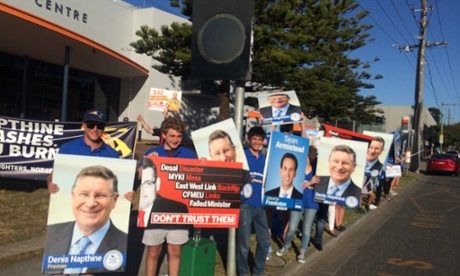
About 40 people from various interest groups - the fire service, environment Victoria, and the Liberal and Labor party are holding placards up outside the centre.
They’re probably distracting the traffic - but they’re all passionately trying to make their views known and getting a few honks. One of the a Liberal party supporters is Damion Otto.
“Frankston is an important electorate for me personally infrastructure is important around here. I’m campaigning for Sean Armisted as in the past Geoff Shaw’s shenanigans meant the seat was a bit neglected, and it was very neglected under Labor. We need to get the Liberal message out here.”
Leaders get a question on whether the ‘tough on crime’ mantra, that has seen sentences and parole toughened up, is wise, given that the evidence seems to say otherwise.
Neither is going for it, keen to be as hairy chested as possible on law and order. Andrews says “some people behave badly and forfeit the right to be part of the Victorian community” and then makes a very awkward segue to the cutting of Tafe funding.
Napthine says “I’m proud to lead a government that’s tough on crime.” He then says he’ll bring in ‘coward’s punch’ law that will see convicted people sent to prison for 10 years if they hit and kill someone with one blow.
There’s perhaps 5mm of space between the two leaders on law and order. Any weakness on the issue is clearly seen as electorally disastrous.
Sophie Mirabella not impressed with Andrews:
Very interesting early inoculation from Andrews against the negativity he knows is coming at him.
Napthine sounds like he believes in his sentencing and community safety policy. Daniel skirted the issue and started talking TAFE cuts!
Updated
Tense discussion about one of the most controversial issues in this election, the cross-city East West Link. The government has signed the contract for the first stage for $6.8b, and Labor has said it will not go ahead, even though it used to say it would abide by signed contracts.
Andrews is quoting from an Age report in recent days that quoted transport experts saying the real cost would be $17.8b - (a little rubbery, perhaps, because that figure doesn’t include the money raised by tolls). Napthine tries to make this point. “That figure is absolutely wrong.”
Andrews asks the audience do they want to know the real cost?
“NO,” comes a few voices. “don’t believe you’.
Numbers, numbers.
And Sean Kelly: Daniel Andrews is very keen tonight to stress that he’ll be avoiding negativity, that he doesn’t want to talk about the past, but about the future.
This could mean that Labor is a little concerned about Napthine’s attack strategy (on union militancy, on Andrews’ record in government), and is trying to inoculate against it, or it could mean they sniff a real weakness on the Liberals’ part - that voters are reacting badly to the fact that Napthine’s campaign so far is heavily negative, without enough “positive plans”. It’s likely to be a combination of both.
Sophie Mirabella (of Andrews) : Not answering the question and dodging the question of the port
John, a carer, asks Napthine why, as a vet by training, he supports duck shooting. Napthine says because it’s well regulated and that it doesn’t harm duck populations.
Andrews says “I’m sorry I’m going to disappoint you” to John, giving him a sad smile. The Labor leader says he sees duck hunting as a legitimate sport.
We’re now onto the East West Link, the vexed road that will go through the northern suburbs of Melbourne unless Labor gets in and rips up the construction contracts.
Responding to a questioner, Andrews says it’s about priorities, that the road is “rushed” and the priority is removing level crossings. Napthine says we need both the East West Link and public transport. They then bicker over level crossings.
And from Sean Kelly: One of the interesting things about these audience-led forums is that the questions can be quite unpredictable.
The forums can provide direct access to politicians, which is rare, and valuable for that reason – but they’re often not an accurate picture of what’s going on in the electorate, and the questions are not necessarily representative of the issues most voters are actually interested in.
Sophie Mirabella with her first response Re question from Roger (small business) - Westgate Bridge already carrying 200,000 plus vehicles a day and is seriously stressed - so Westgate not a solution if Baywest Port goes ahead.
Updated
A little history for you.
Debates are fine in theory, and we at Guardian Australia love the contest of ideas and all that, but the record of Victorian election debates is, well, mixed.
In 2010, Premier John Brumby met Liberal Ted Baillieu for an ABC TV debate before a panel of journalists. The Australian Politics site called it “lacklustre event, enlivened by a scrap over Greens preferences”. Surely not.
There was also a “People’s Forum”, similar to the one tonight. Baillieu started by removing his jacket and wandering about the crowd. It was all about violent crime, stamp duty, and Labor’s record after 11 years in office..
In 2006, it was Steve Bracks and Baillieu, described as a “bore draw” and “as exciting as dancing with your sister”. Baillieu was keen to debate “anytime, anywhere”. Bracks declined and won the election.
In 2002, Bracks debated Liberal leader Robert Doyle (now the popular lord mayor of Melbourne). This one sounds interesting, with Doyle saying he enjoyed it “in a perverse way”.
Both promised there’d be no new toll roads in Melbourne (those were the days), Doyle said he would consider banning government-funded advertising (LoL) and Bracks reneged on a promise to establish supervised injecting rooms for heroin addicts. The focus was on issues that linger, but only just – the state’s reliance on revenues from problem gamblers, and speed cameras.
Before then, you have to go back 10 years to 1992 for a TV election debate, between Labor Premier Joan Kirner and Liberal contender Jeff Kennett. Kennett won the election and banned debates.
He didn’t feel that way in 1988, when he said to Premier John Cain:
Get out of your bunker and come and debate me at a time and place of your choosing.
Welcome to our live blog of the one and only Victorian election TV debate. Oliver Milman and I will anchor the blog and Melissa Davey is at the Frankston Arts Centre where Premier Denis Napthine and Labor leader Daniel Andrews will be questioned by 100 “swinging” voters. Here’s Melissa’s preview.
Also joining us at various stages will be three very interested observers who’ll give us their take:
Sophie Mirabella is a former federal coalition frontbencher and member for Indi. She is now a public policy fellow at the University of Melbourne. Sean Kelly is a political commentator and former adviser to Prime Ministers Kevin Rudd and Julia Gillard. Paul Strangio is associate professor of politics at Monash University.
The hour-long debate starts at 6.30pm. First, the debate about the debate. Why on earth wasn’t the ABC given the gig? I can’t remember a Victorian election in modern times when the national broadcaster hasn’t been involved.
This “people’s forum” is being hosted by the Herald Sun and Sky News, which means it’s not free to air and it’s unlikely hoards will watch it. The ABC did pitch, but was rejected, according to this story in The Age.
A tip, though. You have to have a subscription to watch it on Sky, but the Herald Sun is live streaming it without paywall restrictions and you can also watch for free on http://a-pac.tv/. Better still, follow us here!
A very moody Daniel Andrews
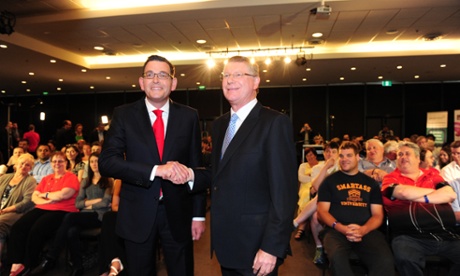
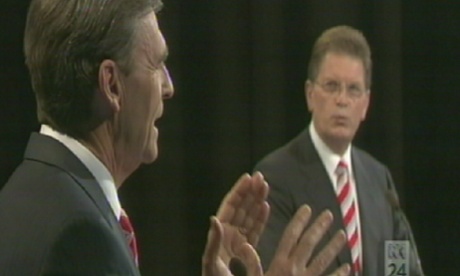
Andrews won the toss and the debate has begun. Both men in sober suits, and both look reasonably comfortable. In their opening addresses, both outlined well-worn stump promises.
Andrews went through promises to get rid of 50 congested level crossings, “end the war on our ambos”, more hospital beds, better school buildings, and to “make sure every child has every chance”. First thing is to “get Victoria back to work”.
This is a big issue in Victoria - with 6.8% unemployment, the highest except for Tasmania. Can states do much about this? This is the question.
Napthine started as he often, does, with the personal, mentioning he is one of 10 children from the country. He’s folksy, and he said he wanted “Victoria to be the number 1 state in the best country in the world.”
His key message is that you need a strong economy to deliver services - something the government has emphasised continuously, And the first mention of the East West Link, with mentions too of Melbourne Rail Link and the airport link (which isn’t coming for many years)
First question from Lucinda was on disability services. Both leaders spoke compassionately, but didn’t quite say what they would do to improve it. Napthine mentioned that he was passionate about this issue, and had fostered an autistic child.
Updated