The Foreign Ministry has taken an unusual step to neutralize nefarious brokers in Vietnam who have sent "fake students" to Japan to work in the country.
The move comes in response to serious cases of brokers in which Vietnamese have found it necessary to work illegally to pay back huge debts after coming to Japan. However, the Japanese side is not blameless.
90 brokers rejected
"Many of them don't even understand greetings such as 'good morning' and 'hello.' They also don't know the names of the Japanese language schools they are planning to attend," said a source familiar with the situation of Vietnamese visa applicants to the Japanese Embassy in Vietnam. "It's obvious their purpose is not to study."
For some time, the Japanese government has asked those who want to study in Japan to submit documents to prove a minimum level of Japanese language proficiency for the purpose of confirming their willingness to study. Their brokers thus submit certificates of Japanese proficiency tests and other equivalent documents.
As a countermeasure, Foreign Ministry officials directly examine prospective students at the embassy to assess their Japanese ability. In September 2018, the ministry introduced a rule that rejects visa applications from intermediate agents that appear to have submitted many "untrustful certificates." So far, 90 brokers have been suspended from using visa application services under the rule.
According to sources, in many cases, the brokers have obtained language certificates by proxy test-taking and other irregularities.
The Japanese-Language Proficiency Test is conducted in Vietnam by several Japanese private companies. According to one of the companies, proxy test-takers have presented forged identification cards commonly used by Vietnamese to identify themselves. There are even posts on social media where people offer to be an impostor to take a test. The companies conducting the language tests have strengthened their checks on test-takers' identifications. However, an official of one of the companies said, "As the methods are becoming more sophisticated, there is a limit to prevention."
Heavily indebted
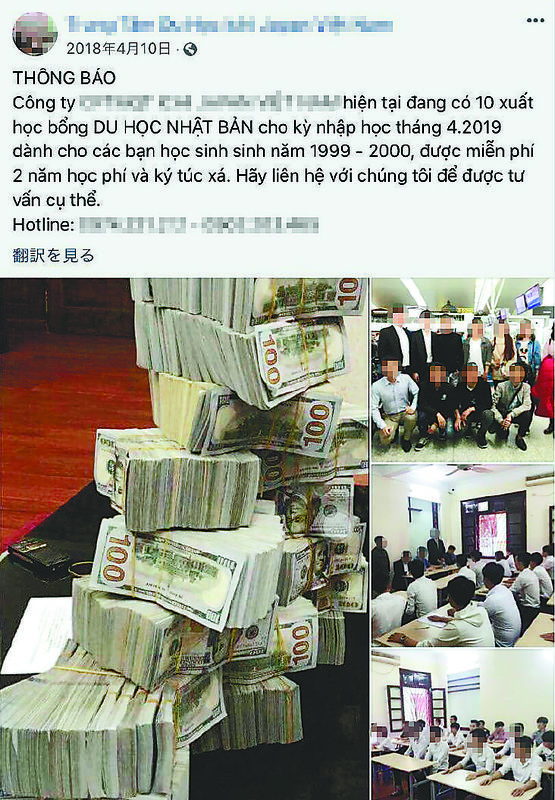
Behind this are "temporary staffing businesses" that are overheating in Vietnam. The number of brokers approved by the Vietnamese government has exceeded 2,000 -- more than triple in the past two years. These brokers are said to be trying to lure even young people in rural areas who have no knowledge of studying abroad.
The average annual income in rural areas is equal to about 200,000, yen but there are quite a few predatory businesses that charge about 1.5 million yen and make claims such as that 300,000 yen can be earned each month with a part-time job in Japan. As a result, people who believe they could easily repay their debts arrive in Japan already in debt.
According to the Japan Student Services Organization, among 90,000 foreign students enrolled in Japanese language schools in fiscal 2018, there were 30,000 Vietnamese students. The figure was the highest by nationality, but there have been a series of cases in which the whereabouts of Vietnamese students have become unknown after being occupied with their part-time jobs. Among students who illegally overstayed visas in 2019, Vietnamese accounted for more than 60%, or about 3,100.
"Young people have been cajoled and exploited," a Foreign Ministry source said. "We have to end the situation in which they come to Japan and then fall into an unhappy situation."
Fundamental solution needed
On the other hand, it is also true that Japan relies on foreign students as a workforce.
Last year, Japan introduced a new residence status for those with "specified skills" that allows foreign nationals to work in simple labor jobs. However, the number of foreign workers with the status has grown at a sluggish pace due to such problems as time-consuming procedures. Amid the ongoing labor shortage, some industries have been supported by foreign students who work as part-timers.
"Even though we seek Japanese workers, we don't see many applicants especially for late-night jobs. So, most of the workers are now foreign students," said an executive of a staffing agency in Tokyo that has contracts with food factories nationwide. "These are simple tasks, so there's no problem if they can't communicate."
Some Japanese language schools also have accepted students even though they know they are here to work and not study. The legal upper limit for foreign students to work is 28 hours per week. However, illegal overwork has been rampant.
"Even though they come to school, they just sleep and classes are losing substance," a Japanese language instructor in Osaka Prefecture said.
A 21-year-old Vietnamese woman who was attending a Japanese language school in Tokyo disappeared after being unable to renew her visa because immigration authorities became aware of her overwork. She had worked illegally in Japan until returning to Vietnam last autumn. "I had no choice to repay my debt," she recalled.
"It is unhealthy for a workplace to depend on foreign students," said Toshihiro Menju, a managing director of the Japan Center for International Exchange who is well versed in measures for foreign residents. "A fundamental solution won't be possible unless a system is established to accept foreign workers who want to work, such as by expanding the scope of new residential qualifications."
Other countries stricter on work
Foreign students are allowed to work 28 hours per week, enabling those from developing countries to earn money for living and school expenses while creating an opportunity to learn about Japanese culture and customs. However, other countries have stricter restrictions.
In principle, regular part-time jobs are prohibited in the United States. Students are allowed to work up to 20 hours a week only at institutions they attend, but it is generally difficult for them to work at language schools, because the opportunities are limited.
In Canada, students are not allowed to work anywhere. Britain also does not allow it in cases when students stay in the country to study the language.
In New Zealand, only students from schools recognized by the government as offering high-quality education are permitted to work, but the upper limit is 20 hours a week. Australia has set the limit at 40 hours over two weeks regardless of the type of schools the students are attending.
Read more from The Japan News at https://japannews.yomiuri.co.jp/