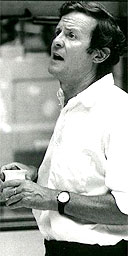
On the way out of the theatre we were handed a four-page letter of protest complaining of the "underlying anti-Semitism" of David Hare's one-man play. It is a startling charge to make against a show that is first and foremost a personal odyssey but that is also as critical of Arafat's corruption as it is of Zionist fundamentalism.
Since Hare first presented this account of his Middle Eastern quest in September 1998, an obvious question presents itself: how does the text stand up in the light of the escalating horror of the past 21 months? The short answer is that it has acquired an even greater tragic irony. When the wife of an implacable Israeli settler says of the surrounding Palestinians "At bottom, I think they want to kill us" the line acquires a prophetic certainty. Equally when a famous Palestinian historian suggests that the so-called peace process is simply about the subjugation of the Palestinian people we recognise the melancholy force of his remarks.
But the power of Hare's eminently re-visitable show lies in its central paradox. On the one hand, it constantly asks whether art has anything to contribute to the reality of fact: visiting Yad Vashem, the Holocaust museum, Hare observes that the sculptures and paintings seem superfluous.
Yet Hare's own play counters that argument by itself being a work of art rather than a living newspaper. It has a shape, a structure and a momentum in tracing Hare's journey from Tel Aviv to Gaza, Ramallah and Jerusalem. But, more than that, the play is an autobiographical account of the jolting impact on a sceptical English liberal of a land possessed by iron certainty.
If anything has changed in the last four years, it is Hare's own confidence as a performer; and there are times when I regret his growing actorly assurance. He still distinguishes elegantly and economically between his sundry interviewees. But when, for instance, he talks of the "sense of loss" he feels on discovering the Via Dolorosa to be an unimpressive pavement filled with postcard shops, he drops his voice to an ashen whisper. If I were Hare's director, (Stephen Daldry), I would remind him that his text is sufficiently strong not to require the calculated inflection he sometimes gives it.
Since Hare also now identifies Ariel Sharon as the military commander who told him that "only 20,000 Jews have been killed in the cause of setting up the state" you wish he had given us some impression of the man himself. But this is to cavil at a truly remarkable piece of theatre: one that not only illuminates a tragic political situation but that also shows how Hare himself was changed by his information seeking quest. It is less a documentary than the record of a soul.
· Until August 31. Box office: 020-7494 5075.