Jargon, acronyms and convoluted language: they’re often responsible for unintentional indistinctness in the development sector, blurring vital messages and causing furious head-scratching. But what about when words that appear to be inflated language or jargon are not? Sometimes it’s just the only terminology that’s available – indicating just how complex international development processes can be.
Take, for example, the case of global public health supply chains. They’re vital systems for getting health commodities to the countries and people who need them the most, but can be as complicated as a 10,000-piece jigsaw of the sky. Fragmentation and poor coordination are perennial problems: the World Health Organisation’s Essential Drug & Medicine (EDM) department estimates that on average there are up to 17 funders, 19 procurement agencies, and 84 distribution channels in each country where they operate. The difficulties faced in the fight against Ebola in West Africa exemplify the challenges that fragile supply chains can cause.
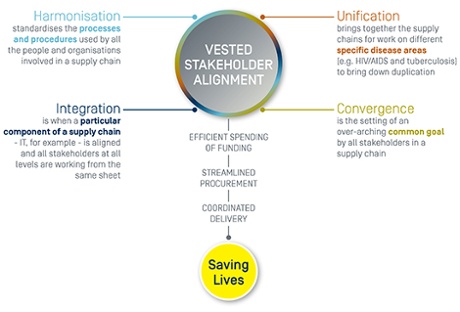
In Crown Agents’ work on global public health supply chains, we have seen lists of words being used that seem to have almost identical meanings: unifying, harmonising, converging, integrating, aligning and more. When applied to supply chains, however, they each represent a different, nuanced approach or affect a different aspect of a supply chain. They are part of an increasing donor drive to explore vested stakeholder alignments (VSA), which aim to make supply chains as efficient as they can be, having all stakeholders and all parts of supply chains working together. So what are the differences between these outwardly similar words and why is it so important for their distinct meanings to be understood and applied?
Unification
This is a process where health supply chain partners consolidate activities across specific disease areas, also referred to as horizontal integration. USAid uses a unified supply chain for its HIV/Aids, tuberculosis and malaria work in Nigeria. Before 2010 there were over 12 parallel supply chains in the country supporting HIV/Aids programmes alone. These supply chains often delivered to the same health facilities that tuberculosis or malaria supply chains were delivering to, but brought uncoordinated packages of health commodities. In 2012 the Government of Nigeria and USAid unified these parallel disease area supply chains for efficiency of health service delivery, increased access to health commodities, reduced stock outs and minimised expiries.
Harmonisation
A harmonised supply chain is where different parties or donors in the supply chain agree to standardise their processes and procedures, allowing for different donors to share information on planning, sourcing, and deliveries across the supply chain, increasing coordination and efficiency. One example of this is Crown Agents’ work with Medical Stores Limited in Zambia. This project is operated through multilateral cooperation between the Swedish International Development Agency, the UK’s Department for International Development and the EU, and the harmonisation allows for the coordinated distribution and delivery of all the commodities to the relevant health facilities.
Convergence
This is when supply chain partners aim towards a common goal for the distribution of commodities – it’s the big idea. It’s set high up in the supply chain process – up in the planning stages – taking place prior to the physical shifting of commodities and is all about establishing a shared value. Through a converged approach to supply chains, the partners use a hub and spoke system to make the most out of converged storage and distribution of health commodities, whatever they’re treating. Vaccines for neglected tropical diseases and antiretroviral drugs for the treatment of HIV/Aids, for example, can be distributed on the same transportation by a common third-party logistics provider if they fall under the converged operations of different supply chain partners.
Integration
Integration is the close alignment of all stakeholders, governments, donors and the private sector on a particular aspect of or product in the supply chain, such as information systems, storage or distribution systems. This is a process that reaches to the highest levels of authority and responsibility in the supply chains. To see this in action look to the current work on vertical integration in vaccine supply chains in Senegal. In this case there is an ambition to integrate all donor and all federal and state level government inputs into a seamless supply chain for vaccines, which could serve as a model for other immunisation and health care services.
Four terms: all seemingly very similar but, in this context, very different. Where they do all come together is in their contribution to the ultimate goal of achieving effective governance, better coordination between donors, governments and stakeholders, value for money, streamlined bureaucracy and, ultimately, the successful delivery of health and medical products to provide basic healthcare for all. Vested stakeholder alignment (VSA) is what it’s called and if you think that sounds like jargon – well, you might want to have another think about that.
Kenny Otto is a Lead Consultant in Health Logistics for Crown Agents, with 15 years of supply chain, logistics and procurement consultancy experience.
Content on this page is paid for and provided by Crown Agents sponsor of the Guardian Global Development Professionals Network.