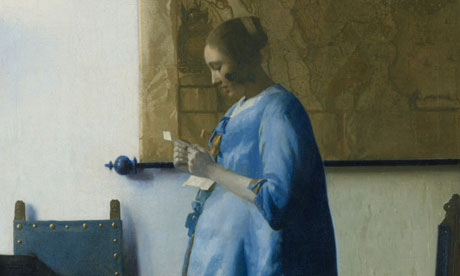
How do you portray someone's interior life? It is one thing to depict outer beauty or ugliness, to capture appearances. That is what painting, and photography, are pre-set to do. But how does an artist see beyond the distractions of faces and clothes to hint at the hidden world of thoughts and emotions?
In his painting Woman Reading a Letter, the 17th-century Dutch artist Johannes Vermeer achieves this by depicting the most private of all cultural acts: reading. This great painting has just been restored and is going back on view at the Rijksmuseum in Amsterdam. The blue of the woman's gown looks deeper than ever, the light from a window that creeps across a map hanging on the wall more silvery. It is a new chance to appreciate one of the most profound of all paintings.
Vermeer is a very objective artist. As far as we can tell from his views of the inside and outside of houses in Delft where he lived, he paints what he sees. Furnishings and decorations – including maps and paintings that he hangs on the wall to introduce layers of symbolism – are all real, and painted with meticulous accuracy. Women pose for him, dressed presumably as they appear in his pictures. But through his almost scientific scrutiny of visible phenomena, he tells of invisible passions and secret selves.
The letter reader in his masterpiece in the Rijksmuseum may be studying a love letter – that's what we feel from her deep absorption in its contents. Or she may be reading news from a war, for the map behind her suggests navies and armies and campaigns. But what holds us is the act of reading itself, and the look it gives the reader: she is in another world, unaware of the colours and details of the scene that attract us. For her, only the words on that sheet of paper exist. She has forgotten that she is being looked at – by Vermeer – as she reads. She is in her own place, a place of the mind.
This painting stops time. Looking at it you are drawn into the reader's rapt moment, and forget the beauty of the scene. It invites everyone who looks at it to share this silent, absorbed moment of reading.
Dutch art in the 17th-century abounds in visual information. It shows us, like a photograph, exactly what life looked like there and then. But its deepest moments draw away from the dazzle of appearances into the darkness of introspection. Rembrandt is far bolder in the way he goes about this. The shadows and golds of his paintings, ripe with contrast and drama, delve straight into the soul. People seem to look back at you from his epic portraits.
Vermeer does not reach for the grandeur that is natural to Rembrandt. He paints the quiet room, the morning light, the woman reading a letter. And in that simplicity, he reveals the power of the inner life.