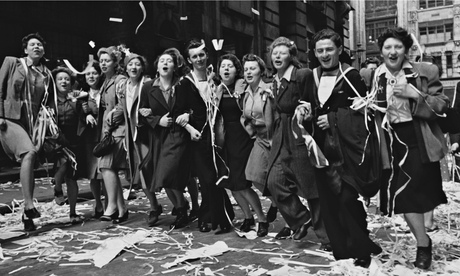
Winston Churchill, London
The war against Germany is over. Advance, Britannia. Long live the cause of Freedom. God Save the King.
Post-mortem of the corpse of a man disfigured by fire (presumably Hitler’s corpse), mortuary, Buch, Berlin
The remains of a male corpse disfigured by fire were delivered in a wooden box (length 163cm, width 55cm, height 53cm). On the body was found a piece of yellow jersey 25 x 8cm, charred around the edges.
On the body, considerably damaged by fire, no visible signs of severe lethal injuries or illnesses could be detected.
The presence in the oral cavity of the remnants of a crushed glass ampoule, the marked smell of bitter almonds and the forensic-chemical test of internal organs which established the presence of cyanide compounds permit the Commission to arrive at the conclusion that death in this instance was caused by poisoning with cyanide compounds.
Alexander Fedotov, Red Army soldier, Breslau
It might sound funny, Mama, but what I’ve longed for most over the last few months was silence. Silence without the thunder of the machine guns, without the roar of shells. Yesterday my superior gave me a pass. The others went trophy-hunting, looking for sub-machine guns, binoculars and medals. I went to the river and spent two hours staring at the flowing water. And in the evening, for the first time in my life, I heard nightingales singing in the bushes.
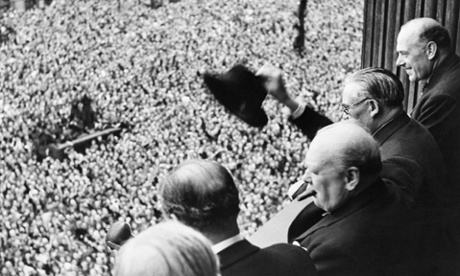
Martin Hauser, sergeant in the British army, near Trieste
I hold a glass of beer in my hand, look into the transparent yellow liquid, and my thoughts wander. So this is the end. Is this what peace looks like? Is this what it feels like? Here we sit, a group of men who left their homes and families a long time ago, who freed themselves from the routine of daily life in the past to assure their lives in the future. Here we sit, happy to have got through these years full of danger and horror sound of limb and mind. But where is the joy, the enthusiasm that can be expected of us? Not a bit of it – a smile here, a chuckle there, a joke as we drink our beer. Time passes with an exchange of memories – memories of past times, serious struggles, friends who have fallen. The past weighs heavily on everyone.
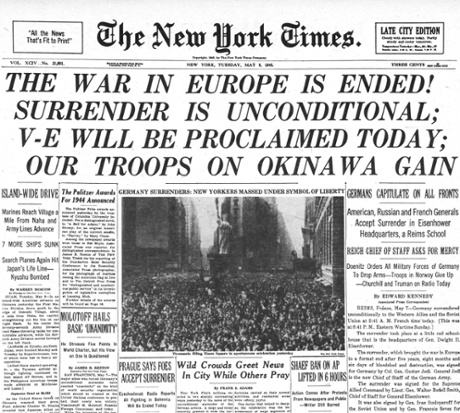
Flora Neumann, transport to Belgium
We were brought to a French prisoner-of-war camp. We both looked so sick and thin. We heard shots and thought it was the Germans, but this time it was shots of joy: the war was over! The Germans had surrendered. We hugged, no one could grasp it. We were brought to Belgium with other PoWs by rail.
Before we crossed the border we were given an injection. They were probably worried that we might spread diseases.
Mrs B Hubbard, West Sussex
The wireless programme here brought home to me the facts and feelings of VE Day by the descriptions of the London crowds – the sound of their cheers: outside Buckingham Palace + in Whitehall. Here, in our peaceful home, we’ve been out of the war for 18 months and at first it’s hard to “get it”: but the other locals who have never been any nearer to the war than this seem to take it very seriously.
The Robinsons have a pathetically ambitious arrangement of bunting draped outside their house: Mrs K drew my attention to it rather apologetically, saying they’d kept it since the coronation + “it needed pressing”.
Joan Wyndham, London
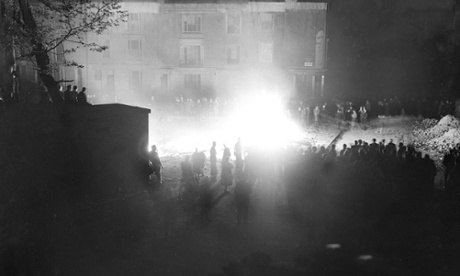
There was wild excitement in Trafalgar Square, half London seemed to be floodlit – so much unexpected light was quite unreal. There were people dancing like crazy, jumping in the fountains and climbing lampposts, and dull red glow in the sky from bonfires which reminded us of the blitz.
Most of the pubs seemed to be running out of booze, so I took them both to the York Minster where red wine was flowing in torrents. Behind the bar was Monsieur Berlemont, his magnificent moustaches practically standing on end with excitement. We sat at a little round corner table. A French sailor kissed Mummy and changed hats with her, taking her little brown velvet cap and giving her his with a pom-pom on top. Very embarrassed, she hastily rearranged her hair, pulling it over her ears. She never could stand people seeing her ears, although they are perfectly nice ones.
Harold Nicolson, London
VE Day. Lunch at the Beefsteak. I then enter the House. The place is packed and I sit on the step below the cross bench. I see a stir at the door and Winston comes in – a little shy – a little flushed – but smiling boyishly. The House jumps to its feet, and there is one long roar of applause. He bows and smiles in acknowledgement.
Bertolt Brecht, New York
nazi germany surrenders unconditionally. six in the morning on the radio the president delivers a speech. listening i look at the blossoming californian garden.
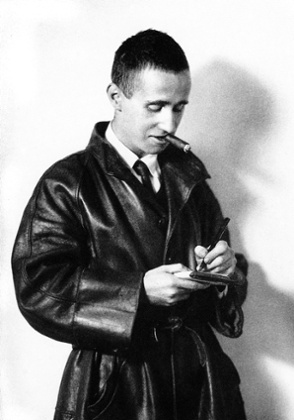
Elias Canetti, London
The crash of the Germans hits one harder than one might admit. It’s the level of deception in which they lived, the vastness of their illusion, the blindness of their hopeless faith that won’t leave one alone. One has always despised the ones who glued together that revolting faith, the few really responsible ones whose spirit was just enough for so much, but all the others who did nothing but believe, and who in a few years, with as much concentrated power as the Jews summoned over millennia, had life and appetite enough really to want their earthly paradise, world domination, to kill everything else to have it, to die for it themselves, all in the shortest time, those countless blossoming, abundantly healthy, simple-minded, marching, decorated guinea pigs for the faith, trained for faith … what are they now, in fact, if their faith collapses? What is left of them? What else have they been prepared for? What second life could they start now? What is left of them without their terrible military faith? How much do they feel their impotence, when there was nothing for them but power? Where can they still fall? What will catch them?
Heinrich Keim, Courland, Latvia
7.5.1945, last day in the Courland Pocket. As I know that my valuables will be in my possession for only a few more hours, I leave my wedding ring, my camera and my home address with a Latvian farmer. The future is as dark as night. The next day we hand over our vehicles, weapons and equipment to the Russians, and an interpreter tells us that from now on we are prisoners of war. The Russians can tell by looking at my epaulettes that I belong to a technical unit of the German Wehrmacht. I am separated from my company. I have just enough time to say goodbye to my comrades with a handshake, and wish them all the best for the future in the circumstances.
Dr Hans Graf von Lehndorff, Rothenstein camp, near Königsberg
On 8 May we hear that the war is over. The loudspeakers ring out a bit more piercingly than usual. In the halls a few sceptical German soldiers are talking about the liberation from National Socialism and the blessings of Bolshevism. Outside the commandant’s door – where can it have come from, in this wilderness? – an opulent flower arrangement is being constructed. Otherwise we aren’t really aware of the final victory.
What bothers us most is still the cold. In early May there have been almost constant storms and rain, and temperatures at night are still around zero. Most of the deaths are due to exposure at the moment. It happens silently too. There’s no sign of a fight to the death. Movements become weaker from day to day, people still speak if you prod them, but then you’re glad when the time comes when you can take them from the rows with a clean conscience and lay them on the pile in the cellar that’s buried every day, because there are a lot of people already waiting for their empty beds.
Knut Hamsun, Nørholm, Norway
I’m not worthy to speak of Adolf Hitler, and his life and deeds do not lend themselves to sentimental emotion. He was a warrior, a warrior for humanity and a herald of the gospel of justice for all nations. He was a reforming figure of the highest rank, and it was his historical fate to have to work in a time of unparalleled vulgarity that finally led to his downfall. That is how the average western European will see Adolf Hitler, and we, his true followers, bow our heads over his death.
Charlotte Rosowsky, Grafschaft Glatz
In our village there was a famous distillery. Moritz Thienelt’s Kroatzbeere blackberry liqueur had a great reputation. The Russians demanded schnapps from there by the bucketload. Drunken Russians! I was in absolutely no doubt about what would happen next.
The women had to be brought to safety at all costs. On a mountain, beyond the summit, in the depths of the forest, there was a little farmyard whose owners I knew. Evening had fallen by now. In the half-darkness my sister-in-law with her two-year-old child, our friend’s wife and daughter and I went up the mountain with my two boys. We reached the farmyard and were allowed to sleep in the hay-barn. At about 2 o’clock things suddenly got noisy down below.
I went down to look for the cause. Out of the village had come weeping women who had already been raped by the Russians, some of them several times. It must have been insane. In our quiet little corner no one troubled us. Dawn came. We hadn’t had much sleep. Now I needed to go into the village to feed the animals. I must say that seldom in my life have I been in a situation stranger than this one.
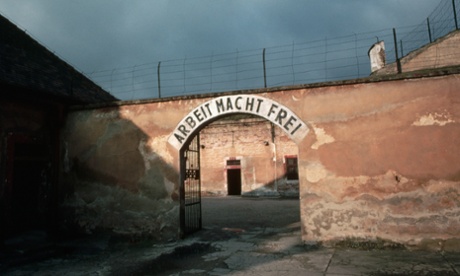
Erich Kessler, Theresienstadt concentration camp
This morning at 6.30 I’m woken to the news that my brother Hans has arrived on a transport to Theresienstadt.
Of course I was out of bed and dressed in a shot, and ran to the collection point. That was a joyful reunion, after so many years of painful separation! So often I was completely dejected and didn’t dare believe we would see each other again. But then I felt hope again, and thank God it proved to be justified. But the way we had to see one another. Emaciated, with the typical expression of the camp inmate, which speaks of unimaginable horror.
Elfie Walther, Sandbostel concentration camp
They are dying before our eyes. There isn’t much we can do. When we get there in the morning we have to clear away the dirt. There’s a pile by almost every bed, and everywhere we find pools of urine, but we aren’t allowed to let on. They think we’re nurses.
Once we’re finished and have washed everything with Lysol, it all starts over again.
The work is hard and strenuous. My legs and hands are swollen from walking and carrying pots around.
The patients don’t want the porridge any more. When we appear in the doorway with the pots, they throw cups at us.
They want bread. I can understand that! But there isn’t any yet. The British have a lot of difficulty getting hold of it.
Our mental state is much worse than our physical state. We will probably never rid ourselves of these impressions. What we’re going through here can’t be put into words.
Today the patients were washed. We didn’t get round to it for the first few days. Now they’re all naked in their beds, and some of them have already cheered up a little, they’re even jumping around in the room.
I think they’ve only just worked out that they’ve been liberated from the Germans.
From the last German Wehrmacht report, Berlin
The weapons on all fronts have been silent since midnight. On the orders of the Grand Admiral the Wehrmacht has halted what had become hopeless combat. Almost six years of heroic fighting is over. It has brought us great victories, but also serious defeats. In the end the German Wehrmacht has honourably submitted to a mighty superior power.
The German soldier, true to his oath, has in the service of his nation achieved feats that will never be forgotten. The home front has supported him to the last with all its might, amidst the heaviest of sacrifices. The unique achievement of front and home will find its definitive appreciation in the later, just judgment of history.
And even the enemy will give his respect to the achievements and sacrifices of the German soldiers on land, on the water and in the air. So every soldier can stand upright as he proudly sets down his gun, and in the most difficult hours of our history go bravely and confidently to work for the eternal life of our people. At this hour the Wehrmacht remembers its comrades who fell before the enemy. The dead compel us to unconditional loyalty, to obedience and discipline towards the Fatherland, bleeding from countless wounds.
• Swansong 1945: A Collective Diary from Hitler’s Last Birthday to VE Day by Walter Kempowski, translated by Shaun Whiteside (Granta, £25). To order a copy for £20, go to bookshop.theguardian.com or call 0330 333 6846. Free UK p&p over £10, online orders only. Phone orders min. p&p of £1.99.