Three days of national commemorations marking the 70th anniversary of VE Day begin on Friday with a service of remembrance at the Cenotaph in London to pay tribute to those who lost their lives in the second world war in Europe.
Hours after polling stations closed, David Cameron, Nick Clegg and Ed Miliband are to join the Duke of York, military representatives and veterans at a half-hour ceremony of hymns, prayers and readings in memory of the 580,400 British and Commonwealth servicemen and women, and the 67,100 UK civilians, killed during the six-year conflict.
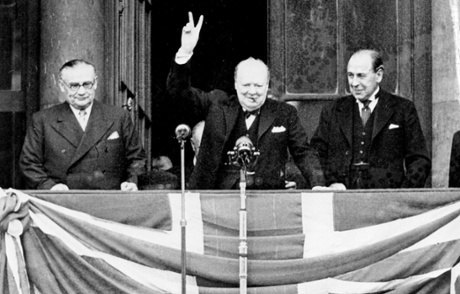
A national two-minute silence will be marked, wreaths laid, and an extract read from the speech that Winston Churchill broadcast to the nation at 3pm on 8 May 1945, officially announcing the end of hostilities in Europe after the formal and unconditional surrender of Germany’s forces.
An hour after sunset, a chain of more than 100 beacons will be lit around the country – from Barnsley to Windsor, Doncaster to Poole, and Lowestoft to the Isle of Unst. The houses of parliament, St Paul’s Cathedral and Trafalgar Square, floodlit 70 years ago for the first VE Day, will light up again with V-shaped illuminations.
At 11am on Saturday, churches and cathedrals across Britain have been invited to ring out their bells in celebration of the hard-fought victory over Nazi Germany, while in the evening, the BBC will broadcast the Party to Remember, billed as a “spectacular 1940s-themed concert” on the Horse Guards Parade ground, featuring acts including Pixie Lott, Jamelia, Diversity, Chas & Dave and Status Quo.
A national thanksgiving service at Westminster Abbey on Sunday morning will be attended by the Queen and Duke of Edinburgh, Prince Charles, the Duchess of Cornwall and other members of the royal family, as well as representatives of Britain’s wartime allies, Commonwealth countries and more than 1,000 veterans.
After the service, a parade of 2,000 service personnel, veterans and their guests and carers will march from Westminster Abbey to Horse Guards Parade, while wartime RAF planes including Lancasters, Spitfires and Hurricanes perform a flypast over central London with the Red Arrows display team.
The events, likely to mark the last major anniversary that any significant number of second world war veterans will be able to attend, have been overseen by William Hague after fears were expressed by the armed services and veterans organisations that the 70th anniversary of VE Day might have been overlooked because it fell on the day after the general election.
Schools have been encouraged to mark the occasion, and many have organised picnics or street parties, or invited veterans to speak. Veterans attending the weekend’s ceremonies can apply to a government fund to cover their travel and accommodation expenses.
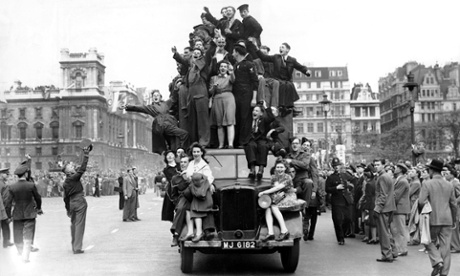
VE Day in 1945 was a riotous occasion, with jubilant Britons gathering in their tens of thousands around the country. Relief, people who were there recall, was the main emotion: after six long years of fear, hardship, loss and destruction – half a million homes had been destroyed – the population was ready to party.
In London, huge crowds gathered to hear Churchill’s radio broadcast relayed over loudspeakers; King George VI and the Queen appeared eight times on the balcony of Buckingham Palace before the cheering throng; and the two princesses – Margaret and Elizabeth – mingled with the crowds. Street parties erupted around the country.