
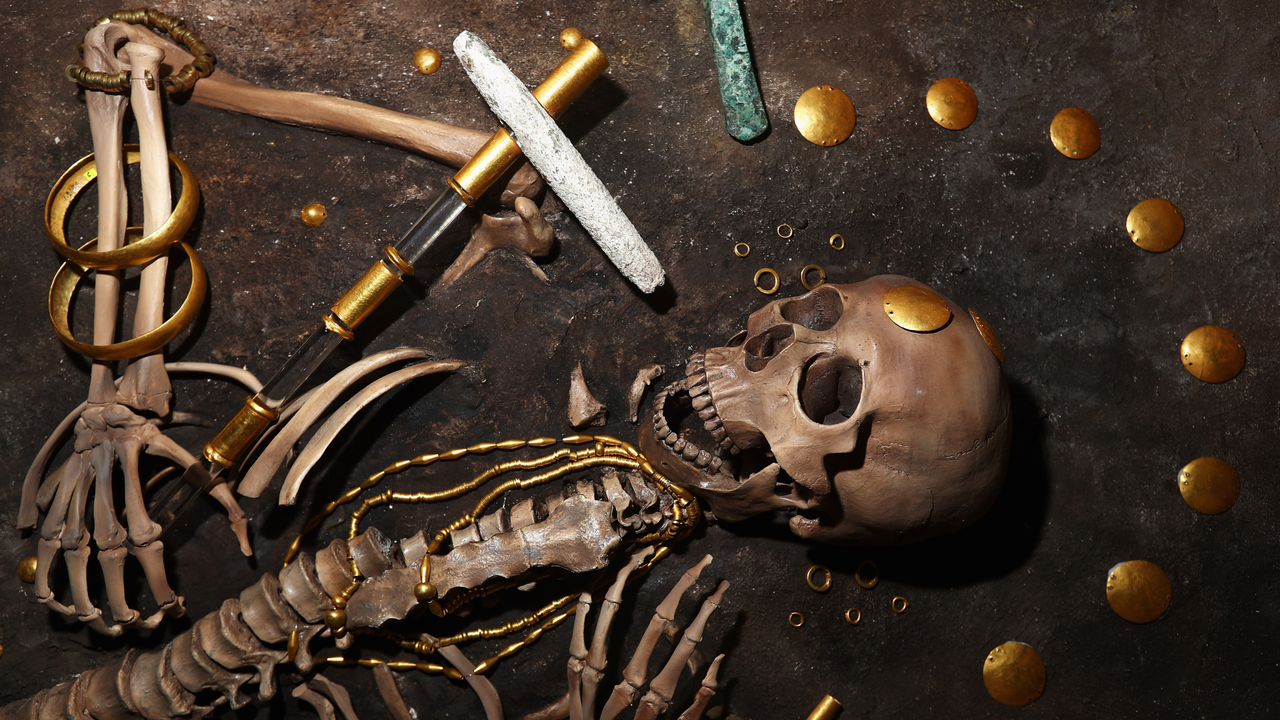
Name: Varna Gold
What it is: A collection of gold artifacts
Where it is from: Varna, Bulgaria
When it was made: Circa 4600 B.C.
In the fall of 1972, workers in the coastal Bulgarian city of Varna accidentally stumbled upon an ancient cemetery filled with treasure. The burial ground contained more than 3,000 gold artifacts that date to between 4600 and 4300 B.C., making them the oldest gold artifacts in the world.
Over a 20-year period of excavations, archaeologists recovered gold objects from 62 of the around 300 graves in the Varna cemetery. But one-third of all the gold finds came from one burial, Grave 43, which also contained the skeleton of a man who was over 60 years old when he died nearly six millennia ago.
The man in Grave 43, who may have been a metalsmith, was buried with a variety of gold artifacts, including beaded gold necklaces, bangles, earrings and pendants; small, gold discs that were once attached to his clothes; an ax with a gold-wrapped handle; as well as a gold penis sheath.
In total, archaeologists found more than 13.2 pounds (6 kilograms) of gold in the Varna cemetery. At up to 6,600 years old, this treasure trove boasts the oldest evidence of humans crafting gold anywhere in the world. (A tiny gold bead discovered in 2016 at Tell Yunatsite, another site in southern Bulgaria, may be a century older, but that date has not been confirmed.)
Archaeologists are still unsure why gold-working was invented in the Balkans more than six millennia ago during the Copper Age (roughly 4500 to 3000 B.C.), although it might be related to a number of innovations in mining, metallurgy and long-distance trade that occurred during this era, according to the Varna Museum of Archaeology, which houses the collection of gold.
"The Varna cemetery illustrates the early stage of the emergence of a class-segregated society, a proto-type of social and political structure," Museum of Archaeology representatives wrote. "As attributes designating the social status of their owners, gold objects were sacred and symbolic rather than indicators of wealth."
The handful of people buried in the Varna cemetery with extraordinary amounts of gold, such as the man in Grave 43, were likely the society's leaders, according to the museum, making Varna possibly one of the world's earliest civilizations.
For more stunning archaeological discoveries, check out our Astonishing Artifacts archives.