OSAKA -- Companies from a variety of industries have increasingly made inroads into the field of onshore aquaculture, in which fish and shellfish are bred, raised and harvested in tanks on land.
In addition to it being a relatively easy field to enter because of fewer obstacles, such as acquiring fishing rights, providing a stable supply of marine products has become an issue. Some of these companies are making their foray into the field to expand their businesses.
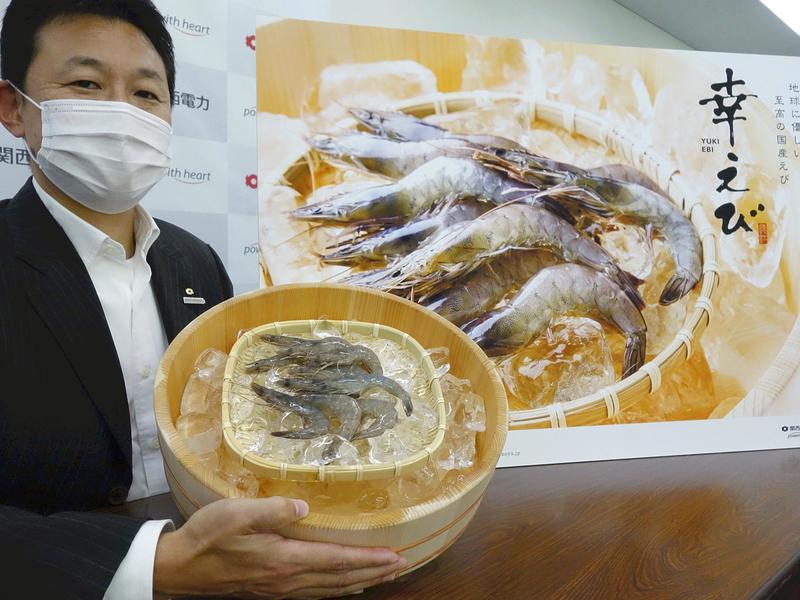
Kansai Electric Power Co. on Oct. 26 officially announced a plan to commence whiteleg shrimp farming in 2022. Partnering with a shrimp farming company in Niigata Prefecture, KEPCO established Kaiko Yukinoya G.K. -- in which the utility company has a majority stake -- in Osaka City on Oct. 7.
The new company aims to begin shipping shrimp under the "Yuki Ebi" brand in May 2022 after setting up a farm in Iwata, Shizuoka Prefecture that would make the transport of products to the Tokyo metropolitan area and the Kansai and Tokai regions convenient.
The farm, to be completely enclosed, will also have the ability to automatically control both water quality and temperature.
KEPCO intends to utilize its power plant operation expertise as well as information technology and artificial intelligence technology cultivated through its subsidiary's telecommunications business to increase its competitive edge by curbing costs, found to be a challenge in the onshore aquaculture industry.
"We want to achieve the same level of umami flavor as that of [high-quality] prawns," a company official said.
According to the Agriculture, Forestry and Fisheries Ministry, domestic production of the fishery and aquaculture industry totaled 4.42 million tons in 2018 -- down from 5.59 million tons in 2008.
Against the backdrop of a shrinking workforce within the fishing industry and a decrease in resources, a way to secure a stable supply of marine products for the future has long been an issue.
On the other hand, it is difficult to expand oceanic fishing grounds for aquaculture as operators are urged to prevent the discharge of feed and feces into the sea, both having a negative environmental impact.
Given the situation, Hitachi Zosen Corp. and Nippon Suisan Kaisha, Ltd. jointly built a new onshore farm for chub mackerel in Yonago, Tottori Prefecture, in May. This initiative is intended to make use of Hitachi Zosen's expertise in water treatment. The companies' goal is to make the farm operational in fiscal 2023.
West Japan Railway Co. (JR West) also made a foray into onshore farming back in 2017 by teaming up with companies along its rail lines, including those in Hiroshima Prefecture. It has already commercialized six varieties of cultivated fish such as mackerel, oysters and puffer fish.
"In addition to industrial development along the rail lines, this will also contribute to achieving the United Nations' Sustainable Development Goals," said a JR West business official.
Read more from The Japan News at https://japannews.yomiuri.co.jp/




.jpg?w=600)