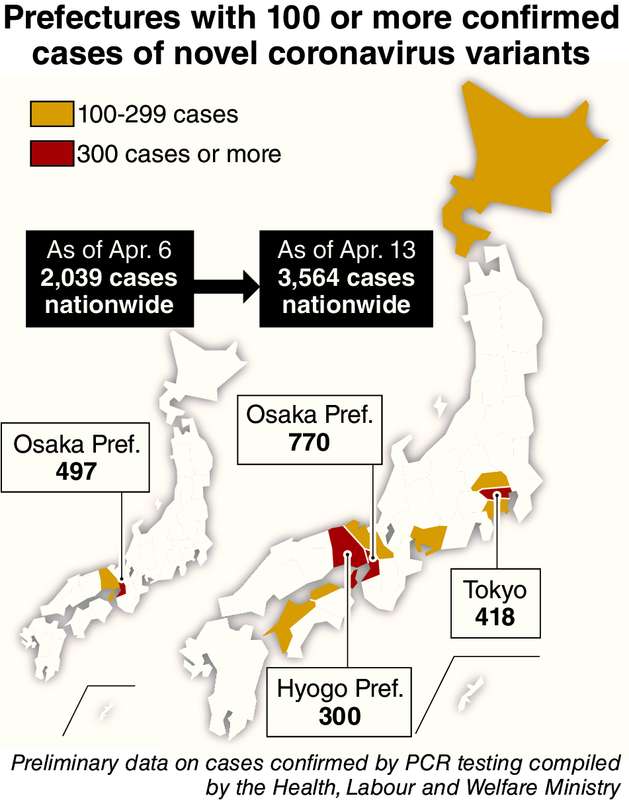
The number of people infected with novel coronavirus variants has been increasing rapidly since the beginning of April. Cumulative total numbers of identified cases had exceeded 100 in each of 10 prefectures including Osaka and Tokyo as of Tuesday, according to the health ministry. The National Institute of Infectious Diseases (NIID) has heightened its alert, predicting that 80% to 90% of cases in and around Tokyo, and over 95% of cases in Osaka, Kyoto and Hyogo prefectures, will be infections with the variants within the next month.
There are several variants, including British, South African and Brazilian types, and they "may be more infectious than the conventional virus," said an official from the Health, Labor and Welfare Ministry.
As of Tuesday, a total of 3,564 people nationwide had been found to be infected with the virus variants, based on tests conducted by prefectural health research institutes and private institutions, according to the health ministry. Osaka Prefecture has the highest number of cases with 770, followed by Tokyo's 418 cases and Hyogo's 300 cases.
As of April 6, only two prefectures, Osaka and Hyogo, had exceeded 100 in their cumulative total cases of infection with virus variants. But the number of prefectures with over 100 cases of variant infections rose to 10 in the past week, and the nationwide total number of variant infections increased by about 1,500.
On Wednesday and Thursday, the daily number of new coronavirus infection cases nationwide exceeded 4,000 for two consecutive days, prompting some experts to declare the arrival of a "fourth wave."
Hospital bed capacity is under serious strain. Occupancy rates reached 60% to 80% in five prefectures -- Osaka, Hyogo, Nara, Wakayama and Okinawa -- as of Wednesday, according to the Cabinet Secretariat.
In Tokyo, Saitama, Chiba and Kanagawa prefectures, the situation hit Stage 3, the second most serious level, with a hospital bed occupancy rate of 20% or higher.
In Osaka Prefecture, the number of seriously ill patients reached a record 261 on Thursday, significantly exceeding the 241 beds secured for such patients by the prefectural government.
Among those infected with the variants who are 40 or older, 10.7% became seriously ill, according to the prefectural government. That is almost double the 5.5% rate of seriously ill patients during the third wave, from October last year to February this year, when nearly all infections were with the conventional type of the novel coronavirus.
"In the Kansai region, the speed of increase in the number of infected people and seriously ill patients is faster, compared to the third wave. The increased likelihood of becoming seriously ill must be because of the influence of the variants," said Takaji Wakita, head of NIID, at a press conference on Wednesday.
Read more from The Japan News at https://japannews.yomiuri.co.jp/