Vanity Fair is a somewhat surprising choice for ITV’s latest period drama. While British TV has thrived on endless lush, romantic productions, Becky Sharp isn’t much of an amiable screen presence in comparison to Jane Austen’s women.
She’s complex, to say the least, and has formed many a pitfall for the numerous adaptations of William Makepeace Thackeray’s novel in the past. Sadly, this latest attempt is another of her victims.
As the protagonist of Thackeray’s Vanity Fair, published in 1848, Sharp is majestically befitting of the story’s subtitle: “A Novel Without a Hero.” She’s far too bitter. She’s cold and manipulative. We don’t root for her romantic pairings, we revile them.
Yet, we can’t help but sympathise. As has always been made clear in Thackeray’s novel, society is the disease at hand, and Becky is merely a symptom of those ills.
Time has only accentuated the message and, increasingly, we’ve come to see her schemes and manipulations as a form of survival, and the only choice for a woman born without station or means.
The villainisation of Becky Sharp has morphed into the reclamation of her, and it’s been reflected in how the novel’s been adapted for screen: Miriam Hopkins played her as pure seductress in the 1935 version, while Reese Witherspoon went for tragic romantic in 2004.
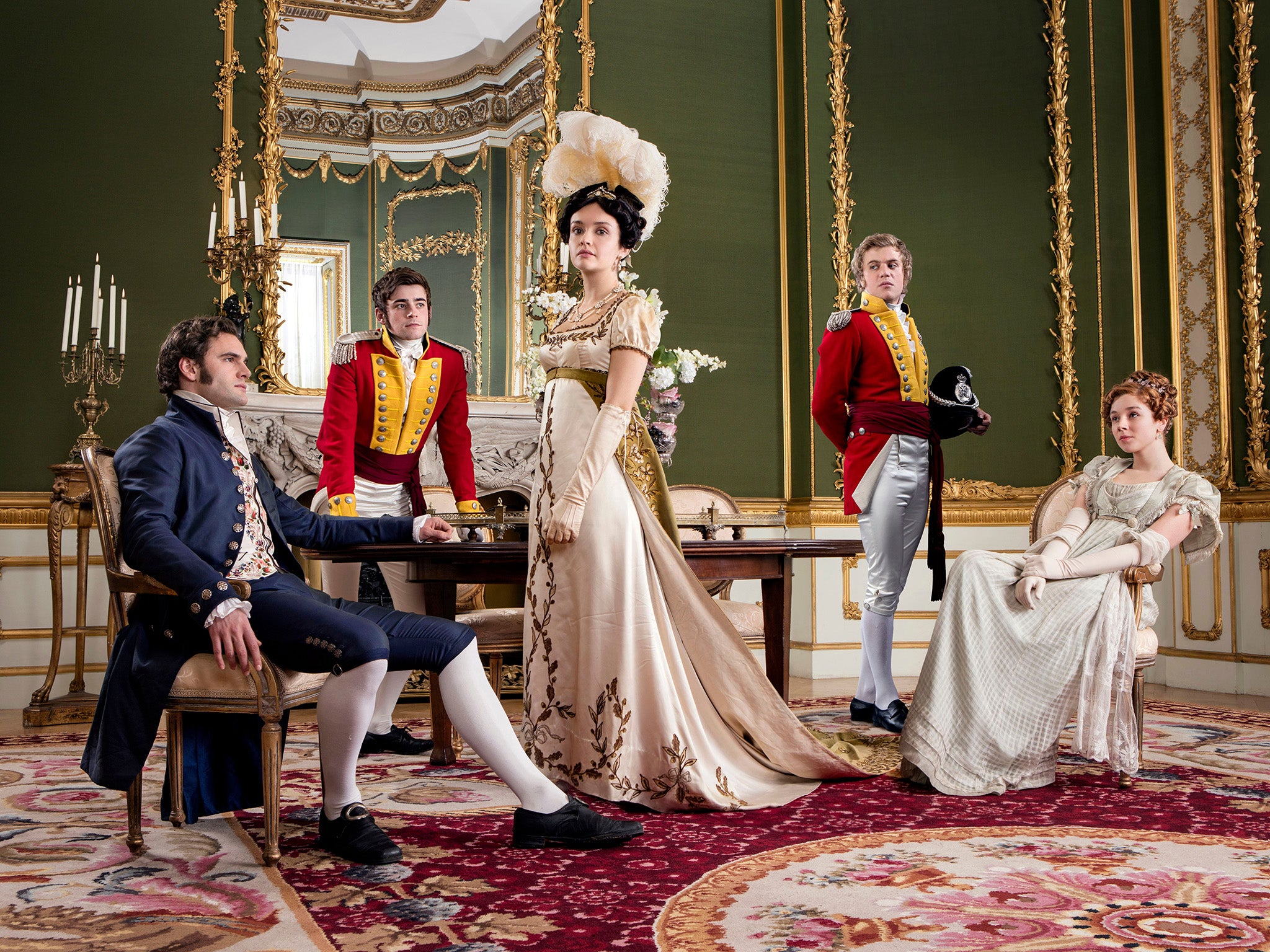
This latest version, from the makers of Poldark and Victoria, attempts to recast her as a woman ahead of her time. As played by Olivia Cooke, best known for Ready Player One, this is a Becky who isn’t afraid to look directly down the camera, a repeated signal that she’s in on the joke with us.
The joke being that Regency society looks a bit ridiculous, now that it’s 2018 and women aren’t regularly shipped off to work as governesses at fancy country estates – which is the miserable fate waiting for Becky if she can’t successfully seduce the awkward brother of her best friend, Amelia Sedley (Claudia Jessie).
Oh, if only Becky could have crowdfunded herself out of the situation, this adaptation despairs. Or if only she could have fired off a couple of viral tweets and landed a sponsorship deal.
There’s little hope that attitude will change over the course of this seven part adaptation, considering how odd the series’ opening titles are: we see Thackery (Michael Palin) enter the scene as a Puck-like enchanter, ready to welcome the audience in to the world of Vanity Fair: “A very vain, wicked, foolish place. Full of all sorts of humbug, falseness and pretension.”
A soft, dreamy version of “All Along the Watchtower” plays, as the camera swoops and tilts, eventually resting on the image of Becky, giddy as she rides a fairground carousel – literal in appearance but presumably metaphorical in nature.
All in all, the titles feel like a timid stab at Baz Luhrmann’s own lurid approach to storytelling, and particularly exemplary of how non-committal Vanity Fair feels in its modernisation. The costumes and staging feel traditional to the genre, but the muted palette and the reliance on lens flares and overexposure make it look as if the whole show’s been put through an Instagram filter.
There are elements of Gwyneth Hughes’s adaptation, at least, that better capture Thackeray’s intentions. There’s a deft handling of Becky’s social marginalisation: she’s immediately viewed as an object of suspicion by those around her, as an orphan of bohemian parentage, the daughter of an artist and French opera dancer.
However, Hughes makes sure to contextualise her privilege as a white woman of some social connection, by contrasting her character with that of the black servant in the Sedley household (Richie Campbell), who Thackeray notes was the only one to see through Becky’s schemes. It’s an important detail, but easily missed in other adaptations.
It’s Cooke, however, who seems to find the most nuance in Becky. She scoffs at authority, rebukes the warning of her headmistress (“You think because you are clever, society will overlook your lowbirth”), and barely hides her contempt. Yet those moments are a never overplayed, especially in a way that feels out of place with her surroundings.
Cooke manages to capture Becky’s vitality, without forcing modernity into her performance. Instead, as she already brilliantly demonstrated in this year’s Thoroughbreds by playing a sociopathic teenager, she relies on the power of a good poker face. She knows, as an actor, that so much of Becky’s resentment can be communicated in an unwavering stare.
Admittedly, finding a way to make Becky Sharp palatable to modern audiences isn’t an easy task. What was keen social satire in Thackeray’s day has lost its immediacy, now that his world is no longer immediately recognisable – it’s the same reason we’re always forgetting that Austen’s work is as funny as it is romantic.
Perhaps it’s impossible now to give Vanity Fair a worthy adaptation, but ITV’s attempt could at least do with sharpening its claws, if only to see how brilliantly flawed and utterly fascinating a character Becky Sharp has always been.
Vanity Fair airs Sundays at 9pm on ITV