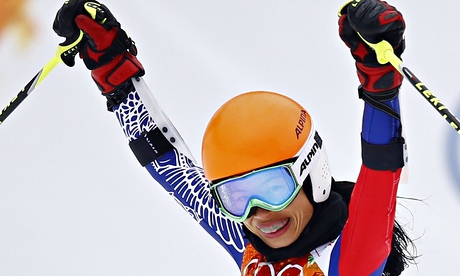
Despite her last place finish, violinist Vanessa-Mae’s giant slalom run at the Sochi Winter Games seemed to define the Olympic spirit – a feelgood tale of sporting fortitude against the odds.
But it will now go down in the history books for altogether different reasons after the International Ski Federation banned the 35-year-old from competitive racing for four years for fixing qualification races in Slovenia.
Vanessa-Mae, the British virtuoso violinist who has sold more than 10m albums worldwide, saw her reputation within the sport plummet downhill faster than her actual run at the Olympics after a panel hearing “found to its comfortable satisfaction that the results of the four ladies’ giant slalom races that took place on 18 and 19 January at Krvavec were manipulated”.
The FIS said that without the manipulation of the results she “would not have achieved the necessary FIS point performance level to be eligible to participate in the Olympic Winter Games”.
The governing body also banned five officials from Slovenia and Italy for between one and two years for their role in the scandal.
“Those who have been sanctioned have been sanctioned for good reason,” said FIS president Gian-Franco Kasper. “At first we were laughing when we heard it. But then we realised it’s quite a serious thing.”
Vanessa-Mae, a British citizen who competed for Thailand as Vanessa Vanakorn using her father’s surname, embarked on an improbable run of results to qualify for her first Olympic Games at the age of 35.
She had tried to enter for Thailand at the 2002 Winter Olympics but at that stage the country had wanted her to give up her British passport in order to do so. However, she was desperate to compete in Sochi.
Her appearance on the Rosa Khutor run at the Games had reignited debate about the standard that should be required before competing in the Olympics, but was welcomed by many of her fellow competitors for bringing extra attention to the race.
“You’ve got the elite skiers of the world and then you’ve got some mad old woman like me trying to make it down,” said a relieved Vanessa-Mae at the time, celebrating amid a media scrum after completing both her runs in challenging conditions in February.
“I think it’s great the Olympics is here, it gives you the chance to try something new later in life. If you do everything when you’re young, you leave no fun until the end. I was lucky that the Olympics, you know, allow exotic nations, for people like me who have day jobs.”
Vanessa-Mae said at the time that the experience was “amazing”, managing to negotiate a course on which 22 of the 89 starters crashed in appalling weather conditions. Ironically, given the illegal assistance afforded Vanessa-Mae by the country’s ski federation, Slovenia’s Tina Maze won the gold medal in Sochi.
Before the Games, Vanessa-Mae had spoken of how her passion for skiing caused a rift with her mother, who was the driving force behind her success. “You can insure yourself up to your eyeballs, but if you don’t take risks, what’s the point? You have to enjoy life,” she said.
Vanessa-Mae, whose result in Sochi could yet be annulled if the International Olympic Committee chose to disqualify her, is likely to have less rose-tinted memories of her competitive skiing career after the extent of the manipulation of her qualifying races became clear.
The FIS, which discovered that two of the competitors listed as being in the race in Slovenia were not even present, said the quality of four qualifying races was falsely inflated to artificially boost Vanessa-Mae’s standing as a potential Olympian.
Race organisers, who staged the event specifically to help Vanessa-Mae qualify, invented times for skiers who did not race and faked finishing times for lower-quality skiers who did finish.
“A previously retired competitor with the best FIS points in the competition took part for the sole purpose of lowering the penalty to the benefit the participants in the races,” the FIS said.
Officials also broke rules by not changing the course design between the first and second runs, and allowing skiers to continue in poor weather which should have led to the races being abandoned.
“The competitions were organised at the request of the management of Vanessa Vanakorn, through the Thai Olympic Committee in its capacity as the FIS member National Ski Association,” skiing’s governing body said.
Vanessa-Mae can appeal within 21 days against the ruling to the Court of Arbitration for Sport. “But it doesn’t make much difference for her,” said Kasper. “She was racing [the Olympics] probably only once and that’s all. But in any case we prevented her from being at the next Olympics.”
The violinist, who released her first album at just 13, was born in Singapore to Thai and Chinese parents but moved to England at the age of four and grew up in London.
She has described her style as “violin techno-acoustic fusion” and became one of the best known and best remunerated musicians in the country with a string of hit albums and television appearances.
The IOC is not expected to take any action of its own until the outcome of any appeal is known.