
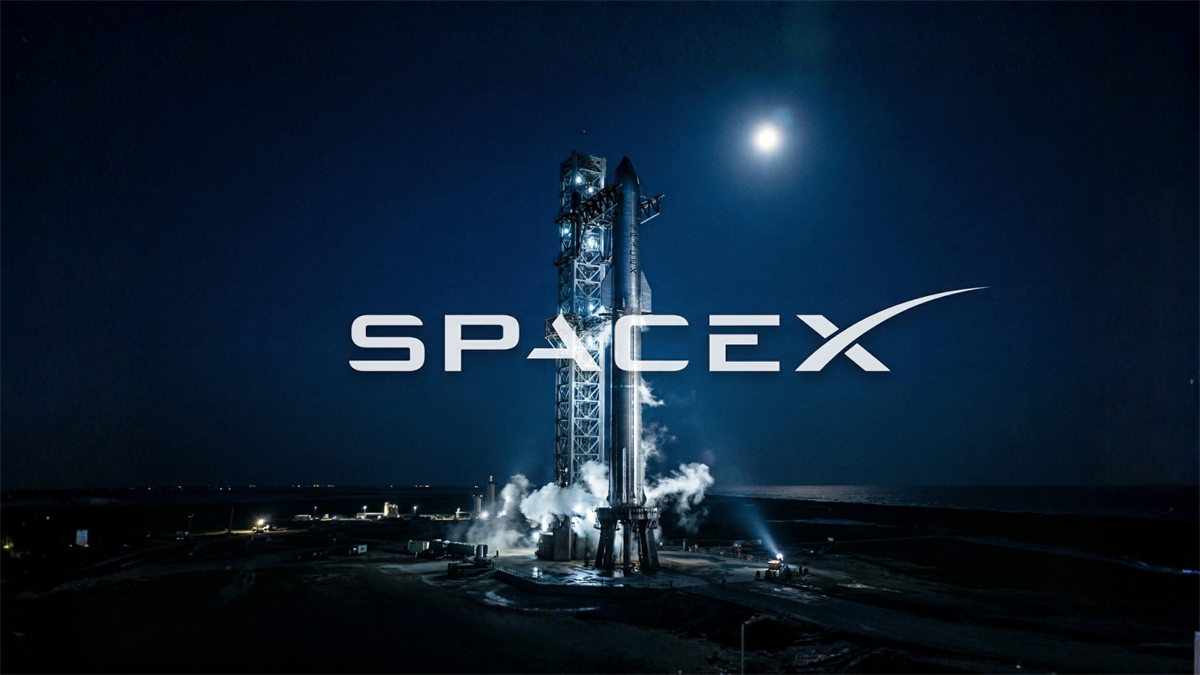
All eyes are on the initial public offering (IPO) calendar as one of 2026’s most highly anticipated debuts prepares for its launch.
On April 1, CNBC reported that Tesla (NASDAQ: TSLA) and Neuralink CEO Elon Musk confidentially filed an IPO for SpaceX with the U.S. Securities and Exchange Commission. The company could be listed on an exchange as soon as June.
Founded in 2002, the aerospace manufacturer and space transport services company is best known for the deployment of its subsidiary Starlink’s satellites.
SpaceX is reportedly seeking to raise up to $75 billion in its IPO, which would be three times the largest IPO in U.S. history. That distinction currently belongs to Alibaba Group (NYSE: BABA), which went public in Sept. 2014 after raising $21.8 billion.
At its current valuation, this would make Musk the first CEO of two trillion-dollar publicly traded companies.
Here is what potential investors and Musk enthusiasts need to know.
A Massive Valuation and Vertically Integrated Business Model
While the satellite stock space may seem like it is getting as crowded as low-Earth orbit (LEO), the collective market caps of the publicly traded companies that call the industry home pale in comparison to what SpaceX will bring to the table. Much of that can be attributed to the company’s multi-layered, vertically integrated business model.
Following the company’s Feb. 2 merger with xAI—the artificial intelligence (AI), social media, and tech firm also led by Musk—SpaceX was valued at $1.25 trillion. Its foundational business segment has positioned the company as the world’s leading launch services provider. That includes SpaceX’s SmallSat Rideshare Program, which provides cost-effective space access for small satellites by launching multiple payloads simultaneously on a single Falcon 9 rocket.
Meanwhile, the company has received notable media coverage for putting more than 10,000 Starlink satellites into LEO since May 2019, providing high-speed, low-latency internet around the globe. Unlike its launch services segment, Starlink provides SpaceX with a subscription-based recurring revenue model that generates the kind of cash flow that investors tend to reward with bullish buying.
Year-end Starlink forecasts for 2026 include:
- 16.8 million subscribers, good for more than 33% year-over-year (YOY) growth
- $11.3 billion in consumer revenue, good for more than 10% YOY growth, with around 85% of that being recurring revenue
- Approximately 133 Starlink mission launches, good for more than 11% YOY growth, deploying a total of 3,500 satellites, good for more than 23% YOY growth
- $20 billion in total revenue, $14 billion in earnings before interest, taxes, depreciation, and amortization; and $8.1 billion in pro forma free cash flow
The merger with xAI adds an additional component, the goal of which could be to present a unified balance sheet to prospective investors in the lead-up to SpaceX’s IPO. The resulting conglomerate means that xAI gains access to SpaceX’s infrastructure and cash flow, while SpaceX can accelerate its integration of AI-powered, space-based computing.
SpaceX’s Massive Government Contracts Point to Foundational Baseline Revenue
Beyond the company’s Starlink subsidiary and its recurring revenue model, SpaceX has grown into a massive defense contractor.
Since 2008, the company has been awarded more than $24.4 billion in federal government contracts. Of those, only around $9 billion has been paid out, leaving approximately $15.4 billion remaining in long-term obligations for future missions through 2030.
Most of those contracts have come via NASA and the Department of Defense, including projects earmarked for the Space Force, Air Force, and numerous U.S. intelligence agencies.
SpaceX’s work with NASA involves the commercial crew program for transporting astronauts to the International Space Station (ISS) via Crew Dragon, the Artemis Program, commercial resupply services for delivering cargo to the ISS, and the development of the ISS deorbit vehicle, which will escort the multinational research laboratory safely to the Pacific Ocean in 2031.
Wall Street’s SpaceX Expectations
Despite the enormity of the IPO, SpaceX’s valuation upon going public could be more than 90 times its 2025 revenue. Early estimates suggest a final valuation that could see shares debut at the $400 level, if not higher.
That stock price could be justified if the company is able to maintain its minimal debt load. In the wake of its xAI merger, SpaceX is focusing on a clean balance sheet in the run-up to its IPO. That suggests that, unlike Musk’s other companies which have carried massive amounts of debt, SpaceX could sustain strong margins and healthy cash flow from its multi-layered business model.
Where Should You Invest $1,000 Right Now?
Before you make your next trade, you'll want to hear this.
MarketBeat keeps track of Wall Street's top-rated and best performing research analysts and the stocks they recommend to their clients on a daily basis.
Our team has identified the five stocks that top analysts are quietly whispering to their clients to buy now before the broader market catches on... and none of the big name stocks were on the list.
They believe these five stocks are the five best companies for investors to buy now...
The article "Valuation to the Moon? SpaceX Gears Up for IPO Liftoff With a Confidential Filing" first appeared on MarketBeat.