The spread of coronavirus variants worldwide and concerns that existing vaccines are less effective against mutated forms of the virus have prompted action from vaccine makers, some of which are developing modified products.
U.S. firms Pfizer Inc. and Moderna Inc. have said their vaccines are effective against the British coronavirus variant. However, there have been claims that the vaccines are less effective against the South African variant.
Several mutated forms of the virus have been identified, including Brazilian, British and South African variants, but existing vaccines have been designed to work against the original form of the virus.
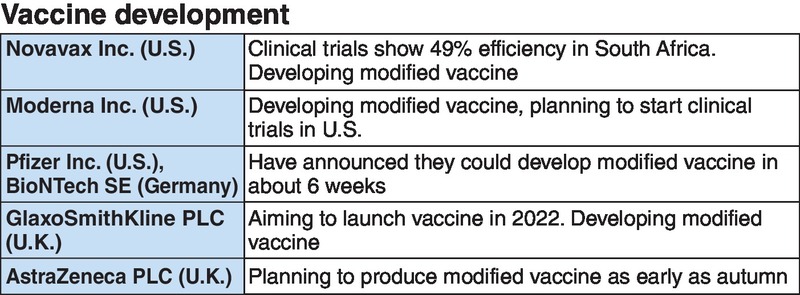
U.S. firm Novavax Inc. announced in late June that clinical trials of a vaccine under development showed 89% efficacy in Britain, but only 49% in South Africa. The South African variant was identified in more than 90% of virus cases detected in South Africa. Novavax said it has started to develop a vaccine to tackle the variant.
Clinical trials of a vaccine being developed by U.S. firm Johnson & Johnson showed 72% efficacy in the United States, while in South Africa the efficacy dropped to 57%.
In January, Moderna announced that antibodies produced by the vaccine in cell-level experiments were one-sixth less effective against the South African variant, but prevented onset of the disease.
The South African and Brazilian variants share some of the same mutations. Although the British variant does not have the same mutations as those in the Brazilian and South African forms of the virus, a small number of similar mutations have recently been reported in Britain, raising concerns in the country.
Moderna has announced that it will create a vaccine that works against the South African variant and begin clinical trials in the United States. British firm AstraZeneca PLC is expected to begin production of a modified vaccine as early as autumn. Pfizer is currently verifying the efficacy of a vaccine against the South African variant that is under review for approval in Japan. BioNTech SE of Germany, which jointly developed a vaccine with Pfizer, announced Tuesday that it could develop a vaccine against new variants in around six weeks.
"We don't know when mutations that make existing vaccines almost ineffective will appear. Japan also needs to take countermeasures," said Tsuyoshi Inoue, professor of structural biology at Osaka University.
Read more from The Japan News at https://japannews.yomiuri.co.jp/