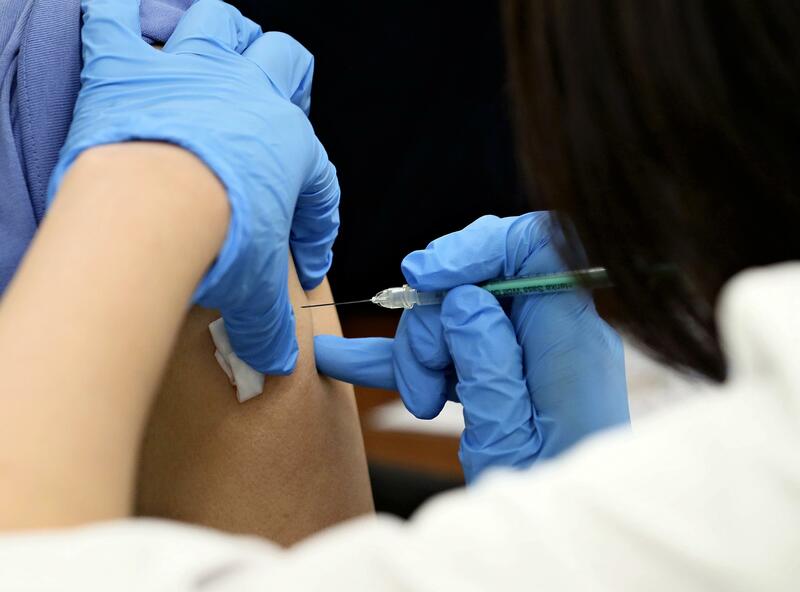
Vaccination opportunities for the younger generations will likely increase rapidly as the government intends to allow COVID-19 vaccinations at workplaces and universities from June 21.
The central government's move, announced Tuesday, has not been entirely welcomed. As local governments have been tasked with drawing up vaccination plans for residents, some have suddenly been forced to change their plans and are scrambling to gather the latest information.
"So far, we were lumped into the category of 64 and younger and didn't know when our turn would come," a 61-year-old company employee said Wednesday after leaving his office in Minato Ward, Tokyo. "If I get vaccinated, I'll have fewer worries about infection during commuting. It's good that there will be more opportunities for people to get vaccinated."
Since April, vaccination programs operated by local governments have started with a priority group of people 65 and older. Although the central government has called for vaccination vouchers to be sent to those 64 and under around mid-June, clear prospects for the start of inoculations for these younger people have not been shown through only the initiative of local governments.
Given the situation, the plan to allow vaccinations to be conducted at companies and universities emerged.
"I was surprised to hear that university students will suddenly become eligible to be vaccinated as I've heard that there's not much progress in vaccinations for the elderly," said a 21-year-old senior at Hosei University in Tokyo.
She added hopefully, "Our campus life might return to normal."
-- Support for SMEs sought
Vaccination czar Taro Kono, who is also the minister in charge of administrative and regulatory reform, said Wednesday that he intends to have firms of more than 1,000 employees be the first to handle workplace inoculations. Preparations are underway at large companies. For small and midsize enterprises, many of which do not have such strong financial foundations, they have found it difficult to secure medical personnel who will administer the vaccines, so support is being requested. Many companies also do not have in-house doctors or other medical staff.
"The biggest problem is securing medical resources," Akio Mimura, chairman of the Japan Chamber of Commerce and Industry whose members are mainly SMEs, said at a press conference Wednesday. "Doctors have to conduct interviews, and people who are qualified to give shots are also needed."
-- Causing confusion
While preparing for vaccinating the rest of the public after the elderly, local governments are also scrambling to respond to the new vaccination plan.
The Sapporo city government has been unable to consider when to start vaccinations for younger residents as it remains unclear when inoculations of the elderly will be completed. A city government official in charge welcomed the plan to launch vaccinations at companies and universities, saying, "That will speed up the overall vaccination drive."
However, it is unclear how the city government can ascertain the status of its residents' vaccinations at companies.
"We are gathering information, but to be honest, we are confused," the official said.
An official of Shinagawa Ward, Tokyo, also expressed confusion.
"We didn't know anything about conducting vaccinations at workplaces until we heard the news reports," the official said.
"We have to review the current vaccination plans and it's perplexing," this official added. "Municipalities operating in the field are being pushed around."
-- Uniting universities
At least seven national universities, such as Tohoku University and Hiroshima University, are coordinating to start vaccinations as soon as possible through arrangements made by the Education, Culture, Sports, Science and Technology Ministry.
According to the ministry, the seven universities responded positively to its preliminary survey on their willingness to serve as vaccination venues. The ministry plans to allow universities to decide who will be vaccinated, such as faculty members and students, as well as secure medical personnel and set up vaccination venues. It is also expected to allow people to receive shots at these venues without vaccination vouchers.
Some of these universities are struggling to secure doctors, however.
"We want to cooperate if requested, but we don't have a medical school," said a person in charge of general affairs at Toyohashi University of Technology in Aichi Prefecture. "If our university becomes a vaccination venue, securing doctors will be a problem."
An official of Obihiro University of Agriculture and Veterinary Medicine in Hokkaido echoed a similar view, saying, "As we have only one resident doctor, it will be difficult to secure many more."
Read more from The Japan News at https://japannews.yomiuri.co.jp/