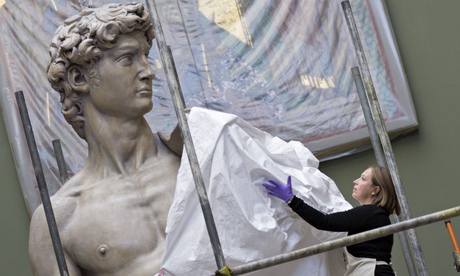
The five-metre high plaster cast of Michelangelo’s David towers above a sacred scene of tombs and pulpits in the V&A’s refurbished cast courts, looking on with a furrowed brow. “It’s the first time he’s been cleaned for 30 years,” says conservator Johanna Puisto from her ladder, hoover in hand. “He was covered in a thick layer of museum dust and his skin was peeling in places.”
Now patched up and scrubbed up, this David double forms the centrepiece of the museum’s Italian cast courts, one of two halls of plaster copies that will reopen this week after a three-year period of conservation.
Originally opened in 1873, the galleries were conceived as a definitive collection of great works from Europe, full-size fragments of exotic cathedrals and palaces, duplicated in London for all to see. It was an aristocratic grand tour for the armchair explorer, conveniently compressed into two rooms.
One contemporary critic compared his first glimpse of the collection to a sighting of Mont Blanc, creating one of those “impressions that can barely be effaced”. And there is still a sense of awe on encountering this stash of simulacra and the scale of Victorian ambition, bringing chunks of great buildings together in one place.
At one end stands a replica of the Gates of Paradise, a gigantic pair of gilded doors made in the 15th century for the Florence baptistery, their biblical scenes sculpted in high and low relief to create a beguiling sense of architectural depth. They face off against a monumental portal from the San Petronio basilica in Bologna, its arched pediment barely able to fit inside the 24-metre-high room. Between them stand finely wrought doppelgangers of Donatellos and replicas of other Renaissance masters.
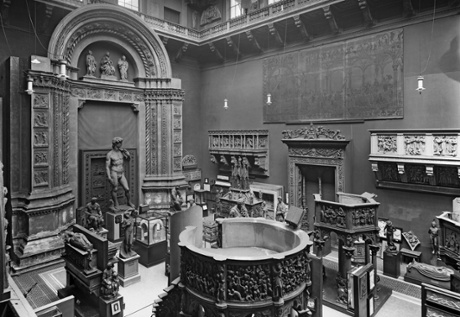
The fate of this magnificent collection wasn’t always certain. “We’re lucky so many pieces have survived,” says senior curator Marjorie Trusted. “Casts were out of favour for a long time, when there was a kind of snobbery against studying copies that saw many other museums dispose of their collections.” Years later, they now serve as invaluable records of the originals, which have often been subject to battering by the elements or botched restoration jobs.
As the only V&A galleries that display the same objects as when they first opened, the cast courts also provide an illuminating picture of Victorian mores. Behind David, framed on a plinth, is a half-metre-long plaster fig leaf – a generous modesty flap that was originally installed on the naked giant so visiting ladies would not blush.
Once crammed full of ephemera, from models to paper mosaics, the display has been thinned out to allow each piece to breathe. In the centre of the room, the younger Giovanni Pisano goes up against his father, Nicola, in a duel of pulpits from Pisa, with torrents of putti and foliage spilling from their mouldings. Cast in plaster, stripped of the gaudy Italian marble and gilding, they stand like mute, white ghosts of the originals – which makes their differences easier to read.
Organised with the pick’n’mix logic of the original display, the leaps between places and periods can be baffling. A huge window from the Certosa monastery in Pavia stands beside the tomb of Henry VII of Luxembourg from 150 years earlier, a tabernacle from a Florentine church and friezes from a 16th-century hospital.
It is a curatorial approach that compelled an enraged student to write to the Times in 1882, describing the cast courts as “a gigantic curiosity shop arranged on no comprehensible principle, which can only perplex and irritate the student”. “The result conveyed to the mind of the ordinary sight-seer,” he continued, “must be one of absolute confusion.” For better or worse, this glorious Victorian muddle remains true to its roots.