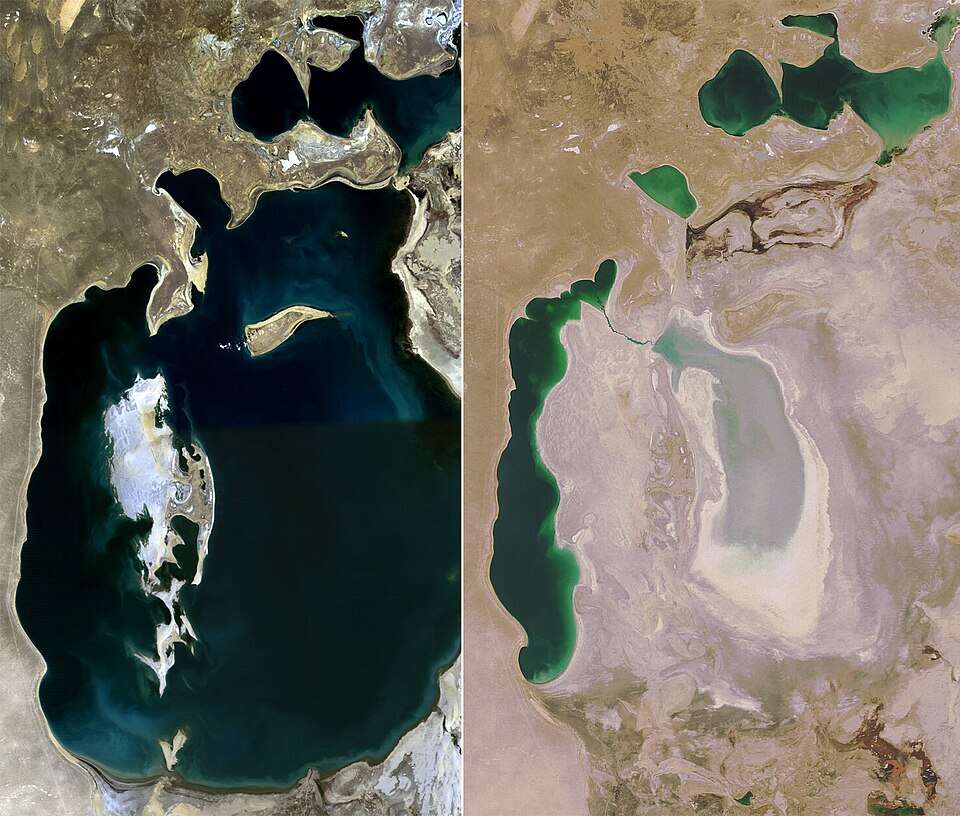
The Aral Sea, once among the world’s largest inland water bodies, is now one of the clearest examples of human impact on an ecosystem. Situated between Kazakhstan and Uzbekistan in Central Asia, the fourth-largest water body in the world has lost about 90 percent of its volume during the last half-century. This led to the formation of a vast desert called the Aralkum.
Get breaking news anytime, anywhere. Download the TOI app now!
Now, international organizations are backing efforts to address the damage. A €100 million project proposed by the European Investment Bank (EIB) seeks to help the Aral Sea region of Uzbekistan address water use and irrigation problems.
Disappearance of the Aral Sea
The Aral Sea began shrinking in the 1960s, during the Soviet era, when water from the Amu Darya and Syr Darya rivers was diverted to boost agricultural output in Central Asia. According to the National Aeronautics and Space Administration , the Aral Sea shrank slowly over decades because the rivers feeding it were diverted. The Aral Sea was split into several parts by the 1980s, and most of its southern part was gone by the early 2000s.
The problem was compounded by an inefficient irrigation system, which wasted large amounts of water. The inefficiency of irrigation and drainage systems resulted in soil salinization, waterlogging, and desertification in the region. The outcome was disastrous: fishing villages that depended on the sea were abandoned as the water receded, leaving ships stranded on the former seabed in the region’s well-known ship cemeteries.
A disaster that has caused millions to suffer from its effects
Beyond harming marine life, the drying of the Aral Sea has affected millions of people living in its basin. The Aral Sea disaster has reportedly caused economic hardship, unemployment, and environmental damage in Karakalpakstan, an autonomous republic of Uzbekistan that has been heavily affected.
As the sea dried, salts and chemicals left in the soil by years of irrigation were exposed and are now being carried to other areas by the wind. A study published in the journal Aeolian Research found that the dried seabed of the Aral Sea had become a major source of dust and salt storms, with airborne particles carrying salts and pollutants across surrounding regions.
The €100 million project to repair decades of damage
In 2018, the United Nations launched the Multi-Partner Human Security Trust Fund for the Aral Sea Region to support efforts aimed at improving livelihoods, strengthening environmental resilience and addressing the consequences of the Aral Sea disaster in Uzbekistan and neighbouring areas.
As reported by the EIB, the measures to be taken concerned improving irrigation and drainage systems, reducing water losses, and increasing water resources for the Amu Darya Basin. One target was to save 20 percent to 25 percent of water use, leaving more water in rivers and ecosystems instead of losing it to the old agricultural system. The EIB’s plans also include restoring degraded land through agroforestry.
Efforts of Uzbekistan to breathe life back into the region
Uzbekistan also began some projects to restore the destroyed landscape. In 2018, the United Nations launched the Multi-Partner Human Security Trust Fund for the Aral Sea Region to support development projects, improve livelihoods and address environmental challenges caused by the shrinking Aral Sea.
The government has also tried to establish forests on the exposed seabed. According to the United Nations, large-scale planting of drought-resistant species such as saxaul trees has been carried out to help stabilise the dry land and reduce dust storms. Experts, however, say it is not possible to restore the Aral Sea to its former size because the original water balance has changed too much.
Aral Sea restoration: Is it possible?
The Aral Sea is widely seen as an environmental tragedy, but there has been some progress in recent years. In northern Kazakhstan, the smaller North Aral Sea began to recover in 2005 after the Kok-Aral Dam was built with support from the World Bank and the government of Kazakhstan.
According to the World Bank , the construction of the Kok-Aral Dam in Kazakhstan helped raise water levels in the Northern Aral Sea, reduce salinity, revive fish production, and support the recovery of local ecosystems. The prospects for the southern part of the Aral Sea in Uzbekistan are much less promising, because most of the lake was lost there.
The drying up of the Aral Sea shows the long-term consequences of diverting natural resources without adequate safeguards. However, current restoration efforts show that parts of the region can still be improved with sustained investment.