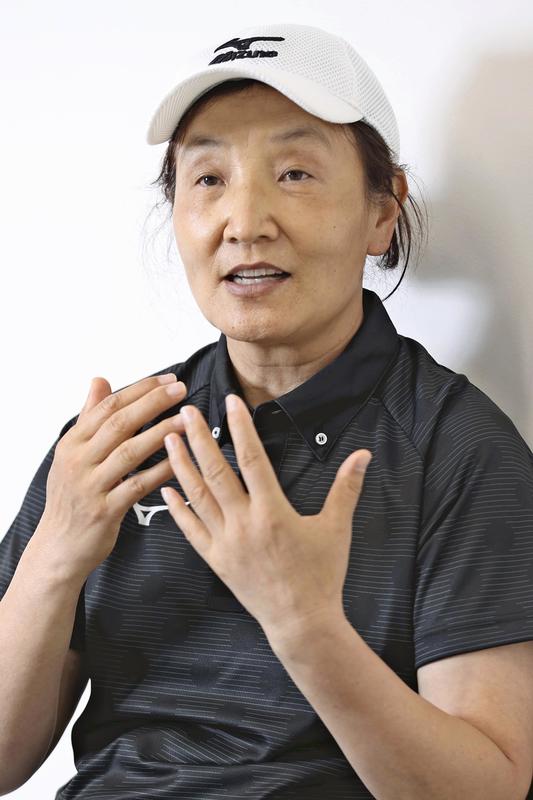
When the Japan Softball Association was looking for candidates to coach the team for the Tokyo Olympics, Reika Utsugi's name was naturally high on the list.
The Beijing-born Utsugi, who had been a star player for Japan after becoming a citizen in 1995, had gone on to lead the national team to world championships in 2012 and 2014 during a stint as manager that started in 2011.
But when the association called on her in the fall of 2016 to return to the helm, she initially turned down the offer.
"The Olympics are going to be held in Japan, so it be a great honor for a Japanese to become [manager]," the 57-year-old Utsugi explained in an wide-ranging interview recently with The Yomiuri Shimbun. "I didn't have a personal desire to do it anymore, so I thought it was better not to accept."
Utsugi eventually was convinced, and convinced herself, to take the job, which she sees as a way to repay her "second homeland." But it also epitomized the mixed feelings she has had during a career that has drawn both praise and criticism in both countries to which she identifies.
Born in 1963, Utsugi came to Japan in 1988 to play in the domestic league and became naturalized in 1995. She was a member of the Japan team that won a silver medal at the 2000 Sydney Olympics, and served as captain of the squad that took a bronze at the 2004 Athens Games.
Despite her success, she had to endure the ugly side of nationalism at times. When she was in a slump, she would hear calls of "Go back to China!" And when she was flag-bearer for Japan at the 1998 Asian Games, she came under attack from the Chinese media.
Caught between a rock and a hard place, such memories do not fade away easily.
"I was born and raised in China, and for that my feeling of gratitude is very strong," Utsugi said. "But getting to the point that I dream in Japanese, I have no qualms about being called a Japanese."
Utsugi went on to add that she never looks at the Internet, thus avoiding malicious comments.
"If I become too shocked to continue [the job], who would help me? I have to protect myself," she said.
Even so, she decided to take the national team job as thoughts of the positive aspects overcame any lingering doubts.
"My mother and father would often say, 'When everyone around you is happy, then you can start being happy.'"
She also recalled the words of Taeko Utsugi, her mentor and former national team manager: "You have to get people to support you regardless of whether you win or lose."
"Japan has accepted me," Reika Utsugi said. "If I can make those people happy by winning at the Olympics, then that will make me happy, too. Looking at Japan softball overall, I thought I had to [take the job]."
When the Tokyo Olympics was postponed for a year, Utsugi took the news a with positive attitude. She did not think that the event could spread happiness amid such anxiety.
"Sports is not just about winning and losing," she said. "It's something that gives joy or encouragement. To watch an event amid such sadness [while the pandemic rages], it's no fun even if your side wins. The postponement was good. It might raise the chances of younger players [making the national team]."
Utsugi is progressing with the task of selecting the national team, taking into consideration minute details derived from watching videos, analyzing data and comparing results against other countries. Naturally, she gives weight to being mentally strong.
"To win the gold medal, it matters how strong your desire is," she said. "I want to put together a team of players who are energetic and can express themselves with their play on the field. Also, they should be able to respond with a smile when they don't want to talk [to the media or others]. These are the ones who will be happy."
Utsugi is confident that her strategy and tactics have been validated by her results. She also strongly believes there will be a happy ending in one year's time.
Read more from The Japan News at https://japannews.yomiuri.co.jp/