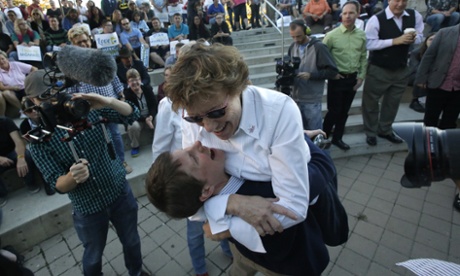
Hours after celebrating in front of Salt Lake City’s public library on Monday night, a dream-like euphoria still clung to the campaigners who helped make same-sex marriage a reality in Utah.
“It’s difficult to express in words,” said Peggy Tomsic, a lawyer who spearheaded the case. “Growing up here there was such hatred for gays and lesbians. Men would come into bars and beat women with sticks.”
The supreme court’s decision earlier that day not to hear an appeal by Utah and four other states seeking to retain their gay marriage bans delivered a victory that once seemed unimaginable. “It’s historic. I didn’t think it’d be a reality in my lifetime,” said Tomsic, 61.
Others expressed the same sense of wonder, barely daring to pinch themselves. How did a small, underfunded and at times ragged campaign help tilt arguably the most conservative state in the union – and much of the rest of the United States – to a new compact?
The unlikely cast included a high-school English teacher, a Lebanese refugee, a dying doctor and, indirectly, a combat engineer-turned-judge. They defied the combined might of the state’s Republican party establishment and the Church of Jesus Christ of Latter-day Saints, better known as the Mormon church, which has dominated this corner of the Rockies since the 19th century.
Their success showed the Beehive state no longer quite fits the stereotype of tabernacles and prohibition: Salt Lake City is a – relative – gay Mecca; and some conservatives here have accepted change with pragmatism and grace.
“I know this sounds silly but I believe that people recognise love,” said Kody Partridge, one of the victorious plaintiffs. “Love, equality, justice, those are the elements on the right side of history.”
Perhaps. But for a long time much of Utah did not get the memo. To be lesbian, gay, bisexual or transgender (LGBT) triggered huge pressure to conform, and ostracism if you did not, said Kate Call, 61, another plaintiff, who used to live in southern, rural Utah.
When word got out in 2007 that she and her then female partner were a couple they lost their jobs and nobody would employ them, not even as labourers, she said. “We had to sell our sheep, board up our ranch and borrow money to move.”
They came to Salt Lake City. Notwithstanding the Mormons’ temple and skyscraper headquarters, and young missionaries in ties and long skirts strolling downtown, LGBT people from rural areas saw this tidy, prosperous, medium-sized city, population 191,000, as a cosmopolitan magnet where they could be out and proud.
And organised. There were bars, clubs, blogs and advocacy groups, especially for the right to adopt children. Over a quarter of gay couples here have children, often from previous, heterosexual relationships, and often want new partners to have parental rights.
They were outmatched in 2008 when well-funded local conservative religious leaders campaigned for Proposition 8, which banned same-sex marriage in California.
In 2010 Call met a new partner, Karen Archer, a retired obstetrician and gynaecologist with a terminal disease. A year later they resolved to marry to gain legal recognition as a couple for medical, insurance and inheritance purposes.
A handful of states had by then granted same-sex marriage, stirring talk of a marathon, perhaps decades-long slog to extend the right to other states. Call and Archer assumed Utah would be the last to fall but did a “bare bones sort of wedding” in Illinois and returned home hoping Utah would eventually recognise it.
The Advocate magazine listed Salt Lake City as the US’s sixth gayest city, but there was little reason to think Mitt Romney’s home state would join such gay rights milestones as Stonewall (1969) and Massachusetts (2004).
Restore our Humanity, a grassroots advocacy group founded by Mark Lawrence, started canvassing law firms to fight for marriage equality. A small litigation firm, Magleby & Greenwood, agreed to let one of its attorneys – Tomsic – take up the cudgels.
A lesbian who wished to formally become a parent to her partner’s daughter, Tomsic had a personal stake in the fight: in Utah it is all but impossible to adopt unless you are married.
With Restore our Humanity’s help she identified three very different couples to press the case. Despite disparities in ages and backgrounds, the experience turned them into friends.
For Call and Archer, both in their 60s, there was urgency to have their Illinois marriage recognised before Archer died.
Partridge, 48, a high-school English teacher, and Laurie Wood, 59, a university English professor, shared a passion for literature, gardening and dog-walking, and yearned to have their commitment recognised by the state. “We plan to spend the rest of our lives together,” said Partridge.
Derek Kitchen, a Salt Lake City native, and Moudi Sbeity, who had fled war in Lebanon, were both 26, and met through Sbeity’s blog. They shared a home, did a joint Ted talk about tolerance, and built a business packaging hummus and other Middle Eastern food. “We knew we were ready to commit,” said Kitchen.
The case, known as Kitchen v Herbert (Utah’s governor is Gary Herbert) sought to overturn amendment 3, which defined the institution of marriage as a relationship between one man and one woman. It was a measure passed by 65% of Utah voters in 2004.
The shoestring campaign launched by Restore Our Humanity, and efforts by the plaintiffs and law firm itself, raised just $212,880 of a nearly $1m legal bill. Magleby & Greewood excused Restore Our Humanity of its obligations to pay the balance of the bill, and the firm and plaintiffs have sought donations from the grass-roots supporters of the case.
Tomsic was gearing up for battle, but not especially optimistic, when in June 2013 the supreme court ruled that part of the Defence of Marriage Act (Doma) was unconstitutional, a landmark decision prompted by Edith Windsor, a widow who sought federal estate tax exemption for the estate of a woman she had married in Canada.
Tomsic sensed a seismic shift rumbling all the way to Salt Lake City. “I thought, you know what, I think this is going to happen.”
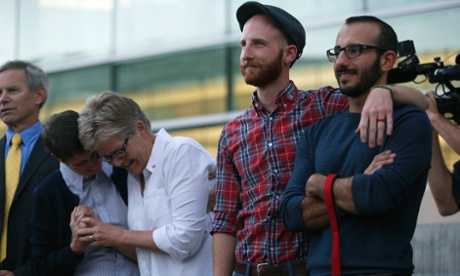
The plaintiffs had braced for a fraught trial with questions about their fitness to raise children but instead Judge Robert Shelby of the US district court for Utah opted for a summary judgment.
Shelby had served as a combat engineer in the Persian Gulf conflict and was a registered Republican. Utah’s Republican senators, Orrin Hatch and Mike Lee, had lauded him when he was first appointed.
But on 20 December 2013, in a 50-page ruling, the judge said Utah’s ban on same-sex marriage violated the constitution and that gay and lesbian couples had a fundamental right to marry. He detailed how the plaintiffs met and fell in love and referred to them by their first names.
For the next 17 days, until authorities obtained a stay, more than 1,200 same-sex couples – including Partridge and Wood, and Tomsic and her own partner – married in Utah.
By fluke Partridge and Wood ran into Shelby and his wife at a gallery. “I gave him a hug,” said Partridge. “I’m the youngest of five children. I hug people. He was very gracious.”
Shelby was condemned by GOP leaders but entered LGBT lore. “The wisdom of his words was quoted in other cases and is something that will go down in the gay history of the United States of America,” said Jim Dabakis, Utah’s only openly gay state senator.
On Monday Utah’s conservative leaders found themselves frozen out, along with Indiana, Oklahoma, Virginia and Wisconsin counterparts, when the supreme court refused to hear their pleas to keep same-sex marriage bans.
Partridge struggled to capture the feeling in words. “Surreal, unbelievable. Just amazing. We’re thrilled.”
Opponents were also incredulous – but some proved gracious and pragmatic in defeat. Governor Herbert expressed disappointment and swiftly ordered officials to follow “the law of land”.
Dallin Oaks, a senior Mormon elder, appeared to anticipate the decision with a statement on Saturday urging followers to coexist peacefully with those who held different values. “We should love all people, be good listeners, and show concern for their sincere beliefs. Though we may disagree, we should not be disagreeable.”
Others, such as Lee and Hatch, suggested the fight was not yet over. Dabakis, who presided at several same-sex marriages this week, predicted resistance would ebb and that legislators from both sides would cooperate on the nuts and bolts of marriage equality.
The state’s attorney general’s office announced it would abandon an attempt to prevent same-sex spouses from receiving full marital benefits, and would lift a hold on four pending adoptions of children to same-sex parents.
In contrast to the bitterness of Utah’s 2004 vote, when 65% approved a gay marriage ban, and the 2008 foray into California’s own vote on the issue, the tone has remained largely civil and respectful.
An opinion poll earlier this year showed the public mood had shifted and that there was now an even split on same-sex marriage.
One reason was demographic – younger people do not see the big deal, said Tomsic, the attorney. The other reason, she said, was the impact of those 17 days in December and January when gay couples flocked to register offices. “The joy of those scenes, the happiness – it made it very hard to maintain this sense of threat. It made people realise that there is nothing to hate, nothing to fear,” she said.
Kitchen attributed the change to the drip drip of people coming out of the closet, as he himself did a decade ago, aged 15. “Once we stopped hiding and started having conversations, once they knew who we were, they weren’t afraid of us.” He plans to wed Sbeity in spring. “We don’t need to rush. We want to invite family and do it right.”
• This story was amended on 28 October to more accurately reflect the sum of the plaintiffs’ legal bill.