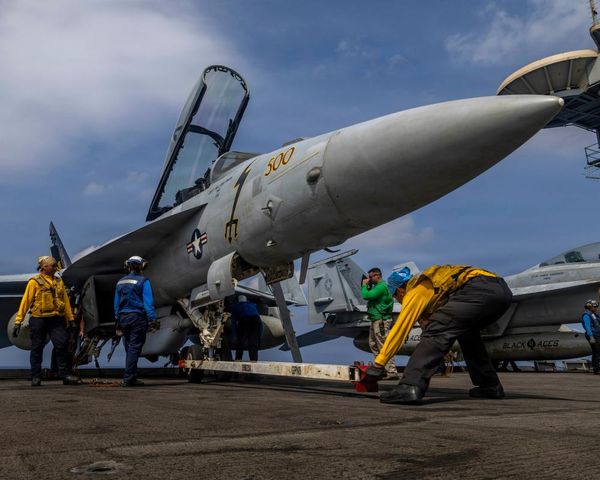
A US aircraft carrier ordered by the White House to rapidly deploy to the Mideast over a perceived threat from Iran remains outside of the Arabian Gulf, amid efforts to deescalate tensions between Tehran and Washington.
Officers aboard the USS Abraham Lincoln repeatedly told The Associated Press on Monday they could respond rapidly to any regional threat from their position, at the time some 320 kilometers off the eastern coast of Oman in the Arabian Sea.
On Sunday, the US Air Force announced a B-52 conducted a training exercise with the Lincoln that included "simulated strike operations."
However, after decades of American aircraft carriers sailing through the Strait of Hormuz, the US Navy's decision to keep the Lincoln away is striking.
"You don't want to inadvertently escalate something," Capt. Putnam Browne, the commanding officer of the Lincoln, told the AP.
Asked about why the Lincoln hadn't gone through the strait, Rear Adm. John F.G. Wade, the commander of the carrier's strike group, said that his forces could "conduct my mission wherever and whenever needed."
"They (Iran) do impose a threat to our operations, but also to the safety and security of commerce and trade going through the Strait of Hormuz and that's why we are here," Wade said.
On Monday, F/A-18s flew maneuvers over the carrier. Accompanying the Lincoln to the Mideast are three destroyers — the USS Bainbridge, the USS Mason and the USS Nitze — as well as the guided-missile cruiser the USS Leyte Gulf.
Iran is readying to commemorate Ruhollah Khomeini's death on Wednesday. This year, Iranian military officials reportedly plan to guard it with HAWK surface-to-air missiles, the same kind the US delivered to Tehran in the Iran-Contra scandal of 1985.