
AHMEDABAD: Use of condoms has remained a taboo subject in Gujarat, and India at large – as men have largely remained reluctant to use the over-the-counter contraceptive rendering it a topic of jokes and even an OTT film recently.
The scenario is changing, however, according to the recent findings of the National Family Health Survey (NHFS)-5 that was conducted in 2019-20.
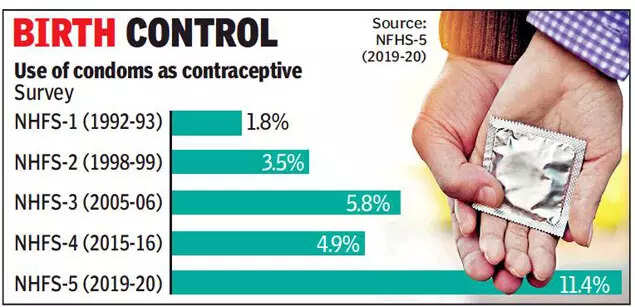
The survey results indicated that overall, 11.4% of the surveyed population used condom as a family planning method. This is a major jump considering this population was only 4.9% in the last survey in 2015-16.
Among the urban population, condom use was 16.8% while it remained less than half at 7.5% in rural areas. Both urban and overall numbers were remarkably higher than the national average of 13.6% and 9.5% respectively. For the rural areas, it was the same as the national average of 7.6%, indicating increased awareness and usage among urban populations.
However, female sterilization remained the most-practised family planning method at 35.9% where rural areas accounted for 40.8% compared to 29.1% in urban areas. These results were also closer to the national average.
Dr Alpesh Gandhi, the immediate past president of the Federation of Obstetric and Gynecological Society of India (FOGSI) and Ahmedabad-based gynecologist, said that the results are encouraging.
“Traditionally women bear the burden of family planning – and as the survey highlights, females either undergo sterilization or intrauterine device (IUD) such as Copper T. Reluctance of their male partners to use condoms is a major factor behind the phenomenon,” he said.
“But our clinical experience highlights that the women undergoing institutional delivery are often more aware of family planning methods. Gujarat has a very high institutional delivery rate of over 90%. Thus, awareness may also have played a part in the rise in condom use.”
An earlier survey showed that condom sales rise by less than 2% annually and are not the most popular of contraceptives overall. Another survey indicated that only 7% of women and 27% men ever used condoms in pre-marital sex and depended on other methods for ‘safe sex.’
Pallavi Patel, director of city-based NGO CHETNA that closely works with women on reproductive health and other issues, said that the need of the hour is to talk more about contraceptives. “Our field experience says that condoms are still not popular in rural areas where men refuse to use them. But as shown in survey, it might have to do with a large younger population that is more aware about use of contraceptives for both sexual health and family planning,” she said.