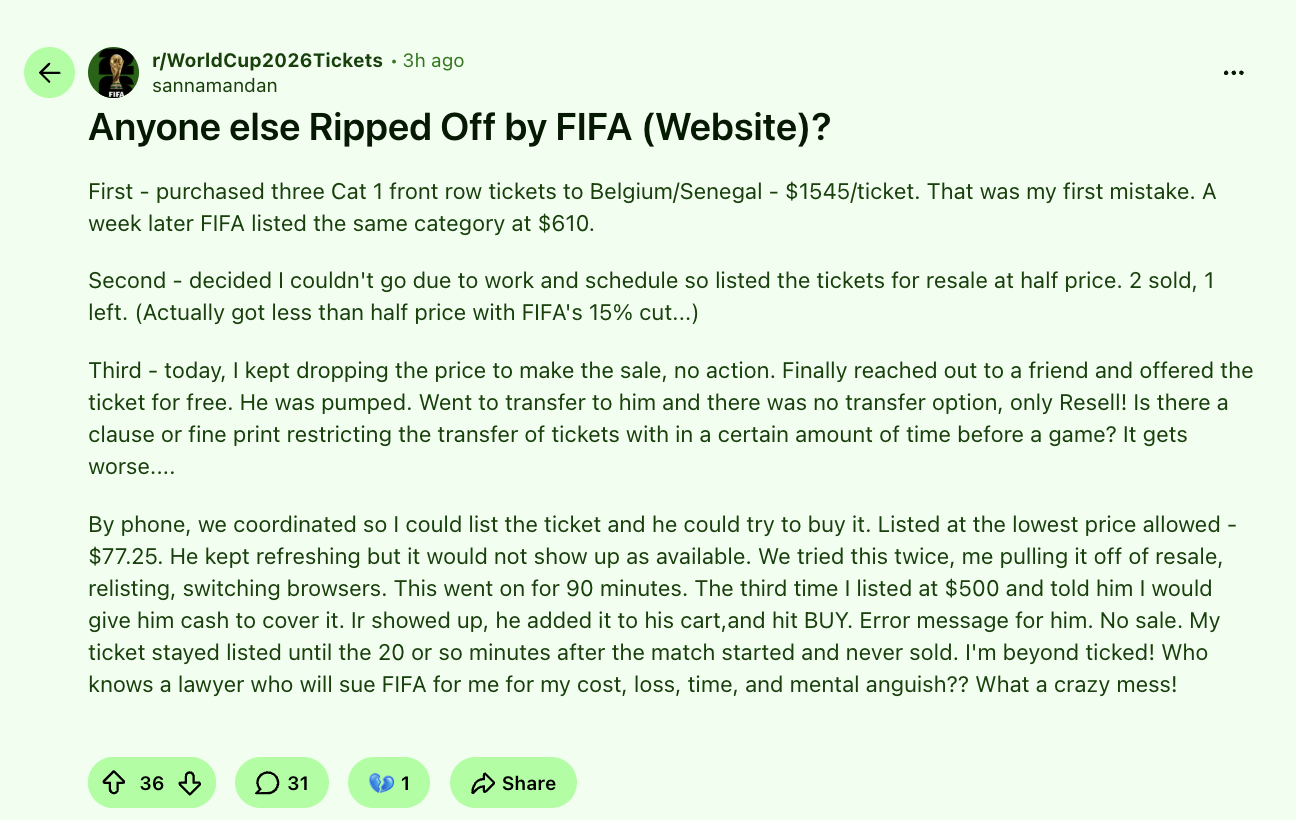
A fan who paid $1,545 (£1,160) each for three front-row World Cup seats said he could not sell them, could not give one away for free, and watched the last ticket stay listed on FIFA's own marketplace until about 20 minutes after kick-off.
The account, posted on Reddit's r/WorldCup2026Tickets forum, describes repeated failed attempts to sell or hand over tickets to a Belgium versus Senegal match.
The fan said he bought three Category 1 tickets, only for FIFA to list the same category at $610 (£458) a week later. Unable to travel because of work, he put the seats up for resale at half price. Two sold. The third did not.
When he tried to give the remaining seat to a friend at no cost, he said the platform offered no transfer option, only resale. The pair spent about 90 minutes coordinating by phone, listing at the lowest permitted price of $77.25 (£58), relisting and switching browsers. On a later attempt at $500 (£375), the buyer reached the checkout and pressed buy, then hit an error message. The sale failed. He described himself as 'beyond ticked' and called the process 'a crazy mess'.
The 2026 World Cup is the first with 48 teams and 104 matches, spread across 16 host cities in the United States, Mexico, and Canada from 11 June to 19 July. It is also the first at which FIFA has used dynamic pricing, adjusting primary ticket prices by demand, alongside an official resale marketplace with no price cap in the US and most of Canada.
How FIFA's Resale System Charges Both Sides
According to FIFA's official resale terms, the governing body charges a 15% facilitation fee to the seller and a separate 15% to the buyer, a combined cut of about 30% of the sale price. At Qatar 2022, resale fees were capped at 5%.
FIFA separates a transfer, which moves a ticket to a friend or relative at no charge, from a resale, which involves payment and the fees. Resale purchases are final; no buyer refunds are issued once payment clears. Any ticket still listed one hour before kick-off is removed from sale and returned to the original account.
In the United States and most of Canada, sellers can list at any price, so tickets often appear above face value. Matches in Toronto and in Mexico are capped at the original price or lower under local law. Buyers outside the US are billed in local currency, so a UK fan pays in pounds.
Attorneys General Probe World Cup Ticket Prices
On 27 May, New York Attorney General Letitia James and New Jersey Attorney General Jennifer Davenport subpoenaed FIFA over its ticketing, saying prices had 'far exceeded the prices for any previous World Cup tournament.' Their offices said that between October 2025 and April 2026, FIFA raised prices on more than 90 of the 104 matches, with the three main categories rising an average of 34%.
Davenport said FIFA had turned ticket-buying into 'a gauntlet of confusion, fake scarcity, and impossibly high prices.' By then, FIFA had tripled the price of its most expensive final seats to about $32,970 (£24,730), and tickets for the eight matches at New Jersey's MetLife Stadium were averaging about $2,800 (£2,100).
New Jersey representatives Nellie Pou and Frank Pallone wrote to FIFA president Gianni Infantino, alleging dynamic pricing 'ripoffs' and saying prices were 'being held artificially high, even when the market signals otherwise.'
Several fans who bought resale tickets have said they were left without valid seats on match day since the tournament began, with many complaints directed at StubHub.
StubHub blamed FIFA's 'ticketing infrastructure', saying app problems had affected transfers across resale platforms. FIFA said it can only guarantee tickets bought through its own platform. Infantino has defended the pricing, saying the tournament operates in the US entertainment market and must 'apply market rates'.
The fan said the ticket stayed listed until the match was underway and never sold, leaving him with a seat he could not shift for $77.25, having paid $1,545 for it.