Agudelo adds the perfect note of caution for Morris
Let’s not forget that Jordan Morris is a college student. Having come through the youth system at Seattle Sounders, just as DeAndre Yedlin did before him, Morris has elected to stay at Stanford University for the foreseeable future, and it’s in that capacity – as a college kid – that he’s earned his national team moments so far.
And moments they have been. Until Wednesday night, Morris has been restricted to brief cameos that haven’t told us much about him. His college status has been the most distinctive thing about him for most casual observers.
And then, for a game against Mexico at the Alamodome, Klinsmann elected to start Morris alongside a barely more seasoned Gyassi Zardes to lead the US line. It had the classic hallmarks of one of Klinsmann’s hazing rituals for young players, which often seem unbelievably risky until their habit of panning out for him, at least in the short term.
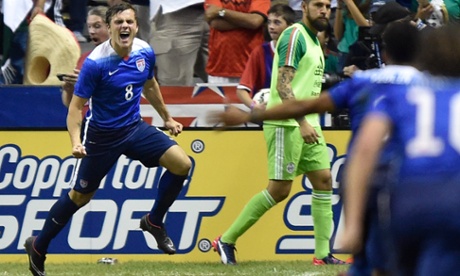
And sure enough, after showing some pace and nervelessness in the first half, Morris stayed alert and smart early in the second to make the run that found him with the ball at his feet in front of the Mexican goal. And when he slotted the ball coolly under Cirilo Saucedo a star was born.
Or not. There’s plenty of time for Morris’s star to rise and fall in the next three months, let alone the next three years until Russia. And if Morris needs reminding of that, he only needs to look at Juan Agudelo, who was subbed into the game late, trapped a raking ball from Michael Bradley, then cut inside to finish coolly from the edge of the box with his marker sprawling.
Agudelo famously scored on his debut as a 17-year-old after the last World Cup, before embarking on a circuitous route through the edges of a European career, and ultimately a route back to MLS with New England. His talent is undisputed, even if his application has been erratic, but his example as a player who has earned his way back into consideration is certainly the more profound achievement than a splashy first impression, and hopefully Morris is smart enough to note that. Not every fan will, for sure.
Never mind the Dos, feel the Cero
It’s hard to overstate the importance of the USA not conceding in the second half. Their habit of conceding late goals started as a slightly noteworthy trend in the build up to the World Cup – particularly in their warm-up games in June – but by the time of their last loss pair of friendlies against Switzerland and Denmark it had become a pronounced tic.
Since those pre-World Cup goals didn’t immediately affect results, they were treated a little bit like fitness issues at the start of a domestic season – something to doubtless be ironed out as the real competition got under way. But from the late slip against Portugal in the tournament proper, the habit showed the first signs of sticking, and it has persisted since the World Cup through numerous friendlies, and a number of alarming late collapses.
The lopsided difference between first and second half aggregates from this period can partly be explained by Jürgen Klinsmann prioritizing giving individual players experience and seeing them under testing circumstances, over getting results. And in fairness if ever there’s a time for his team to do that, it’s before this year’s Gold Cup and Olympic qualifying start the long knock-on effect of tournaments that will lead up to Russia 2018.
But conceding late goals had become a kind of self-fulfilling prophecy in US games, and even as the US led 2-0 late on on Wednesday, with Mexico looking largely dispirited and out of ideas, there was still the sense that what might be a late consolation goal for the visitors would have the power to unsettle the victors post game, even in celebrating a win over their main rivals.
Late on, a ball over the top for Cubo Torres found him battling with two US defenders and an advancing William Yarbrough for the ball. With Torres off-balance he stretched, looking for a touch to send the ball goal-wards. For a split second it looked as if Mexico would score, and it was hard to tell which would be greater, the celebrations from the Mexican fans, or the ensuing angst from the US ones.
Instead, the goalkeeper collected fairly comfortably, and in the event the USA won the half emphatically, saw out the game and the victory and hopefully for them drew a line under a testing period, where rotating personnel has at times made them appear distinct only in the pattern of their lapses.
‘Cubo’ may start a trend
Mexico’s best chance may have come from a smart near post flick by Eduardo Herrera, who put in a decent night’s work up front for Mexico, but Erick ‘Cubo’ Torres, his strike partner may ultimately prove to have been the more significant presence on the field.
Torres, the former Chivas USA striker, is about to start his stint as a designated player for Houston Dynamo, and has become the first Mexican player to make his debut as an MLS player. Miguel Herrera has stated that Torres’s performances for Chivas USA, which were often the sole bright spot of their final doomed season, were enough to change his mind about MLS as a venue where players could convince him of their national team worthiness and those comments have struck a chord among his players.
Historically, most descriptions of the dynamic between Liga MX and MLS have concentrated on the disparity in standards, and the slightly unscientific referendums of the annual Concacaf Champions League quarter-finals (which come very early in the MLS calendar and mid-season in the Mexican league schedule) tend to bear that gap out.
But where the average Mexican league team will stack up, man-for-man, very favorably against even the more consistent MLS sides, the top players in MLS, under the designated player system, can earn very good money in comparison to their Mexican peers and now, perhaps thanks to Torres, do so in the hope of maintaining their international credibility.
Mexican teams have grown increasingly aware of the gaps in the existing MLS youth systems, or even where the rules on parity for MLS teams create openings for less constrained operations such as their own to pick up talent, but for Mexican players to be considering MLS as a viable career route is a pretty fresh development.
On Wednesday Torres tried to set himself up for an audacious overhead kick at one point. It didn’t come off, but as many MLS fans could tell you, it wasn’t beyond him.
Miguel Herrera channels his inner Klinsmann
As results began to stack up against Jürgen Klinsmann in recent months there was a definite sense that the coach could do with perhaps sacrificing a little bit of the micro-focus on testing individual players in favor of picking a line up and series of substitutions to get through a match with an emphasis on the apparently forgotten art of game management.
It was criticism that either missed the point or began to assume validity through the sheer number of games where the US let games slip depending on your perspective, but as noted above Klinsmann has only had so many ‘meaningless’ games before the schedule begins to take on a cumulative competitive resonance starting with the Gold Cup.
Miguel Herrera has had a similar problem to deal with and as the game went on last night it became clear that he too was prepared to sacrifice a certain amount of cohesiveness in favor of challenging individual players to see what they could do – whether they be returning veterans or debutants.
As the US scored then began to stretch Mexico in the second half, Herrera brought on George Corral, Julio Dominguez, Luis Alfonso Rodriguez, Oswaldo Alanis, Antonio Rios, and Marco Antonio Bueno, switched formations, and generally seemed to be bringing the training exercise mentality of his opposite number to a game that generally stands as a competitive state of exception for both teams.
Some of that is real politik. Herrera acknowledged before the match that games against the USA are “complicated” and his managerial life right now is complicated enough. Mexico may have built their post-Olympic hopes on a young generation of players, but with both a Copa America and a Gold Cup to contest this summer, he effectively has to shape and prioritize for two squads and Wednesday’s testing circumstances served as an audition of sorts for potential contributors.
The Copa America may carry more significance, but Mexico need to win the Gold Cup to force a playoff game with the USA for Concacaf’s slot at the 2017 Confederations Cup – seen by both USA and Mexico as the best preparation for the World Cup, for also being in Russia. Herrera has decisions to make and while he’ll have fallout to deal with from this loss, he ended up taking the chance that the bigger lessons may be worth the current loss of face.
Diskerud is growing into his role
During New York City FC’s stuttering attempt to cohere into a team from a standing start, Mix Diskerud’s pass completion has been one of the bright spots giving the midfield a semblance of coherence in their opening games.
Back in the national team and playing alongside Michael Bradley and Kyle Beckerman in the heart of midfield, Diskerud had a good night, consistently showing invention and indeed at a more basic level, just showing for the ball as he combined with Michael Bradley* and most eye-catchingly at moments, DeAndre Yedlin.
Yedlin, whose Tottenham team will arrive to play the MLS All-Stars in the summer, was a doubt for this match, after making a surprise debut for Spurs at the weekend, but in the event he played a big part of the match, and enjoyed a lively battle with Efrain Velarde on both the front and back foot throughout the game.
In the interplay between Diskerud and Yedlin, there was a moment early in the second half where both pinged the ball between them at tight quarters, deep in Mexico territory, to create space, but also a moment of urgency and directness that’s been missing at times for the USA in the last year.
Of course urgency without method would be nothing to celebrate, but Diskerud’s speed of thought and willingness to try things, which have always been there in flashes, are beginning to look more honed. And alongside his growing willingness to do the physical work needed to win the ball back at times, he’s looking more and more like a key contributor in the coming cycle, after the disappointment of getting to Brazil and not playing.
There’s still a question of if and how he fits alongside Bradley, though the dependable contribution of Beckerman in dealing with the basics in front of the defense bought a lot of latitude for the other two to work it out on the night, before Beckerman went off injured at least.
It wasn’t the standout performance necessarily – Morris wrote the headlines, and Omar Gonzalez had one of those commanding games where he got through without a notable error, but the plotted trajectory of Diskerud stayed on the upwards curve with Wednesday’s performance.
*Bradley was shuffled forward yet again in the ongoing attempt to work out exactly where the sweet spot on the central axis of the field lies to get the most out of the Toronto midfielder.