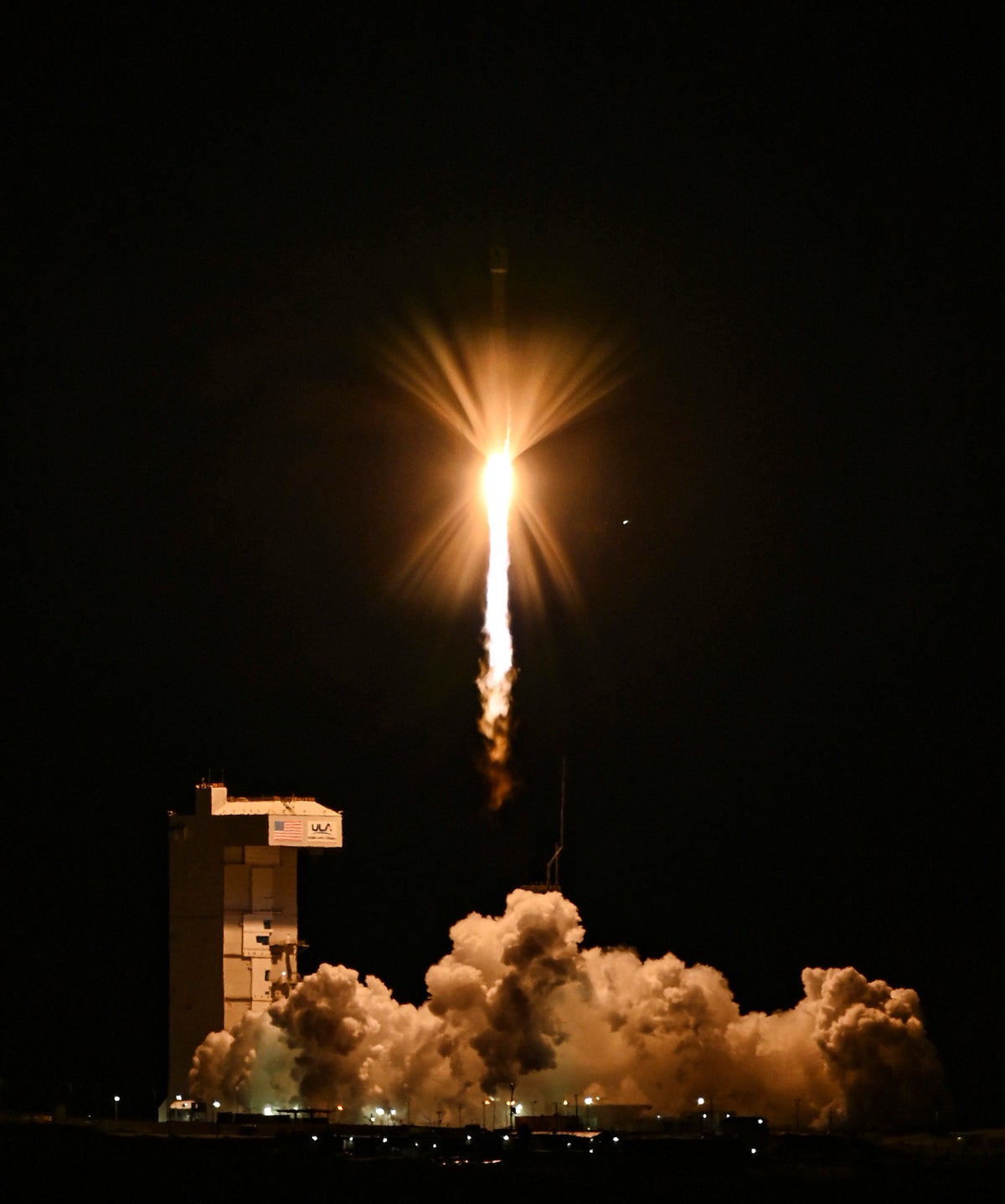
A satellite intended to improve weather forecasting and an experimental inflatable heat shield to protect spacecraft entering atmospheres were launched into space from California on Thursday.
A United Launch Alliance Atlas V rocket carrying the Joint Polar Satellite System-2 satellite and the NASA test payload lifted off at 1:49 a.m. from Vandenberg Space Force Base, northwest of Los Angeles.
Developed for the National Oceanic and Atmospheric Administration, JPSS-2 was placed into an orbit that circles the Earth from pole to pole, joining previously launched satellites in a system designed to improve weather forecasting and climate monitoring.
The NASA mission blog said there was no immediate data confirming deployment of the solar array.
“Mission managers for NOAA’s JPSS-2 confirm the satellite has acquired signal and is receiving and responding to commands. The satellite is currently power positive (getting electricity) and in a safe and stable configuration while teams assess the status of the solar array,” the blog said.
The array has five panels that were collapsed in an accordion fold for launch. The fully deployed array would extend 30 feet (9.1 meters).
Mission officials say the satellite represents the latest technology and will increase precision of observations of the atmosphere, oceans and land.
After releasing the satellite, the rocket's upper stage reignited to position the test payload for re-entry into Earth's atmosphere and descent into the Pacific Ocean.
Called LOFTID, short for Low-Earth Orbit Flight Test of an Inflatable Decelerator, the device is an “aeroshell” that could be used to slow and protect heavy spacecraft descending into atmospheres, such as those of Mars or Venus, or payloads returning to Earth.
According to NASA, effectively slowing heavy spacecraft will require greater atmospheric drag than can be created by traditional rigid heat shields that fit within the shrouds that surround payloads aboard rockets.
The LOFTID shield inflates to about 20 feet (6 meters) in diameter.
In the thin atmosphere of Mars, for example, having such a large shield would begin slowing the vehicle at higher altitudes and reduce the intensity of heating, according to the space agency.
Video showed the inflated heat shield separate from the rocket and descend toward Earth. A camera aboard a recovery vessel a few hundred miles east of Hawaii showed the it splash down under a parachute.
NASA said the shield was picked up by the boat, which then headed to recover a backup data module that was ejected during the descent.